Ancient history
3,500 years of history: Haifa’s oldest site reopens
After two years of work and a NIS 3 million investment, the hill housing ancient purple-dye city remains and a Byzantine church with mosaic floors has been opened to the public.


Israeli Second Temple drama ‘Legend of Destruction’ now available in the US

On This Day: Jean-Francois Champollion announces his success at decoding the Rosetta Stone
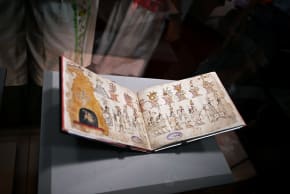
France loans Mexico rare Aztec manuscript as nations celebrate 200 years of diplomatic ties
Celtic teenager buried face down in Dorset pit may reveal Iron Age human sacrifice
"This has the sense of a body thrown into a pit, with hands potentially tied," archaeologist Miles Russell said.

Fossil of 99 million-year-old mosquito larva found in Myanmar amber
The fossil, called Cretosabethes primaevus, shared traits with modern mosquitoes. Scientists think it lived in small water pools in tree hollows or leaf axils during the Cretaceous period.

Bone tools and beads from 13,000 years ago unearthed in Direkli Cave, Turkey
Prof. Erek: "The differentiation of this tool industry and use of varied materials point to the period's industrial development."

Foundation Rock Decoded: INAH Reveals Sixth-Century Maya Powerhouse Queen Ish Chak Ch'iena
During her reign, Ch'ak Ch'een oversaw construction of the Group D ballcourt, finished on December 8, 573, newly deciphered glyphs indicate.

Oldest coin in Saxony: 2,200-year-old Celtic gold piece found near Leipzig
State archaeologist Smolnik presents the two-gram quarter stater, calling it the smallest find ever displayed and proof of the value of citizen-scientist cooperation.

High-status seventh-century Avar warrior grave uncovered at Aba-Székesfehérvár border in Hungary
Volunteers from the Szent István Király Museum crafted a bespoke wooden crate to safely extract a fragile sabre, an exceptionally rare Avar weapon.

Lost letter of Emperor Caracalla Found — Burdur Museum Rushes to Save 1,800-Year-Old Stones
Following a demolition order, the Burdur Museum Directorate is retrieving ten slabs reused in the 1950s from the ancient city of Takina to safeguard them as cultural heritage.

Neolithic engravings may push Chinese writing back 7,000 years
Feng Shi confirmed that inscriptions on ceramic stands from Liulinxi are the earliest known Chinese characters, appearing in groups rather than alone, making them easier to interpret.

Ancient Crocodile Species Discovered in Egypt Sheds Light on Evolutionary History
“The discovery underlines the Western Desert’s importance as a natural repository of secrets from ancient geological eras,” said Mansoura university president.

Dresden Codex decoded: study unveils the Maya’s 700-year eclipse calculator
“The 405-month eclipse table had emerged from a lunar calendar in which the 260-day divinatory calendar commensurated the lunar cycle,” the authors wrote.
