Ancient history
3,500 years of history: Haifa’s oldest site reopens
After two years of work and a NIS 3 million investment, the hill housing ancient purple-dye city remains and a Byzantine church with mosaic floors has been opened to the public.

Israeli Second Temple drama ‘Legend of Destruction’ now available in the US

On This Day: Jean-Francois Champollion announces his success at decoding the Rosetta Stone
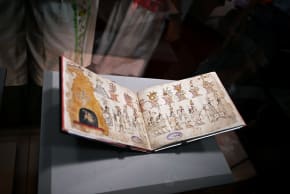
France loans Mexico rare Aztec manuscript as nations celebrate 200 years of diplomatic ties
15,000 years ago, hunters gatherers on the Carmel lived off coastal lakes teeming with birds
The study by Dr. Amos, Prof. Weinstein-Evron, and Yeshurun analyzed bird bones from Nahal Me’arot and el-Wad caves to reveal Natufian hunting and environment.

Radiocarbon breakthroughs place Thera mega-eruption before Egypt's new kingdom
Researchers from Ben-Gurion University and Groningen report in PLOS One that the volcanic ash layers predate the Eighteenth Dynasty, extending the Second Intermediate Period.

Face carved on T-shaped pillar at Karahantepe links Neolithic Anatolia and the Levant
Munro says the minimalist carving closely matches a twelve thousand year old face unearthed in Israel, hinting at a shared symbolism across early settlements.

Excavations resume at ancient Ugarit near Latakia after 14-year pause
Ugarit is famous for its vast archive of clay tablets inscribed in seven languages, considered among the oldest records of bronze age political and social life.

'New chapter in the history of the pharaohs': Zahi Hawass teases 2026 Great Pyramid reveal
Egyptologist Zahi Hawass said advanced scanning and robotic tools opened hidden spaces and predicted "a great archaeological discovery that will write a new chapter in the history of the pharaohs".

Ancient shipwreck appears on Hoi An beach, dated by experts to 14th–16th century
Researchers say the 17m hybrid craft, found 400m from former Cẩm An ward office, is among Vietnam’s best-preserved underwater relics and will undergo urgent excavation.

5,000-year-old building found in Kani Shaie, Iraq, reshapes view of Uruk-era networks
Researchers say verifying the structure's monumentality could transform understanding of early Mesopotamian exchange, revealing how sites like Shaie linked distant regions.

Ancient 5,000-year-old wine press and Canaanite ritual vessels found near Tel Megiddo
Israel Antiquities Authority archaeologists found first clear proof of early winemaking and folk worship outside the city, with offerings buried beside a rock altar along a 1.2 km excavation.

Ancient 4,000-year-old limestone mural vanishes from 'cursed' Khentika tomb in Egyptian necropolis
A British mission working in the tomb discovered that a mural was missing in May, and officials only publicised the disappearance on Sunday.

Crimean Neanderthal ochre crayon reveals earliest symbolic artistry
The shaped and reused crayons, engraved patterns, and tool marks suggest that some ochre materials were intentionally used for symbolic activities.
