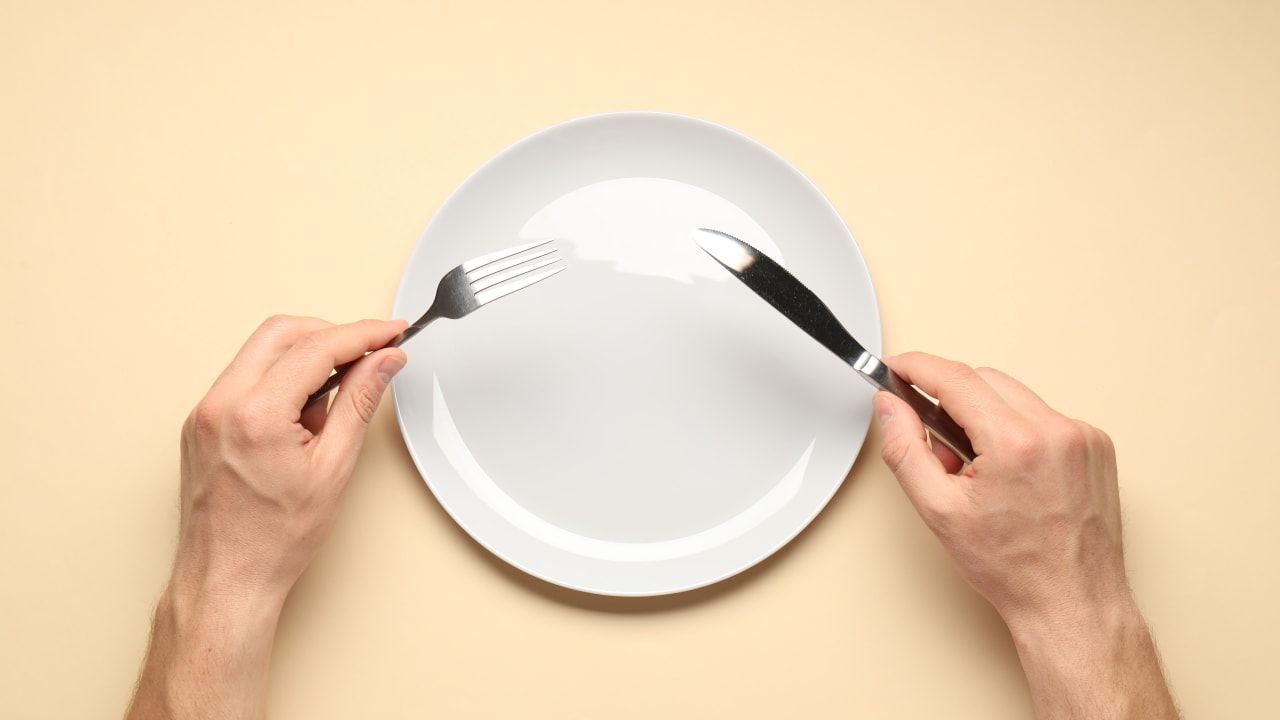
Imagine you’re not allowed to eat for a month.
That was my reality this summer when my medical team finally settled on a diagnosis that explained many (if not all) of my recent problems: a partial small bowel obstruction resulting from my terminal ileum being progressively narrowed by Crohn’s disease since my 20s.
In the end, the simple act of eating was the cause of much of the discomfort in my abdomen, which radiated to my lower back.
The doctors concluded that I needed surgery to remove the diseased part of my intestines – the ileum, which connects the large and small bowels. But by this point, because I was so malnourished, the required operation would have been too dangerous. When I was finally hospitalized, I had lost 15 kg.; my fingers had become so thin that my wedding ring slipped off on its own, and my temples had hollowed out.
Hence, the introduction of TPN – total parenteral nutrition – a white liquid filled with proteins, fats, carbohydrates, vitamins, minerals, water, and electrolytes that’s delivered via IV.

I joked it was the “mother’s milk” I never received from my own mom, who in the early 1960s, like many new parents of that age, was convinced by the pharmaceutical industry that breastfeeding was less healthy than formula.
To beef me up, I needed to receive TPN for some three weeks before the surgery could be scheduled. I was set up with “TPN-at-home,” only returning to the hospital a few days before surgery. A private company contracted by Hadassah, “Home Cure,” taught my wife, anointed Nurse Jody, all she needed to know to connect me 16 hours a day to the IV.
During this period, I was not allowed to eat or drink anything. I didn’t fight the recommendation – I needed to get this taken care of, so I could get back to some kind of normal life. I was already craving a burger from Crave.
Still, this raised all manner of questions about my – and society’s – relationship to eating.
Food is used as a primary social lubricant
HUMAN BEINGS in general – and Jews in particular – use food as one of our primary social lubricants. We get together with friends and family over a meal, at home, on Shabbat or in a restaurant. Holidays and celebrations are marked by food.
I clip newspaper reviews and save them for date night. I follow restaurant groups on Facebook and share tips on where to eat.
Eating serves as a tool for building community, shaping cultural identity, and strengthening relationships. Research has shown that if we’re with someone who is eating a lot, we are likely to model that behavior and consume more than if we were dining alone.
Food books are big business. Jerusalemite Joel Haber has a delectable new tome all about the infamous Shabbat stew known by its many local names, including: cholent, hamin, dafina, osavo, and khalebibi.
There is, of course, ambiguity in all this abundance: As the world grows increasingly obese, GLP-1s like Ozempic and Mounjaro have become the hottest medications. By 2025, one in eight American adults reported using a GLP-1. “Off-label” vanity use has risen to over 30% among non-obese patients.
One of the great pleasures of traveling has always been experiencing new tastes. A solid palak paneer could compensate for the Delhi dive where it’s served. I was looking forward to our since-canceled vacation in Europe, in large part so I could find the butteriest croissant in Paris or try Reykjavik’s famous sourdough ice cream.
When we first moved to Israel, the country was a culinary wasteland. Falafel and shawarma were the height of cuisine. But ethnic food? The best Jerusalem had to offer was Richie’s Pizza.
The veteran Chinese place downtown wasn’t kosher, and Israelis hadn’t yet traveled the globe and brought back everything from crispy Vietnamese Banh Mi to spicy Ecuadorian empanadas.
I was never entirely satiated
FOR A MONTH, the TPN was appropriately nourishing me, although without that same crunching, chewing, and swallowing sensations. For much of the time, I was literally starving (albeit not to death). I was never entirely satiated.
The hardest part during the home TPN period was Shabbat. For the first weekend, I sat at the table as my family ate, although I didn’t even have a plate. It was torture. After that, when we had guests, we’d visit in the living room, then Jody would continue with them downstairs in the kitchen, while I hid from the aromas in my bedroom.
Ultimately, my terminal ileum was removed, and the two ends of my intestines were successfully sewed together. Two CT exams showed no “leakage.” My gallbladder came out, too, for good measure.
If all had gone well, I should have been home in three to five days. But nothing with my body proceeds apace. I was hospitalized for another two weeks with infections, fever, sepsis, and a whole load of antibiotics. The TPN continued. When I was finally allowed to eat, I contracted “ileus” – a condition where your bowel, after not having functioned or being manipulated during surgery, literally “forgets” how to work. The ileus made me vomit violently until it passed.
As I kept losing weight, I was eventually put back on TPN, although this time I was allowed to eat… slowly.
“You’re a very complicated case,” my doctor, the head of colorectal surgery at Hadassah, told me, trying to be reassuring. “You had lymphoma and all kinds of chemicals and radiation as treatment, then CAR-T. You have a background of Crohn’s. You were severely malnourished and pancytopenic,” a term to describe when all three blood cell counts – white, red, and platelets – are depressed at the same time.
“You will get better,” he said, smiling. “You just need patience.”
I will have that hamburger someday. And when I do, it won’t be “to die for.” It will be to live for.■
The writer’s book, TOTALED: The Billion-Dollar Crash of the Startup that Took on Big Auto, Big Oil and the World, was published earlier this year as an audiobook. It is available on Amazon and other online booksellers in print, eBook, and
Audible formats. brianblum.com