Romans
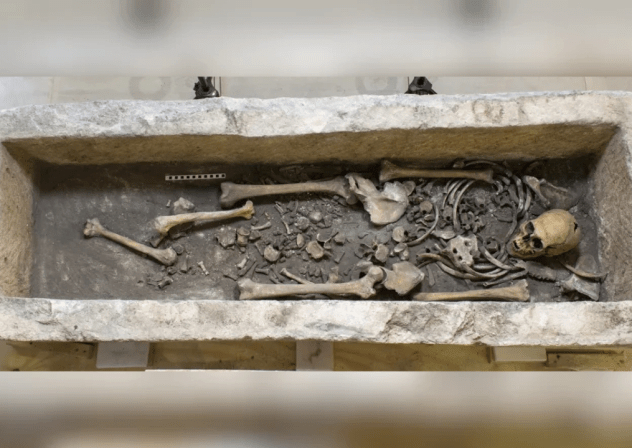
Skeleton found in Roman sarcophagus at Westminster Abbey may have belonged to medieval monk
The sarcophagus’ decoration made researchers draw pause. Sculpted onto its lid was a Latin cross, dating to approximately the 10th or 11th century.
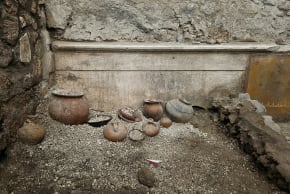
Time capsule of Pompeii: Ancient cupboard provides glimpse into life before Vesuvius erupted

Theological beliefs linked more strongly than church attendance to antisemitism in young Christians

Turkey unearths rare statues of Roman Emperor Hadrian, Empress Sabina in ancient Mediterranean city
Ancient tablet found at Roman fort in Netherlands bears Greek curse against enemies
The lead curse tablet found in the Netherlands was discovered by a team of Dutch archaeologists in a pit beneath the town hall square of the Roman military settlement of Coriovallum.

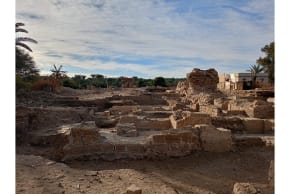
New sections of ancient Egyptian temple reveal inscriptions of Pharaoh Psamtik I
The temple dates back to Egypt’s 26th Dynasty, the last native dynasty of ancient Egypt before the Persian conquest in 525 BCE.
AI helps recover complete text of Herculaneum scroll burnt by Mount Vesuvius
The blackened, fragile scrolls cannot be physically opened without severe damage. Researchers have instead used high-resolution scans and computational techniques to "virtually unwrap" them.
WATCH: Two Roman-era statues unearthed during infrastructure dig for Israel Railways near Haifa
“This is a once-in-a-lifetime discovery,” added Oren and Reiss. “It was very unexpected, but somehow, the really big discoveries always turn up on the excavation’s very last day.”

Ancient Greco-Roman cemetery unearthed at archaeological site in Egypt's Nile Delta
Several painted plaster and barrel-shaped pottery coffin, among those most common coffin types in the Ptolemaic period, were also found at the site.
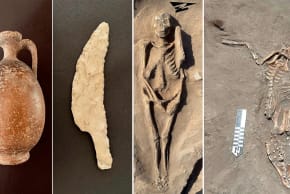
Collection of ancient Egyptian, Greek, Roman-era artifacts discovered at Egypt’s Heracleopolis
The finds include the ruins of a Roman basilica and Doric temple, the head of a marble statue of the Greek goddess Aphrodite, several cartouches, and molds used to mint coins in the Roman period.

Rare, intact ancient Roman burial unearthed during excavations in eastern Croatia - report
Previously, a total of 44 other Roman graves were discovered during excavations for the project, however the most recent find is the first to be fully undisturbed.

Plaster-making technique attributed to Romans used at Motza some 8,000 years earlier, study shows
"The Pre-Pottery Neolithic B residents of Motza were surprisingly able to differentiate calcite and dolomite stones and used both in their plaster making," the study said.

‘Lexden Lady,’ wealthy Roman woman buried in lead coffin, goes on display in UK
Her exact burial date is unclear, according to the Trust’s statement, but it was likely during the late Roman period - lasting from approximately the late 3rd century to early 5th century CE.

Pompeii victim revealed to be a doctor fleeing Vesuvius’ eruption over 60 years after discovery
The doctor’s identity followed new analysis of archaeological finds kept in the park’s storage warehouses - including a small case hidden within the cast of one of the victims from the garden.
