Archaeology
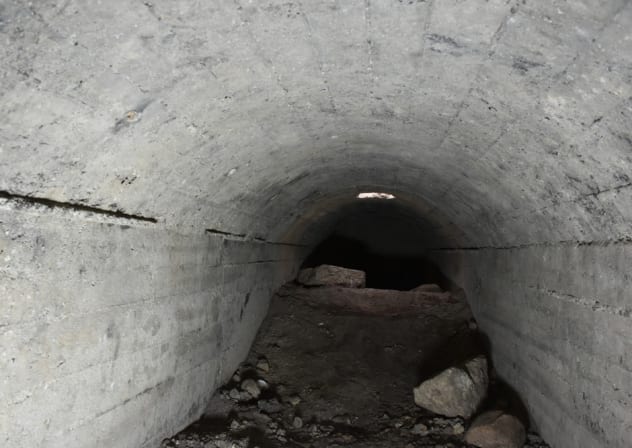
WWII air-raid shelter buried beneath German playground rediscovered during construction work
During the time of the German Democratic Republic (GDR), the shelter was partially back-filled through the ventilation shafts, before a playground was built over it and the structure below forgotten.

Archaeologists discover lost temple to war god near abandoned Roman military fort in Germany

Multi-million Herod’s Pools renovation project begins amid gov’t push to promote West Bank tourism

Ancient Greek elegy dedicated to judge found in ancient Egyptian tomb sealed with protection spells
WATCH: Two Roman-era statues unearthed during infrastructure dig for Israel Railways near Haifa
“This is a once-in-a-lifetime discovery,” added Oren and Reiss. “It was very unexpected, but somehow, the really big discoveries always turn up on the excavation’s very last day.”

Marble bust believed to depict Roman goddess of love found during excavations at Alicante beach
Archaeologists have also uncovered the foundations of houses and rooms belonging to a Roman villa used between the 3rd century BCE and the 4th century CE.

Ancient Greco-Roman cemetery unearthed at archaeological site in Egypt's Nile Delta
Several painted plaster and barrel-shaped pottery coffin, among those most common coffin types in the Ptolemaic period, were also found at the site.

Greece reopens country’s only surviving Byzantine palace after over 40 years of restoration work
The palace dates back to they 14th century and served as the seat of the Despotate of Mystras, a province of the Byzantine Empire. It has been on UNESCO’s list since 1989.

Ancient jars unearthed at biblical Shiloh days before annual wine festival
In the Tanach, Shiloh served as one of the ancient Israelites’ central locations of worship and housed the biblical Tabernacle.

WATCH: A Paleolithic time capsule: Rare prehistoric cave discovered near highway outside of Haifa
The cave dates back to 400,000 and 250,000 years ago, to the time of the Acheulo-Yabrudian culture – a collection of archaeological cultures in the Levant from the end of the Lower Paleolithic era.

Ancient water reservoirs discovered at Red Sea's Port of Aydhab site near Egypt-Sudan border
Archaeological surveys of the site also revealed the foundations of residential buildings, watchtowers, and service facilities located nearby.

Collection of ancient Egyptian, Greek, Roman-era artifacts discovered at Egypt’s Heracleopolis
The finds include the ruins of a Roman basilica and Doric temple, the head of a marble statue of the Greek goddess Aphrodite, several cartouches, and molds used to mint coins in the Roman period.

First near-complete ancient Egyptian funerary set discovered at Heliopolis necropolis site
In antiquity, Heliopolis served as a primary religious center for the worship of Ra - indicated by the Al-Masalla obelisk of the Temple of Ra-Atum.

WATCH: Norway recovers Chinese porcelain, European-made goods from 18th-century shipwreck
The ship, coined "The Porcelain Wreck," is believed to have sunk around the mid-1700s, and was found at a depth of some 600 meters, the museum said.
