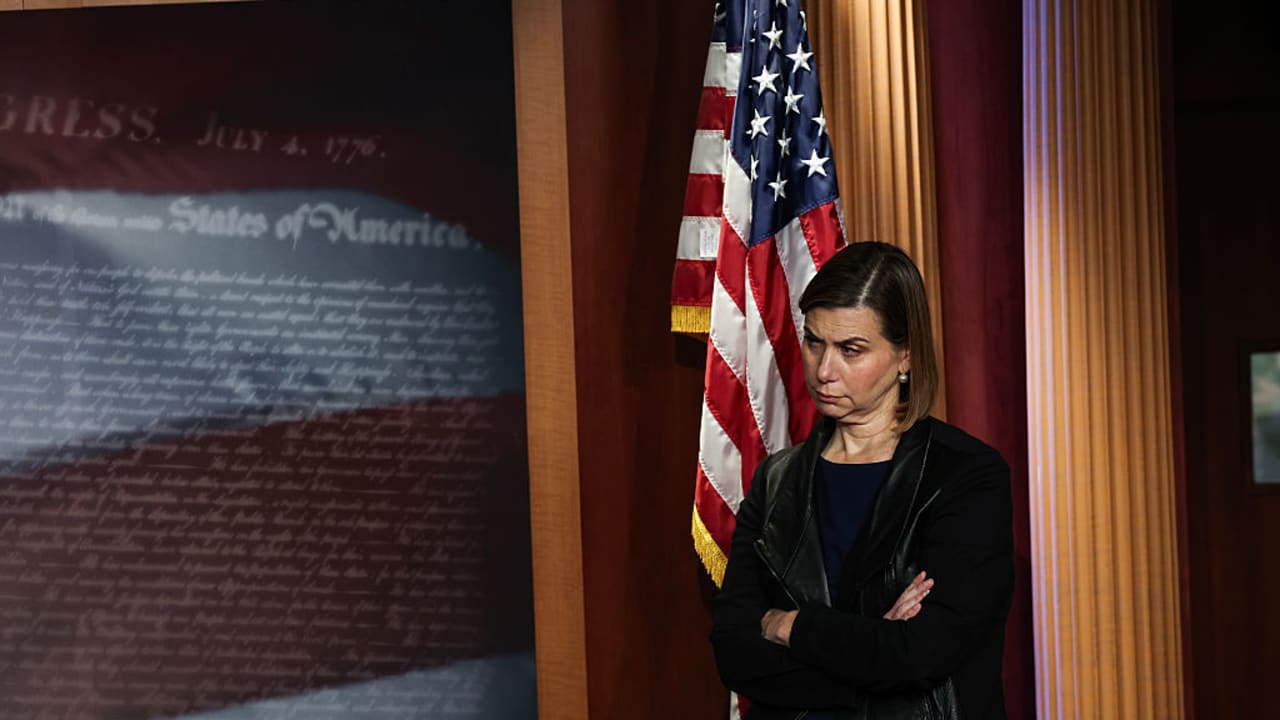
Ordinarily, Michigan Sen. Elissa Slotkin would seem an anodyne choice to speak at a Shabbat event for Jewish veterans.
Slotkin is Jewish and a former Defense Department official who served three tours in Iraq as a Central Intelligence Agency analyst. Emphasizing her national security background, the Democrat has also championed Israel as a US ally and identifies as a Zionist.
Yet the clergy at Congregation Shaarey Zedek, a large Conservative shul in the Detroit suburbs, needed to defend their invitation to Slotkin in an email to congregants on Friday. One day before the Veteran’s Shabbat program, the synagogue’s leadership acknowledged “your concern, your offense, and even your hurt” in regards to Slotkin’s planned appearance.
The senator wound up not attending the service, with her staff citing flight trouble. The Federal Aviation Administration had ordered a four-hour ground stop for all US flights late Friday stranding more than 1 million travelers.
But why were so many of the congregants at Shaarey Zedek up in arms about the prospect of their Jewish senator’s Shabbat appearance? The clergy didn’t elaborate, and a representative for Slotkin declined requests for an interview for this story.
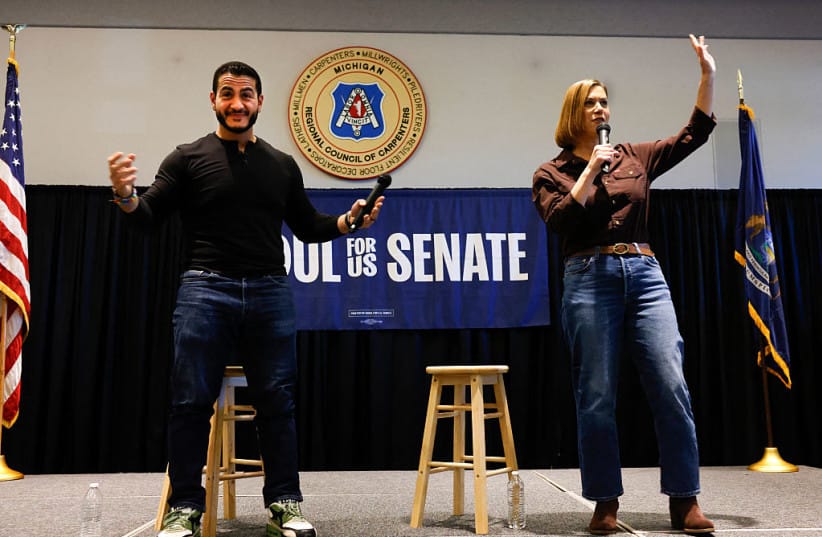
Some Jewish former supporters of Slotkin’s summed up the biggest backlash to the Jewish Telegraphic Agency this way: She campaigned with the state’s senator-elect, Abdul El-Sayed. More broadly, Slotkin has also sought to put some distance between herself and the party’s staunchly pro-Israel wing as she has strayed left from her own moderate brand.
As Jews question their place in the Democratic Party, Slotkin’s moves - and her Jewish constituents’ reactions to them -could add further instability to the shifting ground.
Michael Horowitz, a Michigan resident and former CEO of the Jewish federation of Atlanta, is one Jewish community member who feels betrayed by her support of El-Sayed.
“I think as a leader in the party, she could have, and should have, called out some of the narrative coming from him and his supporters,” he told JTA about Slotkin stumping for El-Sayed across the state in the general election. “And I’m disappointed that she didn’t do that.”
The furor some Jews in the state have directed at their senior senator for associating with El-Sayed on the campaign trail is indicative of the deep wounds remaining in the state from the election, and a warning sign for the Jewish lawmaker in their midst hoping to rise in the ranks unscathed.
Slotkin hints at 2028 presidential run following US midterm elections
El-Sayed’s historic midterm win, and the Jewish community’s divisions over it, have grabbed the lion’s share of the national headlines from Michigan. But Slotkin’s profile has also grown, and she has teased she may run for president in 2028. If she does, some of her top former Jewish donors are signaling they see her support for the senator-elect as a problem.
El-Sayed has alienated many in the traditional pro-Israel camp with his criticism of Israel, and has had to walk back other statements of his from during the campaign that many Michigan Jews considered offensive. US Rep. Haley Stevens, El-Sayed’s primary rival and a favorite of the state’s pro-Israel Jewish community, broke with her party in the race’s final days to endorse GOP nominee Mike Rogers. Slotkin took the opposite approach, campaigning with El-Sayed across the state and emphasizing the areas they agreed on.
Slotkin has built a name for herself as a bipartisan figure: She worked in both the George W. Bush and Obama administrations before running for Congress. She has sought to play a role as a bridge between El-Sayed’s progressive wing of the party and more moderate members of the voting bloc, including Jews.
“The state of Michigan can send one Jewish senator and one Muslim senator, the first time ever in history,” she told the cheering crowd at the Michigan Democratic Party’s election night watch party in Detroit, hours before El-Sayed’s victory. “That is who we are. That is the promise of America, and we are going to do it and show the whole damn world today.”
That approach speaks to some in the Jewish community. Mary Ellen Gurewitz, a vice chair of Michigan’s state board of canvassers and Jewish El-Sayed supporter, told JTA that she was glad to see Slotkin campaign with him.
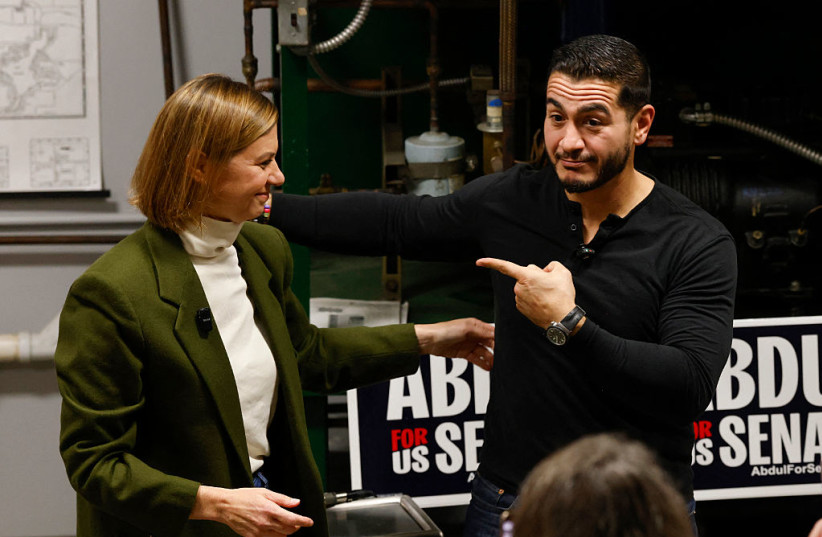
The Jews who are opposed to Slokin over her support for El-Sayed, Gurewitz said, have their priorities wrong.
“That is so self-defeating. They need to be communicating with, and speaking on good terms with, their representatives in Congress,” she said. “To say, ‘We don’t want to talk to you because you supported Abdul,’ that’s just astounding to me.”
But Slotkin’s strong support of El-Sayed risks splitting her supporters rather than bringing them together. Slotkin won her 2024 Senate bid against Mike Rogers by 19,000 votes, in a year when US President Donald Trump won Michigan in the presidential election. Analysts at the time chalked up her narrow win to her political identity as a moderate. Despite her background as an intelligence analyst with extensive Middle East experience, she did not make Israel a defining issue in that election.
Two years later, El-Sayed, also facing Rogers but from a progressive flank, improved on Slotkin’s margins considerably. Around 340,000 votes separated El-Sayed and Rogers as of press time, according to Associated Press tallies that have given El-Sayed a seven-point victory.
Slotkin backs away from AIPAC support, takes on Trump administration
One of the major issues of the campaign was the lobbying activities of AIPAC. El-Sayed made AIPAC’s spending against him a key part of his own campaign pitch. Before then, Slotkin had already begun backing away from the group.
“I have not been endorsed by AIPAC,” Slotkin told the populist-minded show Breaking Points in 2025, noting that this was a shift from when she had accepted the group’s support in her first congressional run in 2018. She also hedged when the hosts asked her if AIPAC “should register as a foreign lobby.”
In the meantime, independent of El-Sayed, the senator has taken on Trump. She drew headlines last year for filming a video urging active duty military to “refuse illegal orders,” and again in recent weeks for saying she wanted to send a “deterrence message” to college graduates thinking of working for Trump’s administration.
And last week, Slotkin took on a leader of her own party, too. She joined progressive Vermont independent Bernie Sanders to announce they would not support New York Sen. Chuck Schumer for majority leader. The announcement helped to lay the table for Maryland Sen. Chris Van Hollen, a progressive Israel critic, to formally challenge Schumer, who is Jewish, days later.
“We need a new generation of leadership,” Slotkin said then.
There are other signs that Slotkin is listening more to the progressive flank of her party these days. Along with much of the Democratic Party, she has shifted on Israel. In April the senator voted to block the sale of offensive weapons to Israel, saying, “Being pro-Israel today is not about simply supporting the political or military agenda of Prime Minister Netanyahu, just like being pro-American should not be equated with loyalty to President Trump.” She continues to support funding for the Iron Dome, the country’s missile defense system.
'AIPAC dogwhistle' is concern for some Jewish donors
Slotkin’s rhetoric on Israel was another concern for Horowitz, the donor who was previously much more supportive of her. A Jewish Democratic Council of America fundraising call between the two of them briefly led to accusations that she was unethically using her Congressional office to fundraise in 2022.
Now, though, he accuses her of jumping “on that AIPAC dogwhistle.”
“I know she has had criticism of some of the actions of the Israeli government, which is fine,” he said. But, he added, “What she does, and how she says it, becomes tools and ammunition because it’s coming from a Jewish leader.”
Halie Soifer, head of the Jewish Democratic Council of America, does not share the qualms about Slotkin that some Michigan Jews have.
“Senator Slotkin reflects a growing Jewish American consensus of support for Israel’s security and right to self-defense, while opposing extreme policies of the current Israeli government,” Soifer told JTA in a statement.
“We are confident that Senator Slotkin will continue to be a leader and champion on the issues that matter most to Jewish Americans, and we’re grateful for her leadership.”
Back at Shaarey Zedek, the congregation’s leaders may have dodged a scuffle thanks to the FAA. But before they realized that, the rabbis and cantor wanted to offer their own praise of the senator.
Slotkin, they told their members, would address them “with kindness and respect, with humility and empathy, and with an open mind and heart to the differing opinions and concerns of our shul.”