
Critical infrastructure in Kuwait was a “relatively attractive target” for Iran as it sought to escalate without risking a larger response from its Gulf neighbors, international relations expert Dr. Arman Mahmoudian, a research fellow at the University of South Florida’s Global and National Security Institute, explained to The Jerusalem Post on Sunday.
Over the weekend, Iranian attacks caused significant damage at a power generation plant, a water desalination plant and several residential areas in Kuwait.
Kuwait Petroleum Corporation also confirmed on Saturday that one of its oil facilities was hit by “repeated Iranian attacks,” resulting in significant material damage and some injuries.
Iran’s Islamic Revolutionary Guard Corps claimed the attacks had been on a US military support center at Kuwait’s Camp Arifjan, and alleged it had destroyed a radar facility at Ali Al Salem Air Base.
The attacks, which also saw Bahrain, Jordan and Saudi Arabia targeted, carried through onto Sunday, a signal that Iran has “re-prioritized its objectives,” Mahmoudian said.
The attacks are part of “calibrated signaling” efforts by the Islamic Republic, he explained, adding that it was clear that “Iran is willing to increase pressure on the Gulf states if doing so advances its broader strategic objectives.”
Though clearly willing to escalate its attacks on the Gulf, Mahmoudian suggested this was not a sign that Iran had abandoned plans to engage with its neighbors on a diplomatic level but that it was now in a state where it had to prioritize survival.
“Tehran has re-prioritized its objectives. At this stage, its primary goal is no longer preserving détente with the Gulf states, but ensuring the regime’s survival and emerging from the current conflict with the United States in a position that does not appear strategically defeated or isolated, while ideally extracting some concessions from Washington,” he commented.
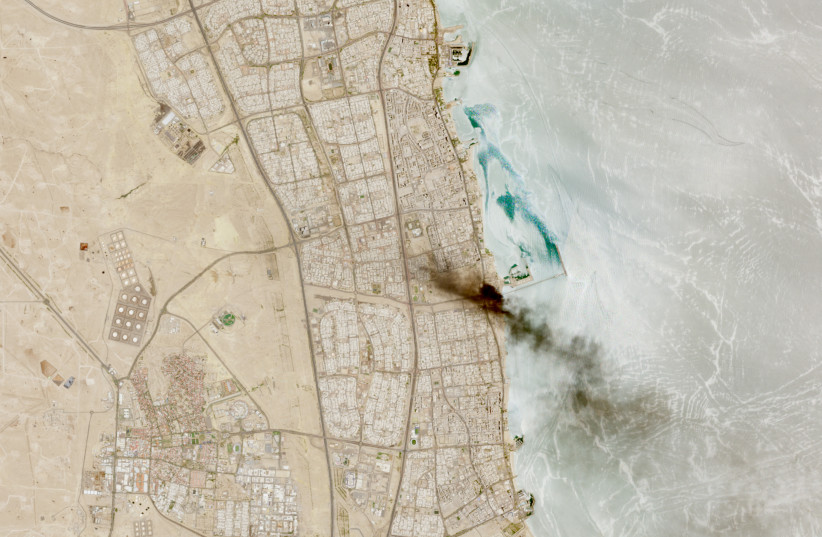
Kuwait's infrastructure is a 'relatively attractive target'
As part of this calculation, Kuwait’s critical infrastructure emerged as a “relatively attractive target.” Hosting important US military infrastructure and serving as a major logistical hub for American operations, allowing Iran to justify its attacks while, unlike many other Gulf states, presenting “more limited military capabilities and, arguably, less willingness to retaliate.”
As for why the critical infrastructure became a target, rather than just the US military assets there, Mahmoudian explained that it was likely a “message to the United States.”
“Over the past several days, reports have suggested that the United States has expanded its strikes against Iran’s critical infrastructure in southern Iran,” he noted.
“By targeting infrastructure in Kuwait, Tehran is signaling that continued attacks on Iran’s critical infrastructure will not go unanswered. Rather than responding symmetrically against the US mainland, Iran is demonstrating its ability to impose costs on America’s regional partners, thereby increasing the broader political and strategic costs of continued escalation for Washington.”
Iranian media alleged on Saturday that the United States struck a desalination plant in the village of Bonji on the Iranian coast, disrupting water supplies to several villages.
The reported attack on Iran’s water infrastructure comes as the country is already grappling with an unprecedented water crisis that has fueled significant social unrest in recent years.
Kuwait in 'extremely high' stress category for water
Notably, the World Resources Institute placed both Kuwait and Iran in the ‘extremely high’ category of the National Water Stress Ranking of 2023, along with many other Gulf states and Israel.
Mahmoudian said the Islamic Republic was also signaling that “it retains the capability to threaten the energy infrastructure of US partners in the Gulf,” and so can wreak further havoc on global energy markets and the international economy, “should the United States expand its campaign to include Iran’s oil and gas sector.”
“Energy markets are already under pressure because of tensions surrounding the Strait of Hormuz, and any sustained disruption to Gulf oil or gas production, or damage to refineries and other facilities that require considerable time to repair, could generate significant shocks to global energy markets and the broader international economy,” he stressed.
On Friday, a day before the attacks on Kuwaiti infrastructure, the United States carried out strikes against roads and bridges connected to Bandar Abbas, Iran’s main port, through which roughly half of the country’s trade is transported. Additionally, according to Iranian media, power plants in Jask were also targeted.