
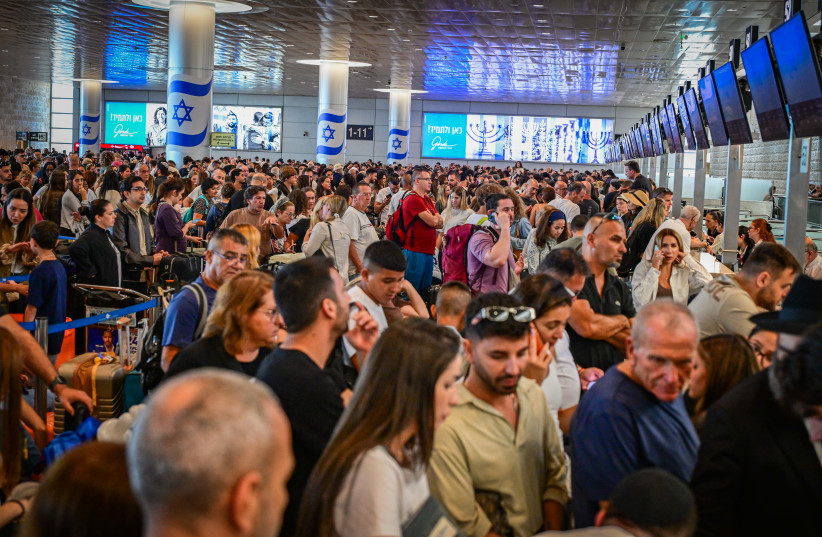
On August 20, Israel-bound passengers at airports in Cyprus and Greece were separated into two groups. The vast majority were forced to wait long hours for their flights due to disruptions at Ben-Gurion Airport, while a minority were whisked through and boarded Air Haifa flights, flying almost without delay to Haifa Airport.
Air Haifa operated some 32 flights that day, carrying around 2,200 passengers, with the vast majority of flights taking off on time. So, while the chaos was unfolding at Ben-Gurion, one airline emerged that could be relied upon: Air Haifa.
Beyond the benefits to Air Haifa, the situation once again brought into focus the issue of the growth potential for a northern airport and the possibility that it could constitute an alternative and reliable infrastructure in the event of problems at Ben-Gurion Airport.
About 10 days ago, the Israel Airports Authority (IAA) announced the construction of a new parking lot at Haifa Airport, which will cover 20 dunams (5 acres) and contain 900 parking spaces.
The move was born out of congestion that forced passengers to park on sidewalks and other illegal locations. “Haifa Airport is experiencing significant momentum, with an impressive increase in the number of passengers and flights and the expansion of flight options for residents of the north,” the IAA said at the time.
The National Infrastructure Committee (NIC) approved, in 2023, a plan for the regulation and expansion of Haifa Airport, which was built by the British in 1934. The plan included extending the takeoff and landing runway, adding taxiing and parking areas for aircraft, expanding the terminal, and arranging an area for general aviation. Meanwhile, alongside the construction of the parking lot, the IAA is promoting the construction of additional parking lots and aircraft inspection stations. The expansion of the terminal itself is scheduled to begin at the end of 2027.
Haifa Airport continues to expand mainly due to the activities of Air Haifa. So far this year, about 250,000 passengers have passed through the airport: 192,000 on international flights and 58,000 on domestic flights.
Throughout 2025, around 282,000 passengers passed through Haifa Airport (199,600 on international flights and approximately 82,600 on domestic flights). In 2024, before Air Haifa began operations, only some 53,600 passengers used the airport.
Ilana Shafran, director of the transport department at the Planning Administration, said, “The airport in Haifa provides a solution for short-haul destinations and, in the future, it will be able to provide flights for two to three million passengers a year. In addition, an airport in the North is the answer to a predicament because most of the demand today is from Tel Aviv and northwards.
Still, by 2050 we expect about 80 million passenger flights a year, so Haifa’s response remains limited.”
Why not expand it?
“The length of the runway is relatively short and extends over about 1,300 meters even after the expansion,” Shafran said. “The shorter the runway, the smaller the planes and the limited ranges. As a result, the airport can currently only provide flights to Greece, Cyprus, and Bulgaria.”
According to Shafran, the Planning Administration examined lengthening the runway but encountered physical obstacles: “The new Haifa Port is located at the seaward end, and in order to extend the runway, it would have to be demolished from the ground up. Thoughts arose about diverting the runway, but in the end, because of Mount Carmel, you will be limited in the type of flights.”
“We have seen the significant renewal of the airport since the addition of Air Haifa, but its capacity cannot replace that of Ben-Gurion Airport,” Yehuda Zafrani, an expert in tourism and international aviation at the HOT consumer club, noted.
“It is located in an area devoid of land reserves, and its expansion requires expropriation of land over a 20-year process. At the moment, it is not feasible to turn it into a main airport. Adding hundreds of parking spaces is a positive step, but an airport of national size requires tens of thousands of parking spaces.”
Can Israel rely on it as a temporary and rapid alternative in emergencies, as we saw on Thursday?
“When there is a general strike by Israel Airports Authority employees, Haifa is also shut down,” Zafrani explained. “In isolated incidents, it provides assistance, but it cannot serve as a full replacement: It is impossible to divert large aircraft to it, and its proximity to the heart of the population poses considerable complexity to its expansion.
How much can the airport actually grow soon?
For Air Haifa CEO Gonen Ussishkin, the answer depends mainly on the scope of the investment. “With minimal effort, next year we can grow by 50% and reach about 600,000-650,000 passengers a year. A more planned move will allow us to double the activity within 18 months to 1.2 to 1.5 million passengers. With a long-term effort on the part of the Airports Authority, we can even reach 2.5 to 3 million passengers a year,” he said.
How is that done?
“The runway needs to be extended by hundreds of meters,” Ussishkin explained. “On the operational level, a new terminal must be built, parking spaces for aircraft must be prepared, and supporting infrastructure must be established, including car parks. This is a five-to-six year project.”
Is there any ambition to expand beyond that?
“If the state realizes all its dreams, I estimate we will reach a ceiling of 3 million passengers. So we will certainly not replace Ben-Gurion Airport.”
“Ultimately, this is a ‘sports field.’ From the moment you arrive at the field until you are in the air, the matter is completed quickly, and the same goes for departure – parking is nearby, and within 10 minutes, you are out. There are no competitors in this; that is the structure of the field.”
And while Haifa is providing a specific solution, the government last February approved moving forward with planning two additional airports: in Ziklag in the Negev and in Ramat David.
“The first plane will take off from Ziklag within five years,” Transportation Ministry Director General Moshe Ben Zaken said at the Globes Southern Business Conference about three months ago.
Where does this stand?
“In September, three location alternatives in Ziklag are supposed to be submitted for review,” Shafran said.
“We will examine the effects of noise and open land and choose an alternative. At the same time, we have completed the tests in Ramat David, and the environmental impact assessment will be completed in the coming days.
“Ultimately, the only way out is to turn military airports into dual-use ones. In Ramat David, an agreement has already been reached with the Ministry of Defense to allocate one of the runways for civil aviation.”