When disaster strikes and people are wounded in war or terror, or injured in accidents and natural catastrop stinctively rush to help them. Yet there are times when EM physicians and hospitals themselves need help.
After October 7, large numbers of Israeli doctors, including many ER specialists, were called to IDF reserve duty and had to leave their hospital departments for weeks or even months. Since then, and since the war with Iran, which hurled ballistic missiles and other explosive weapons all over the country, many more Israelis got hurt.
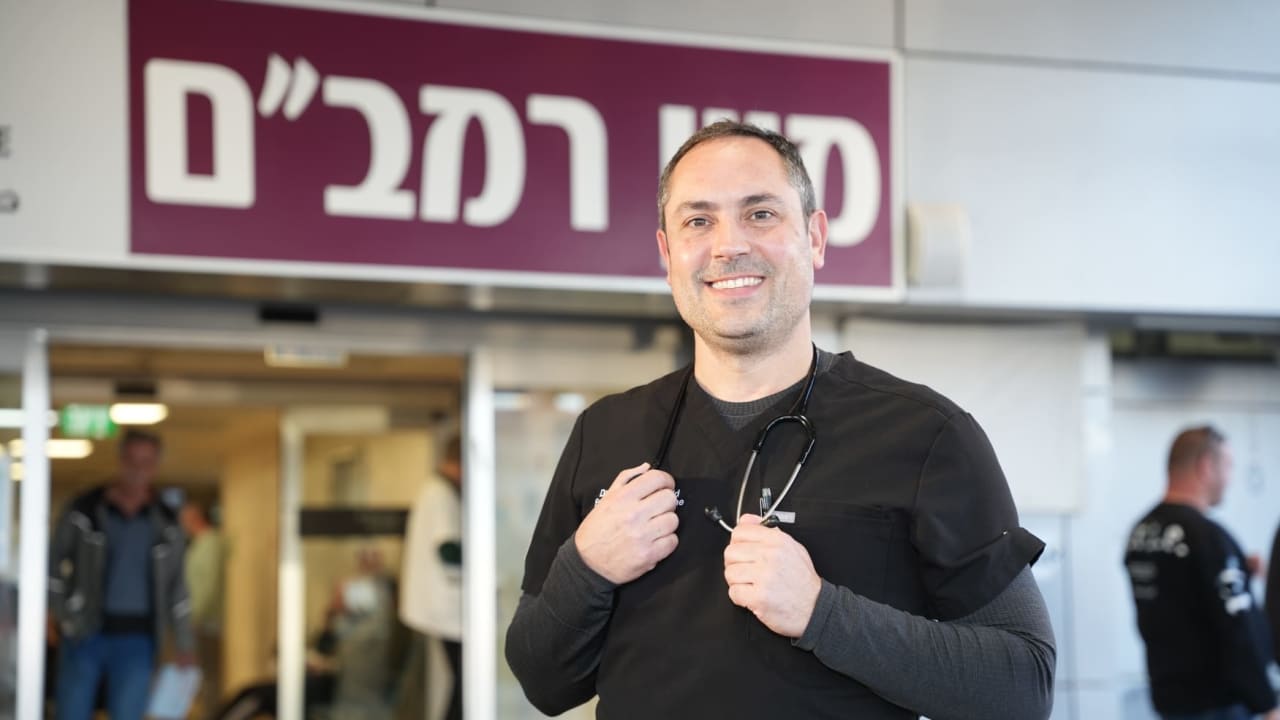
Dr. Ari Greenwald, an emergency medicine specialist and a devoted husband and father of four from Toronto, Canada, wanted to do something. He and colleagues decided to play a vital leadership role in strengthening Israel’s emergency medical system during Operation Swords of Iron, in partnership with the Nefesh B’Nefesh organization.
A respected physician at Mackenzie Health, a community hospital, he felt a deep responsibility to help following the Hamas attacks. He brought his clinical expertise and calm leadership to Shamir Medical Center (formerly Assaf Harofeh Medical Center in Tzrifin), where he worked tirelessly to provide skilled and compassionate care to patients, and returned to volunteer on multiple occasions.
Together with four fellow physicians, the 47-year-old Greenwald co-founded Milu-EM – a global volunteer network of over 250 emergency physicians committed to supporting Israel’s emergency medical system.

A volunteer force born from crisis
The name is a combination of the Hebrew word miluim for “reserve duty” and EM for “emergency medicine.” More than 7,000 doctors signed up to come after Oct. 7, and at least 1,000 actually arrived.
His tireless dedication has made a lasting impact on Israel’s medical resilience. Beyond his clinical contributions, Greenwald helped lead emergency preparedness initiatives, training IDF medical reserves and hospital teams. His presence at Shamir served not only to expand clinical capacity but also to boost morale and mentor younger medical staff in a time of national crisis.
He worked with Adam Kotler of the international department and Tamar Keinan of the licensing department of the Health Ministry in Jerusalem, who streamlined examination of credentials and granted a temporary license in a day or two to practice medicine here.
With help from the Israel Association of Emergency Medicine, Greenwald traveled across the country to discuss the needs of emergency departments and then helped recruit volunteer doctors with the skills each hospital required. Thus, they provided essential reinforcement to over 20 public hospitals and laid the groundwork for long-term collaboration and international partnerships.
Dr. Michal Mekel, director-general of Rambam Health Care Campus in Haifa, told the Magazine: “Unfortunately, the recent conflict has been marked by numerous injuries among both civilians and soldiers arriving from the battlefield.
“The support we received from the Milu-EM physicians’ organization was tremendously significant for Rambam and helped us cope with the many challenges we faced during this complex period, particularly alongside the mobilization of many of our staff members for reserve duty.”
She added that “their professional and human contribution was an important part of our ability to continue providing high-quality, continuous, and safe care to our patients, even during periods of heavy workload and uncertainty.
“Beyond strengthening our workforce, this collaboration enabled us to expand our medical capabilities, share knowledge and professional experience, and foster a strong sense of mutual responsibility and deep connection among medical teams in Israel and around the world.
“The physicians’ willingness to mobilize quickly, arrive during a very challenging time, and work alongside our teams with determination and dedication gave our hospital staff a profound sense of support and greatly strengthened us all.
“We see this collaboration as an important asset – not only during emergencies, but also as an opportunity for continued partnership, knowledge exchange, and the development of professional ties during routine times as well,” she added.
A global network filling the gaps in Israeli ER care
Dr. Yona Vaisbuch, Rambam’s deputy director-general, who was director of the Biodesign Program and deputy head of its ear-nose-and-throat department, said that although most of the foreign ER specialists have gone home, “we still have one or two of the physicians here now. Our trauma department is the largest in Israel, and our underground hospital is the largest in the world, with 2,000 beds.
“We send our ER specialists to a new branch in Kiryat Shmona on the northern border, and the Milu-EM volunteers help us at our hospital to fill the slots. We continue to admit many soldiers who have been wounded in Lebanon by Hezbollah terrorists.”
When milu-EM doctors arrived in Haifa, they were given rooms at the Bat-Galim Hotel nearby, where they stayed for several weeks. Many speak Hebrew, but those who don’t were matched with medical residents who worked with them, said Vaisbuch. “Both sides have learned a lot. It’s a win-win situation.”
Most of the volunteers are Jewish, and a few have already made aliyah to Israel as a result of the experience. There are also pro-Israel non-Jews from Hong Kong, England, Brazil, South Africa, and Australia. Since residents are on duty in the evening, it helps greatly when Milu-EM specialists are in the hospital, said Vaisbuch.
Dr. Daniel Trotzky, the deputy director general of Tel Aviv Sourasky Medical Center and former director of Shamir Medical Center, was a co-founder of Milu-EM.
“In 2024, I organized a delegation of doctors to tour Israel and ER facilities. They visited the site of the Nova party, where Hamas terrorists savagely murdered celebrants and took hostages, and to the border kibbutzim and moshavim near the Gaza Strip,” he said.
Trotzky and colleagues established a digital program called EMconnect that brings together 13 subgroups in the ER.
“My first visit to Israel was a gift from my grandparents for my bar mitzvah,” said Greenwald in a phone interview from Canada. “I was very impressed.”
“I also lived in Israel for a sabbatical year in 2015-2016,” he added, “where I had a teaching role with residents at Jerusalem’s Shaare Zedek Medical Center. After Oct. 7, I immediately went to volunteer at Shamir Medical Center. I have also spent time at Rambam.”
“I had total support from my wife, who is an accountant, and children to leave Toronto and go to a war zone and help out,” he recounted. “I come from a Zionist family. One of our sons made aliyah when he was 19 and is serving in the IDF and has served in Lebanon.
“During his time at Rambam, I worked in the trauma room treating wounded soldiers, some from his own unit. But when the crisis is over, I want to lay the foundation for relationships among medical communities. Another Milu-EM volunteer is coming on Thursday.”
Asked whether the heads of their medical departments abroad are upset about their leaving for weeks on end, Greenwald answered that “close to 100 came in the last two and a half years. They go with the blessing of their departments – either enthusiastic or just with permission.”
The language of medicine all over, including in Israel, is very much in English, he said.
“Israelis working in the emergency system – men and women – are incredible people. They do so in very challenging circumstances, and they do meaningful work. Israel isn’t an easy place to live and work. That’s reality on the ground. I’d be happy to see people come on aliyah. For me, it’s a dream,” he said.
“Everyone in our organization knows that if they are called, they show up, as with reserve duty. We come with a sense of commitment and deep appreciation for what is happening in Israel. We have the support at home to stay here as long as needed, and there is no other place we would rather be,” the Canadian physician continued.
Greenwald noted that Israeli doctors have had to become very good at mass casualties: “We in North America learn about theory, but we don’t practice it, so we’ve been able to learn about actual preparedness in Israel. In Haifa, a missile hit, and some civilians and soldiers in Lebanon had been killed, and others were injured.
“The Israeli medical system is amazing. Israelis are misunderstood in much of the world today. We see an incredibly diverse patient population and hospital staffers who all work together in the most beautiful way. They treat soldiers like VIPs, and such patients are respected by both Jewish and non-Jewish staff.
“It’s a privilege to be part of this coexistence. The volunteers bring their experiences back and tell their colleagues. I hope to come in the summer; I’m itching to come back.”
“Since Oct. 7, I’ve been in Israel more than 10 times,” noted Greenwald. “Other doctors in the organization have also been in Israel several times, rotating through different hospitals. We are working on establishing a system that will allow us to return to the same hospital and maintain continuity throughout the year.
“The intention is to contribute from our knowledge and experience to assist where needed, when needed, to help advance and develop Israeli medicine, and to be part of it. All of us have connections to Israel. Some have family and roots here; some simply love Israel.
“Given the situation here in the country, and in Jewish communities worldwide, with rising antisemitism, this feels like the right thing to do,” he concluded.
Dr. Michael Estreicher, a married father of three children from Hollywood, Florida, who completed his MD degree at Tel Aviv University Medical School and returned to the US to finish his training, also volunteered in Israel for the organization.
“My family comes from a long history of Zionists – my father was born in Israel after my grandfather made aliyah from Slovakia in 1948. I have a unique skill set with experience that can be used in a time of need.
“It felt natural for me after Oct. 7 to find a way to come to Israel to help. I’m a run-to-the-fire type of person, especially working in emergency medicine, so I came here after Oct. 7 and again, for 10 days during this war,” he recalled.
“I believe that we live for something more than just the day-to-day. In my hospital in Florida, I practice regular emergency medicine. Here, I’m treating our people. It feels like a higher calling that reaffirms the decisions I made and why I became an emergency physician.
“I believe that living a life that’s more than the four walls of your house. This is how I show my kids that we are part of the bigger picture. This is how I help,” he concluded.■