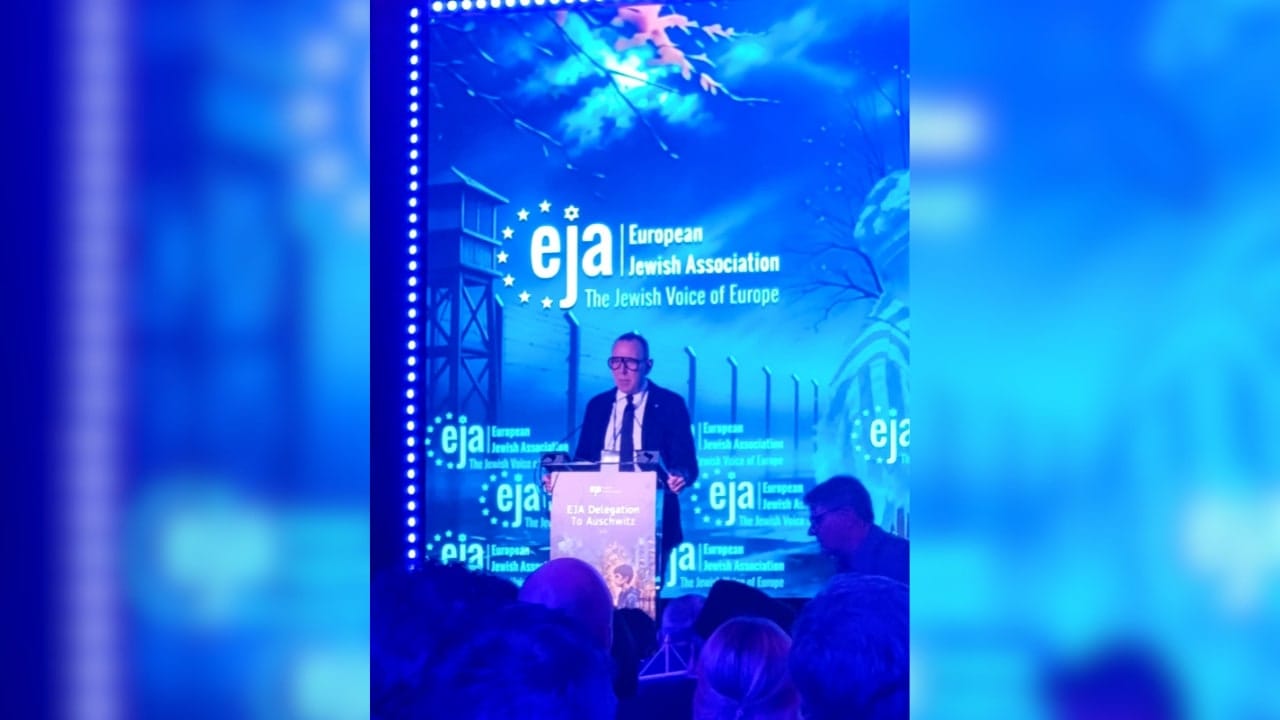
In the diplomatic calculus of contemporary European Jewry, timing is everything. Yet when the European Jewish Association (EJA) convenes its annual delegation to Auschwitz in Krakow this week, the choice of dates is pointedly deliberate. Rather than aligning with standard calendar routines, the gathering serves as an intentional focal point for high-level political engagement across the continent.
While international Holocaust memorial delegations traditionally converge around International Holocaust Remembrance Day on January 27, the EJA chose the anniversary of Kristallnacht, the November pogroms of 1938, for its gathering.
For EJA Vice-Chairman Alex Benjamin, the distinction is not merely calendar-deep; it is the cornerstone of how modern political leadership must confront rising antisemitism before it reaches its terminal phase.
"We've been taking delegations every year to Auschwitz," Benjamin told The Jerusalem Post in an interview in Krakow. "But a lot of delegations tend to happen around International Holocaust Memorial Day... whereas, we feel that Kristallnacht is every bit as important because it was the beginning of the end for European Jews."
Walking through Krakow’s historic Kazimierz district, where centuries of vibrant Jewish life were entirely eviscerated, offers a sobering physical context. Benjamin points out that while Auschwitz-Birkenau stands as the ultimate, horrifying apex of industrialized mass murder, the "end station" of hate, it has almost become an abstract symbol in the public consciousness, akin to visiting the Anne Frank House in Amsterdam.
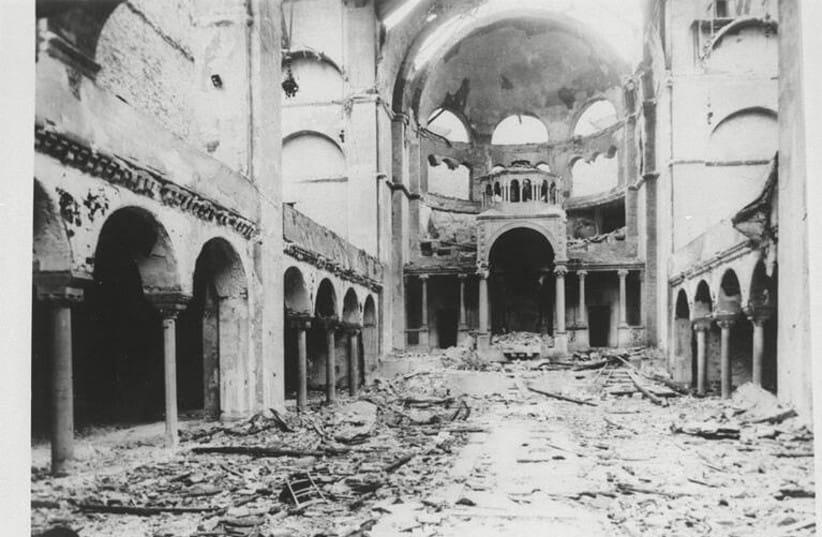
It's easier to understand Kristallnacht than Auschwitz, Benjamin explains
The greater challenge, Benjamin argues, is helping modern politicians understand how societies slide down the slippery slope from normalized social exclusion to catastrophe. Understanding the gradual breakdown of civic norms and legal protections is vital to preventing history from repeating itself in subtle yet dangerous ways.
"When you go to Auschwitz, it's extremely difficult to get your head around the scale and exactly what happened," Benjamin explained. "But it's kind of easier to get your head around how Kristallnacht came about, and how you could get from point A to point B. We want to constantly remind people that there's an early warning system."
That warning system, Benjamin warns, is flashing red across Europe today. Drawing a direct parallel to the psychological climate of the late 1930s, where ordinary neighbors closed their curtains and ignored the mounting persecution of Jews, he notes that contemporary European Jews are once again asking themselves terrifying, fundamental questions about their future.
"They're asking themselves, 'Is it safe to live in this country anymore? Do I trust my neighbors? Will the government look after me? Is it safe to walk my kids around?'" Benjamin said, recounting anecdotes of community members altering their daily routines out of fear. "These are the very same things which were happening in Krakow and around Europe around the time of Kristallnacht. People just scratching their heads, going, 'I don't understand what's going on. Why is this country that I lived in... why has my entire life changed irrevocably?'"
For the EJA, bringing high-level parliamentarians, ministers, decision-makers, and prominent figures, such as the Crown Prince of Iran, face-to-face with these historical parallels is designed to puncture institutional complacency. The delegation is intentionally structured not as a passive historical tour, but as an active seminar on policy enforcement, legislative safeguards, and online accountability.
Benjamin stresses that token political statements or hollow political slogans of solidarity do little to ensure the real-world safety of vulnerable Jewish populations without matching legislative and security measures.
"Saying 'never again' all the time, well, 'never again' on its own doesn't actually mean anything, unless you deal with a situation that started in 1938, arguably before, and you watch out for the warning signs," he said. "It's not enough just to come to Auschwitz and go, 'What a terrible tragedy happened here,' and to lay a wreath, light a candle, and join us in saying Kaddish. That's wonderful. But much more important is looking after the Jewish community."
Benjamin highlighted a recurring blind spot among European political establishments, noting wryly that authorities have historically proven far more adept at "remembering dead Jews" than protecting living Jewish communities when they require urgent intervention.
Conference discusses antisemitism packaged as anti-Zionism
The conference sessions in Krakow also tackle how traditional antisemitism has successfully repackaged itself under the guise of anti-Zionism.
With experts like Alex Hearn of Labour Against Antisemitism addressing delegates, the discussions explore how political discourse frequently crosses the line from legitimate criticism into virulent prejudice. Benjamin likens the phenomenon to legal maneuvering: an antisemite will always find a loophole, consistently utilizing anti-Israel sentiment and geopolitical conflicts, such as Operation Cast Lead in 2008–2009, naval flotilla incidents like the Mavi Marmara, and ongoing Middle East conflicts, as pretexts to repackage traditional antisemitism into anti-Zionism.
"The language that is being used is exactly the same language; it's just been repackaged," Benjamin said. "Genocide is just a modern blood libel... dual loyalty comes up, 'all Jews support Israel, therefore they can't be trusted because they're more loyal to Israel than their own countries.' Age-old conspiratorial tropes about shadowy cabals and fifth columnists, once invoked to accuse Jews of disloyalty, have been seamlessly adapted into modern political rhetoric, portraying Jewish communities as a collective, untrustworthy entity operating against the interests of society. “This sort of conspiracy, fifth columnists... it's all very hidden under the language of free speech," Benjamin told the Post.
Across Western Europe, the environment has become particularly acute, marked by a wave of severe anti-Zionism, security incidents, and a hostile climate. In France, for instance, community leaders and rabbis experience physical attacks multiple times a month, while Dutch Jewish leader Ellen van Praagh expresses bewilderment at the rapid decay of safety in their home countries. Small towns across Western European nations, alongside intense hostility driven by far-left and communist political traditions disguised as anti-Zionist activism, present a constant challenge to daily Jewish life.
By contrast, Jewish communities east of the old Iron Curtain confront a different landscape of traditional, far-right, and sometimes bizarre cultural tropes. In countries like Poland and the Czech Republic, centuries-old folk charms persist, such as the widespread practice of buying small figurines or paintings of a rabbi holding a coin, believed to bring wealth and good financial luck to the owner. Yet alongside these seemingly benign superstitions sits a darker political resurgence. High-profile far-right figures like Polish MP Grzegorz Braun, notorious for using a fire extinguisher to douse a Hanukkah menorah in the Polish parliament in December 2023, embody the persistence of overt, radical antisemitism in the region. Navigating these dual dynamics of virulent antisemitism rooted in far-left and communist traditions masked as anti-Zionist hostility in the West, alongside deep-seated traditional tropes in the East, remains one of the EJA’s primary challenges.
Operating across a continent where Jewish populations represent a tiny fraction of a percent, roughly 0.2% of the total European population–the EJA views its core mission as an indispensable counterweight to political isolation.
Representing roughly 650 communities ranging from major urban centers like London and Paris down to smaller and micro-communities, such as those in Ukraine, Luxembourg, Montenegro, Florence, Liege, Besancon in France, Ceuta, Cyprus, and Greece, the organization functions as an advocacy shield at the heart of the European Union.
"What we do is very, very simple: we want to foster, protect, and ensure that no Jewish community is left behind," Benjamin reflected. "We advocate for them at the heart of the European Union, at the highest levels. We combat antisemitism, but more than that, we also fight defending circumcision, shechita... We firmly believe that a rising tide lifts all boats, so that it doesn't matter if you're a huge ocean tanker of a community like London or Paris, or you're a tiny community. We try and lift that tide and make sure that Jewish life in Europe is protected, is safe, and can continue into the future."
As the EJA delegation moves from the conference rooms of Krakow to the solemn grounds of Auschwitz-Birkenau, the underlying message to Europe's visiting lawmakers remains uncompromising. The canary in the coal mine is still singing, and a society that permits the normalization of antisemitism is fundamentally sick at its democratic core.
"Once you remove the demographic question, that's something that is so visceral to people that they can understand it," Benjamin concluded. "That it's a barometer by which one can judge a healthy, functioning democracy. And once people start turning their backs on the Jews and we allow that to happen again, then we're taking a turn to a dark place."