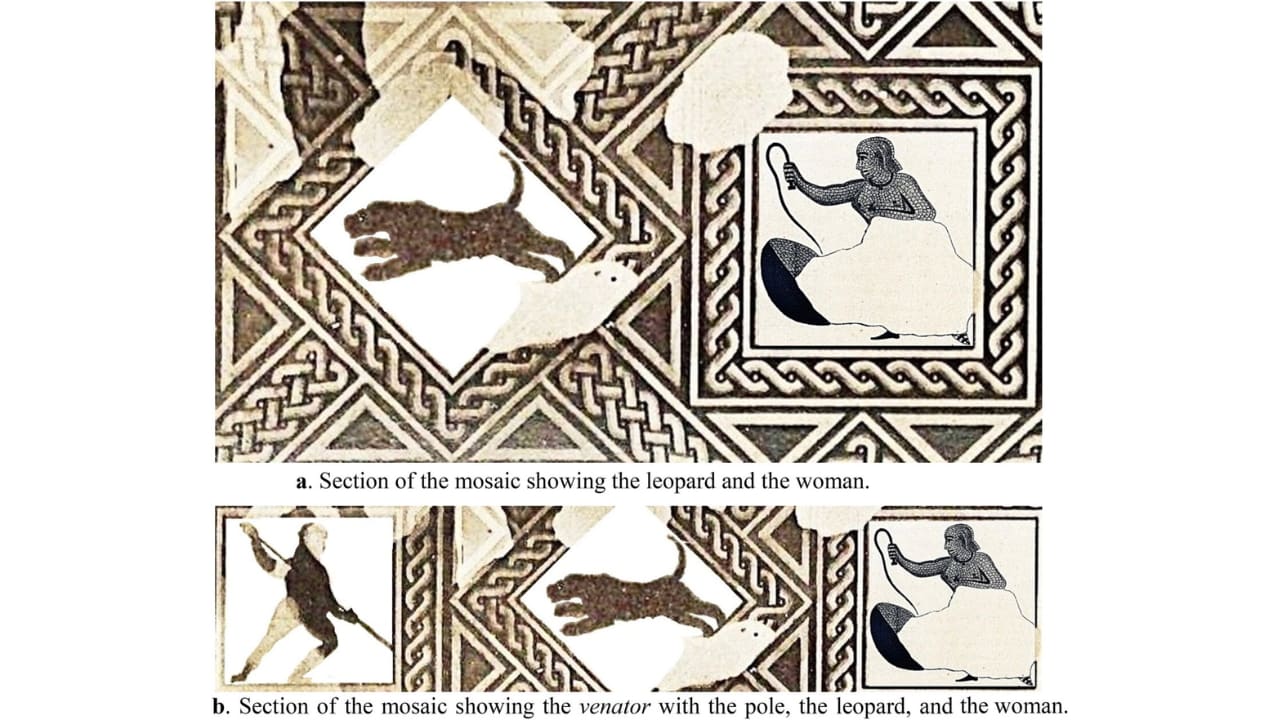
A 19th-century mosaic destroyed in World War I may have depicted the only known image of a woman fighting beasts in the Roman arena, according to a new study published in the International Journal of the History of Sport in March.
The mosaic, recovered in 1860s Reims, France and dated to the third century CE, shows about 35 different gladiatorial and hunting scenes, each surrounded by diamond or square-shaped decorations called "medallions."
It was “found in a house that likely belonged to a wealthy individual who sponsored beast-fighting shows held in arenas,” Alfonso Mañas, a sports researcher, told Live Science in an email, further explaining that it had most likely been displayed on the floor of a dining hall "so that the guests of the host could admire the mosaic during the banquet.”
While there are six surviving written texts that say that women fought beasts in the Roman arena, the mosaic, studied and sketched by French archaeologist Jean Charles Loriquet in 1862 before its destruction, provides the first visual account of such a thing.
Previous researchers, such as Loriquet himself, described the woman as an "agitator, an inexistent arena role, or a paegniarius, a kind of clown with a whip," Mañas wrote in the study, though noted that she does not hold the traditional sticks and padding the paegniarius bore.

According to Mañas, there is no doubt that the figure is a woman, and pointed to the careful and deliberate depiction of her right breast using pointed tiles, clearly contrasting the other individuals shown in the mosaic as flat chested.
Female fighters would "always fight topless, with bare breasts,” Mañas explained, “because [otherwise] spectators from the stands would have had problems notic[ing] that they were actually women.”
Beast hunter or prisoner?
Regarding the woman's role, Mañas argued that she was a venatrix (beast hunter), as she is armed and unrestrained, unlike others sentenced to death in the arena. However, there were various types of beast hunters, including those trained to perform in the arena as punishment and released if they were alive by the end of their sentence.
But “in practice, visually, it was impossible to distinguish a venator, someone who became an arena hunter voluntarily, from a damnatus ad ludum venatorum, someone who became a venator obliged by sentence,” Mañas wrote, so there is no way of knowing which type of hunter she was.
The accuracy of Loriquet’s drawing also raised questions about Mañas’s conclusion, Thomas Scanlon, a professor emeritus of classics at the University of California who was not involved in the study, shared with Live Science.
"The article is well documented,” he said, “but my concern is that the actual mosaic is not extant, but was destroyed in WWI, so the images are from an old [drawing] which may not be reliable in detail.”
In the study, Mañas pointed to the surviving fragment of the mosaic housed in a museum in Reims, showing that Loriquet’s portrayal of the medallion is accurate.
"I agree with the author," Arizona University History Professor Alison Futrell told Live Science in an email, adding that "I think that women were regular participants in arena events and that they're underrepresented in surviving textual and visual evidence."