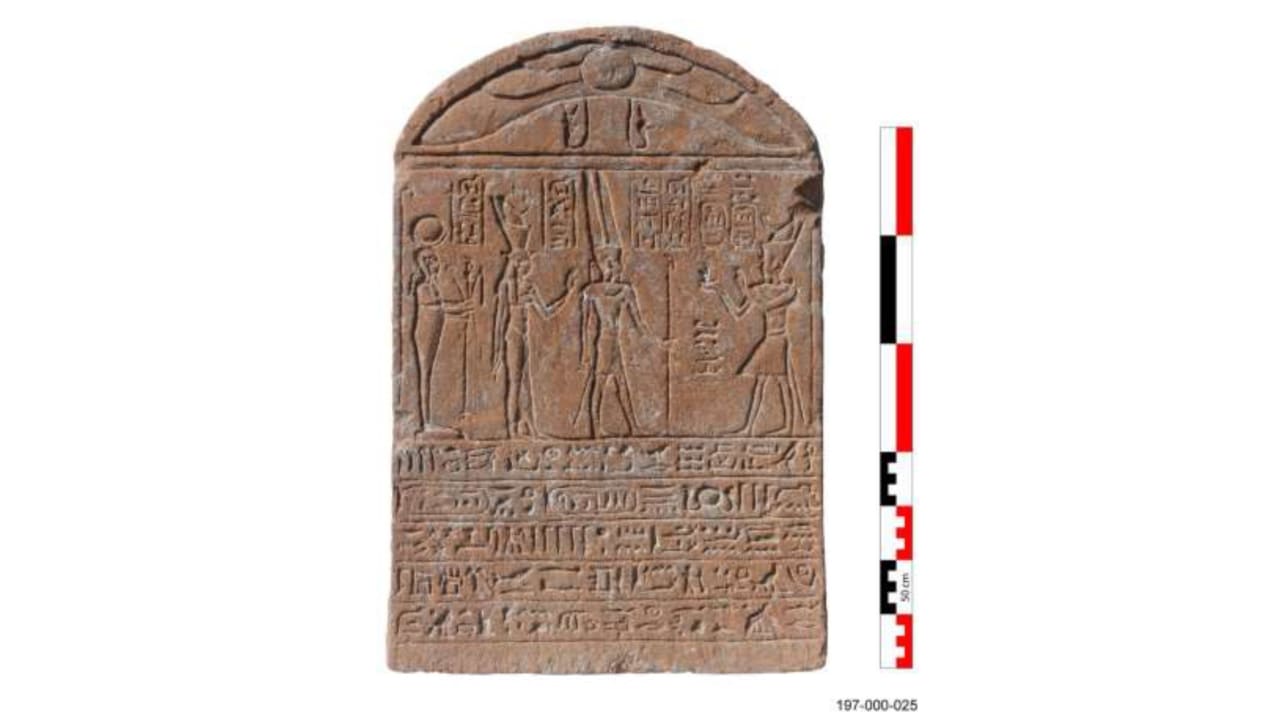
A sandstone stele dating to the reign of Roman Emperor Tiberius (14 to 37 CE) was discovered near Luxor, Egypt, by a team of Egyptian and French archaeologists, Egypt’s Tourism and Antiquities Ministry announced is a statement last week.
The stele depicts Tiberius standing before the Theban triad of the ancient Egyptian gods: Amun (or Amun-Ra), Mut, and Khonsu.
Below the scene are five lines of hieroglyphic text documenting the restoration of the retaining wall of Amun’s Temple within the Karnak Temple Complex.
Dr. Abdel Ghaffar Wagdy, director-general of Luxor Museum and leader of the Egyptian side of the archaeological mission, noted that the stele underwent meticulous restoration and is set to be displayed at a museum in the future.
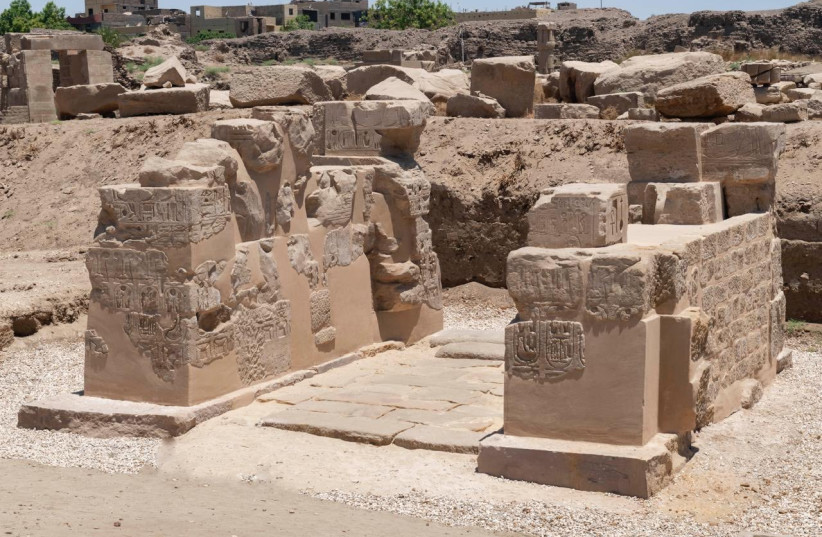
The stele was discovered during the three-year-long restoration efforts of a gateway from the time of Ramesses III, the second pharoah of the 20th Dynasty (1189 to 1077 BCE), in Karnak, after the lower part of the wall had been found heavily deteriorated and covered in vegetation.
Evidence of earlier construction, restoration found
In order to restore the gate, archaeologists needed to dismantle it, restore each stone block, and document them all before reassembling the gateway fully. They found that several of the decorated stone blocks actually dated to the earlier reign of Amenhotep III of the 18th Dynasty (1550 BCE to 1295 BCE), possibly reused from an older gate set along the same wall.
Sections of the northern wall of Amun’s Karnak temple were discovered on either side of the gate, themselves belonging to the New Kingdom (16th-11th century BCE), as well as evidence of additional construction from the 18th Dynasty and reign of Ramesses III.
Further evidence suggests Greek and Roman era restoration efforts of the wall and gate.
Additionally, during excavations at the site during the summer of 2025, archaeologists succeeded in uncovering a paved road linking the gate to the Courtyard of the Third Pylon within Karnak’s complex.
Egyptian Tourism and Antiquities Minister Sherif Fathy praised the joint French-Egyptian efforts, noting that the restoration and discovery are a part of a larger framework to develop Karnak into an open-air museum.
He added that “the restoration work and archaeological discoveries achieved in recent years represent an important scientific addition that contributes to providing a clearer vision of the development of the Karnak temples throughout the ages, especially during the first millennium BCE.”