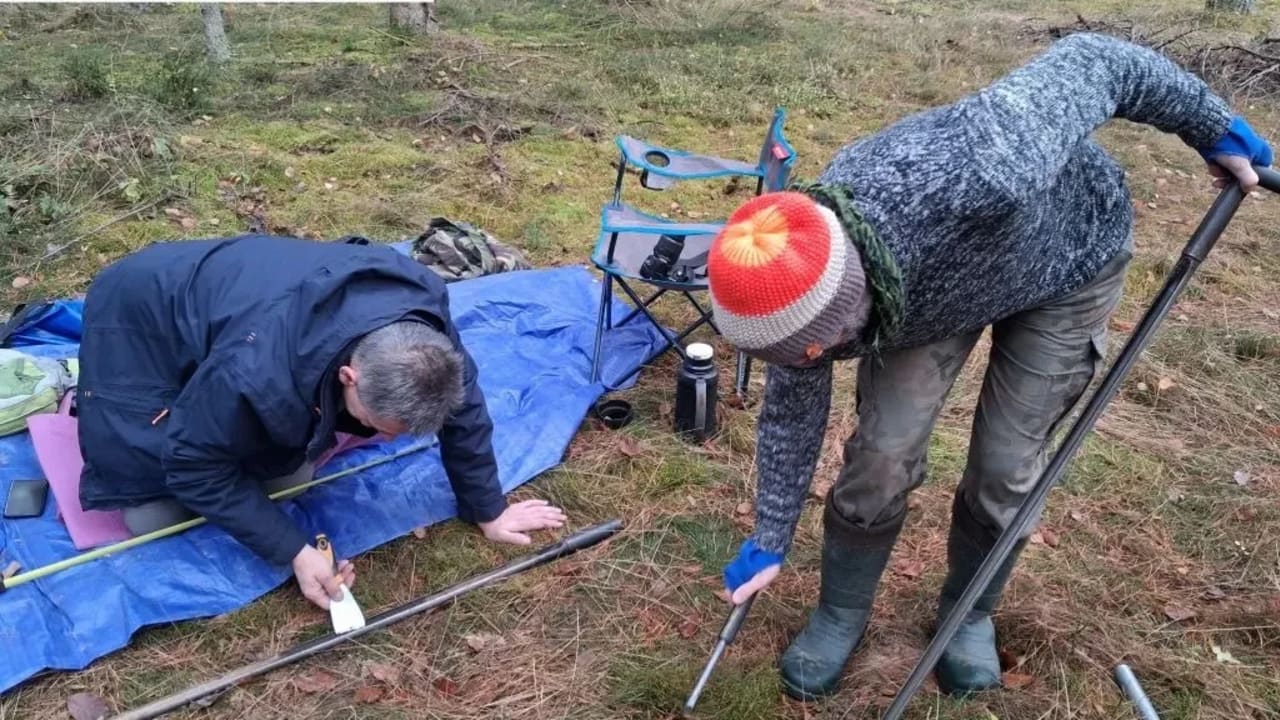
Archaeologists rediscovered the lost medieval town of Stolzenberg in a dense forest near Słobocze in northwestern Poland. They confirmed its footprint with geophysical surveys that mapped gigantic earthen ramparts and an approximately 5.5-meter (18-foot) deep moat. Magnetic anomalies revealed building remnants framing a rectangular market square and traces of structures lining a street toward the expected city gates, a layout typical of medieval towns founded under German law. “The results of these studies have removed any remaining doubts,” Marcin Krzepkowski said, according to the Mirror.
Researchers trace Stolzenberg’s origins to the 14th or 15th centuries on the historically disputed border between Pomerania and Neumark. The town appears to have been deliberately planned around a regular central marketplace. The clear geometry of the streets and the square supports the view that Stolzenberg functioned as a full-fledged economic center. Researchers believe the town was later abandoned in the 16th or 17th century, though the precise cause remains unknown; possibilities include relocation, shifting trade routes, competition from nearby towns, climate change, or depleted water resources. Krzepkowski assesses that Stolzenberg may have been the first site of a town that moved after faltering in its early stages.
Cannonballs and lead rifle bullets
The team and collaborating metal detectorists recovered roughly 400 artifacts from the forest floor and subsurface layers, highlighting the settlement’s medieval character. Finds include silver coins, metal belt fittings, cloak clasps, coat fasteners, knives, and iron padlocks, with Krzepkowski noting that the most valuable discoveries were the medieval items. In addition, fragments of cannonballs and lead rifle bullets were uncovered, which historians link to a 1761 battle fought in the area during the Seven Years’ War between Russian and Prussian forces.
Investigators combined historical sources, old documents, and maps with on-the-ground survey methods to relocate the town after initial searches failed to confirm its precise position. Expanded efforts, including geophysical work that pinpointed magnetic anomalies matching the moat, ramparts, and market square, established the settlement’s layout and boundaries, according to Newser.