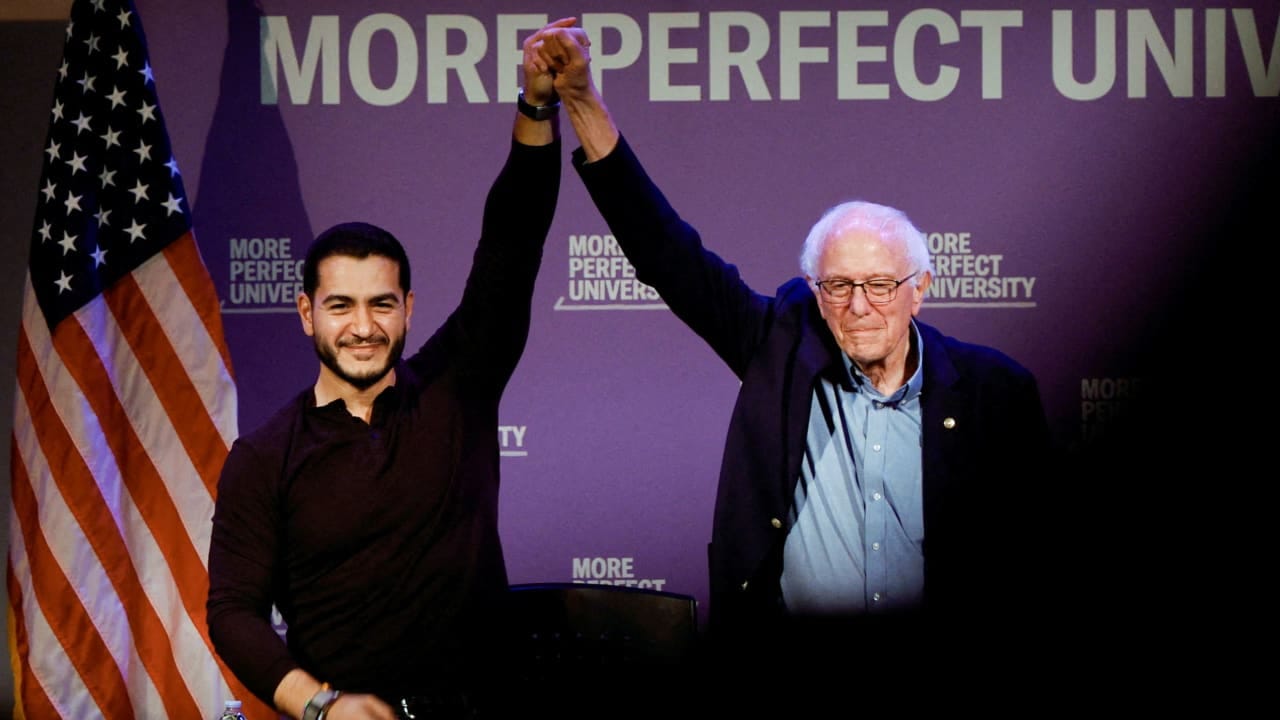
Roughly one-third of Jewish voters in New York City supported Zohran Mamdani in the recent mayoral election. In Michigan, approximately half of Jewish voters supported Abdul El-Sayed in his Senate campaign.
Both are Muslim politicians whose positions challenge Israel’s legitimacy as the nation-state of the Jewish people.
Mamdani has made clear that he cannot support a state that gives Jewish national identity a special place, while El-Sayed has pledged to stop American arms sales to Israel.
Given Israel’s dependence on American military supplies to defend itself against the numerous threats it faces, this is no ordinary policy disagreement: it would undermine Israel’s ability to protect its citizens.
How can so many Jews vote for politicians whose political agendas could seriously endanger the future of their brothers and sisters across the ocean?

Part of the answer may lie in the very Jewish education they received.
Tikkun olam, repairing the world, is not an invention of the Reform movement. Its roots reach back to ancient Jewish sources and Jewish mysticism.
But its modern interpretation, emphasizing a Jewish obligation to advance social justice and improve the human condition, developed primarily in the United States during the second half of the 20th century.
The Reform movement was the principal institutional force behind its popularization and elevation to a central place in Jewish identity, although the idea subsequently gained considerable traction among Conservative Jews, other religious streams, and secular Jews as well.
The motivation behind this development is understandable. After centuries of persecution and discrimination, culminating in the Holocaust, many American Jews sought to secure a different future.
Perhaps the best way to do so was to demonstrate that Jews were not an insular community concerned only with their own welfare, but an open, generous, and socially responsible part of American society.
This was done by fighting discrimination, providing education to disadvantaged African Americans, offering medical assistance to those in need, and supporting environmental protection,
Jews could demonstrate their contribution to the common good and, hopefully, reduce the likelihood of renewed persecution. The more we give to the world, the more warmly the world might embrace us.
This aspiration was admirable, and its contribution to American society has been substantial. Yet something problematic happened along the way: solidarity with humanity at large began to overshadow solidarity with the Jewish people themselves.
Prof. Jonathan Krasner of Brandeis University has documented how tikkun olam evolved from a relatively marginal concept in Jewish tradition into one of the defining pillars of contemporary American Jewish identity.
Its adoption was closely connected to the broader currents of American liberalism, which undoubtedly helped it spread rapidly and take firm root across many Jewish communities.
This transformation coincided with a gradual change in the way American Jews viewed Israel. Until the Six Day War, Israel was widely perceived as the underdog – a small, vulnerable country surrounded by hostile neighbors and in dire need of Jewish support.
When Israel's image changes
After 1967, as Israel became a regional military power and assumed control over a large Palestinian population, the moral picture began to change in the eyes of some American Jews.
Israel increasingly came to represent the powerful, while the Palestinians were cast as the powerless and oppressed. The moral framework of tikkun olam seemed to offer an obvious answer as to which side deserved their solidarity.
Imagine a young Jew raised in a Reform household. In synagogue preschool, Sunday school, and rabbinical sermons, the message is repeated: we must repair the world, defend the disadvantaged, and stand against oppression.
At 18, that young person arrives at a university campus and encounters a relentless narrative portraying Palestinians as helpless victims and Israel as a brutal colonial oppressor.
The connection seems almost inevitable: if I am a Jew committed to repairing the world, I must stand with the Palestinians.
The question of what their victory might mean for Israel, or what would happen to Jews if their national homeland ceased to exist, is pushed aside.
Of course, this is not the only explanation for Jewish support for Mamdani or El-Sayed. Affordability concerns, party loyalties, and opposition to US President Donald Trump also played a role.
Given the close ties between Trump and Prime Minister Benjamin Netanyahu, hostility toward the former can easily spill over into hostility toward the latter, and sometimes toward Israel itself.
But it is difficult to ignore the moral framework that allows some Jews to separate their commitment to universal justice from their responsibility toward their own people.
There is no need to abandon tikkun olam to preserve Jewish solidarity. Secular Israelis volunteer in Africa and other remote regions, provide free medical care, assist local farmers, and share professional knowledge. They do so out of humanism and moral responsibility, without renouncing their national identity.
But perhaps American Jews who place tikkun olam at the center of their identity should ask themselves a difficult question: What happens if the assumption that the world will embrace us because of everything we have done to improve it proves wrong?
Vivian Silver, a peace activist from Kibbutz Be’eri, devoted her life to helping Palestinians. She helped patients from Gaza reach Israeli hospitals for treatment and worked tirelessly to promote coexistence.
On October 7, 2023, Hamas terrorists murdered her in her home. Her story is a heartbreaking reminder that goodwill and generosity cannot guarantee protection against those who reject the possibility of coexistence.
By all means, continue to practice tikkun olam. Help the disadvantaged, fight discrimination, and contribute to a better world. But don’t abandon your insurance policy along the way.
Israel is the one Jewish state, the national home of the Jewish people, and ultimately the place that provides Jews everywhere with a measure of collective security and refuge.
Its survival should matter just as much to a Jew living in Detroit or Miami as it does to one living in Tel Aviv.
The writer is a senior research fellow at the Neaman Institute and an emeritus professor at the Technion, Israel Institute of Technology, where he has served in various leadership positions. He also serves as a board member and as a strategic consultant to some companies and organizations.