
Yitzhak Rabin was the first prime minister to advance the plan to build in the E1 area. The international community – primarily the United States – prevented the plan’s implementation for decades.
Fortunately, under President Donald Trump, the US changed its position, and the current government should be commended for carrying out its decision to build in the E1 area.
The publication of tenders for the first 1,400 housing units – the first stage in linking Ma’aleh Adumim to Jerusalem – sends a clear signal to the entire world of Israel’s commitment to preserving a united Jerusalem and maintaining a defensible border along the Jordan River against attacks from the east.
Ma’aleh Adumim was built in the 1970s by Rabin’s government as part of the Allon Plan, which considered the Jordan Valley as a defensible border and attributed great importance to the road providing access to it.
The city of Ma’aleh Adumim, located east of Jerusalem and currently home to about 40,000 Jewish residents, secures the only route by which Israel could transport military forces, if necessary, from the coastal strip – where most Jews live and where most army bases are located – through Jerusalem to the Jordan Valley. Jerusalem, Ma’aleh Adumim, and the E1 area command Route 1, the central highway connecting the Mediterranean coastal strip with the Jordan Valley, along which Jews can move almost unimpeded by Arab population centers.
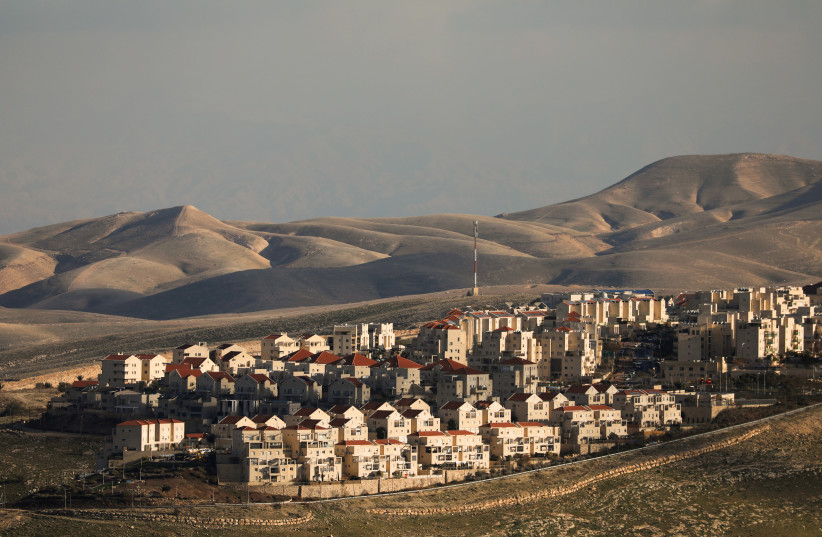
Jerusalem holds not only historical and religious significance for the Jewish people but also great strategic value. The city sits at an important junction of north-south and east-west axes in the Land of Israel. Its location also allows military movement north and south without having to cross the Arab-populated slopes of the Judean Mountains.
Opponents of Jewish settlement in the E1 area are concerned about territorial contiguity for the Palestinian state (from Ramallah to Bethlehem) that is meant to be established, according to international community plans, as a solution to the prolonged Israeli-Palestinian conflict.
But this is a hollow argument. There is no difficulty in arranging free passage between Samaria and Judea via overpasses or tunnels. Indeed, Israel plans to build Route 80 between north and south, parallel to construction in the E1 area, to enable Palestinian movement from Ramallah to Bethlehem (a road between az-Za’ayyem, north of Route 1, and Eizariya to its south, is also planned).
Significance of connecting Ma'aleh Adumim to Jerusalem
Connecting Ma’aleh Adumim to Jerusalem also prevents the city’s division. The implicit purpose of this opposition is to prevent Israel from cutting off Arab contiguity to the Arab neighborhoods of east Jerusalem, which are meant to become the capital of the Palestinian state.
The Palestinians want the E1 area to create territorial and demographic contiguity between their communities east and north of Jerusalem and the Arab neighborhoods in east Jerusalem, and to advance the city’s division in a future arrangement. The Palestinians are also aware of the Allon Plan and want to thwart it.
Of course, the Palestinian claim to control over east Jerusalem – and especially over the Holy Basin, which includes the Temple Mount and the Western Wall – must be firmly rejected. The Palestinians are engaged in constructing a new narrative that denies the historical connection of Jews to Jerusalem, and in particular the existence of the Jewish Temples on the Temple Mount.
Significantly, Jews have constituted a majority in the city since the mid-19th century, and Jerusalem has never served as the capital of any Muslim entity. Furthermore, surveys indicate that most Arab residents of Jerusalem prefer the status quo, since rule by the Palestinian Authority or Hamas holds little appeal for them – rightly so.
Although Ehud Barak broke the Israeli taboo against compromising on a united Jerusalem at Camp David in 2000, nearly 70% of Jews (depending on how the question is phrased) still support keeping Jerusalem united. About 80% of Jews in the country say the Temple Mount cannot be relinquished in a peace agreement.
A Palestinian takeover of the E1 area would lead to the city’s division, the isolation of Ma’aleh Adumim, and would undermine the State of Israel’s claim to control over the Jordan Valley. Settling Jews in the E1 area, therefore, prevents the realization of the Palestinian plan.
Some argue that Israel no longer needs the Jordan Valley as protection against attacks from the east, since the peace treaty with Jordan has consigned to the past the dangerous threat once posed by the eastern front’s proximity to Israel’s population centers and economic infrastructure. They also dismiss the Valley’s topographical importance, pointing to current military technology that enables precise strikes from a distance. In their view, the ability to launch defensive strikes from the coastal strip eliminates the need to hold the Jordan Valley.
Such arguments, however, are politically and militarily short-sighted. This position ignores the enormous potential in our region for rapid political change. Today, scenarios such as instability in Jordan or Saudi Arabia, or Islamist radicalization of the regime in Syria, can no longer be dismissed – any of which could revive the threat from the eastern front.
These experts likewise ignore the history of military technology, which shows a clear pattern of fluctuation over the centuries between the superiority of offense and defense. The belief that the current balance – in which existing technology temporarily diminishes the importance of topography – will remain unchanged is a dangerous fallacy.
Defensible borders that rely on transient technological superiority and changeable political circumstances amount to strategic folly. If Israel is genuinely interested in defensible borders along the Jordan Valley, it must therefore secure the road connecting the Valley to the coastal strip – a road that passes through a united Jerusalem and through Ma’aleh Adumim.
Furthermore, Israel’s international standing could improve, and opposition to building in the E1 area could soften, if Israel simultaneously presented the world with a clear vision based on the principle of territorial compromise for a future (a distant one) in which the Palestinians are prepared to be good neighbors.
There does not appear to be great strategic wisdom in indiscriminate settlement throughout Judea, Samaria, and Gaza. The settlement movement seems to have forgotten that Jerusalem is the most important hill in the Land of Israel, and that its population lacks a Zionist majority.
The rush toward hills of questionable strategic importance wastes Zionist energy and resources that could be used more wisely elsewhere. Israeli governments should instead adopt a policy of selective settlement, focusing on areas at the heart of the Israeli consensus – Jerusalem and its surroundings, Ma’aleh Adumim, and the Jordan Valley – without provoking excessive external disruption.
Alongside such a policy, illegal outposts located outside the consensus areas, especially in Areas A and B, should be evacuated. And, of course, Jewish terrorism in Judea and Samaria – which constitutes a moral stain on Israel and causes tremendous damage abroad – must be firmly stopped.
The E1 area is vital to Jerusalem’s political future, and its importance is equally decisive for Israel’s ability to maintain a defensible border in the east. Building Jewish neighborhoods in this area is a strategic and political imperative.
The writer is a senior researcher at the Jerusalem Institute for Strategy and Security (JISS) and head of the Program in Diplomacy, Strategy and Security at Shalem Academic Center.