
There appears to be a growing alliance between Israeli rightists and Romanian antisemites, built on the fantasy that both sides are united by a common enemy: Islam. Yossi Dagan, the prominent Likud figure and West Bank settler leader who has repeatedly embraced George Simion and his far-right AUR party, is only the latest and most striking example.
It is difficult to imagine a more foolish or morally obscene bargain than the one visible in Dagan’s early July meeting with Simion (which, according to the leading Romanian newspaper Evenimentul Zilei, took place in Bucharest).
Dagan was quoted by the Hebrew site Srugim as saying they “share the same values.”
He might be advised that AUR draws political and intellectual inspiration from movements that helped carry out the Holocaust in Romania, while its present-day representatives work to weaken Holocaust education, antisemitism legislation, and institutions that preserve the memory of murdered Jews.
Israelis who embrace such people are helping extremists launder antisemitism – an insult to Jewish history and Romanian historians, survivors, and civic leaders who spent decades forcing their country to face the truth.
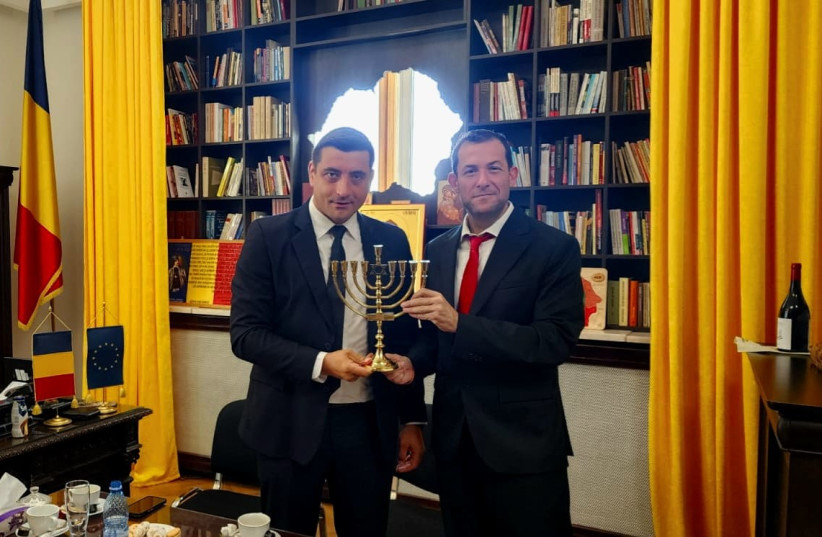
Dagan and Simion have met at least three times – in January 2023, August 2023, and July 2026. Their August 2023 meeting, which also included Israel’s then-ambassador to Romania Reuven Azar, prompted criticism from Yad Vashem, Romania’s Elie Wiesel National Institute for the Study of the Holocaust, and the Simon Wiesenthal Center.
AUR’s European Parliament faction indeed opposed proposed European sanctions against settlers in Judea and Samaria – a seeming quid pro quo. But at the same time, its politicians traveled across Romania collecting signatures to repeal recently strengthened legislation against antisemitism.
Dagan’s is hardly the only such flirtation by right-wing Israelis. In December 2024, Diaspora Affairs Minister Amichai Chikli held a supportive telephone conversation with Calin Georgescu, then the leading candidate in Romania’s annulled presidential election and an outspoken admirer of Romanian political and military leaders responsible for the Holocaust.
Shortly afterwards, Romania’s ambassador to Israel, Radu Ioanid, described Chikli as “meshugeneh” – Yiddish for “crazy” – and reportedly demanded an apology.
Chikli’s outreach was part of a broader embrace of Europe’s far Right. In March 2025, his ministry organized an international conference on combating antisemitism in Jerusalem that included politicians from several European far-right parties with histories of antisemitism and extremist roots.
The guest list was so controversial that prominent Jewish figures, including Anti-Defamation League CEO Jonathan Greenblatt, French philosopher Bernard-Henri Levy, and British Chief Rabbi Ephraim Mirvis, pulled out or stayed away.
This marriage of convenience is particularly absurd in Romania. Unlike in much of Western Europe, mass Muslim immigration is scarcely a defining political issue. AUR’s leaders have shown far more enthusiasm for rehabilitating Romanian fascists and undermining Holocaust education and Jewish institutions than for waging any meaningful battle against political Islam. The real beneficiary is therefore not Israel but Simion and his party.
AUR and Nazi Germany
Last year, Foreign Minister Gideon Sa’ar conceded that “some of these parties have bad roots,” but “we judge them by what they do today.” So let us examine what Simion and AUR do.
Founded in 2019, AUR combines ultra-nationalism with apocalyptic rhetoric, and leading figures associated with the party have praised leaders of Romania’s World War II-era fascist movements, including the Iron Guard, as well as wartime dictator Marshal Ion Antonescu and other figures associated with the persecution and murder of Romanian Jews.
Romania was not merely an ally of Nazi Germany during the Holocaust. Under Antonescu’s fascist dictatorship, Romanian authorities were themselves active perpetrators of genocide. Romanian soldiers, police, gendarmes, and officials carried out massacres and deportations, often with little or no direct German involvement.
The violently antisemitic Iron Guard murdered more than 100 Jews in the January 1941 Bucharest pogrom. Later that year, Romanian authorities murdered thousands in the Iasi pogrom and forced thousands more onto sealed “death trains,” where many died of suffocation, thirst, and heat.
After Romania invaded the Soviet Union alongside Nazi Germany, Romanian forces massacred tens of thousands of Jews in Bessarabia and Bukovina and deported many more to Romanian-administered Transnistria, where they faced mass shootings, starvation, and disease.
Romanian troops were also responsible for the October 1941 massacre in nearby Odessa, in which tens of thousands of Jews were murdered. Romania’s own International Commission on the Holocaust, chaired by Elie Wiesel, concluded that Romanian authorities were responsible for the deaths of between 280,000 and 380,000 Romanian and Ukrainian Jews.
The historical record is unequivocal: the Romanian fascists whom figures associated with AUR have praised were not peripheral sympathizers of Nazism but independently persecuted, deported, and murdered Jews on a massive scale. Yet AUR described the history of the Holocaust as a “minor topic.”
In 2021, it was the only Romanian political party to oppose legislation making Holocaust education mandatory in Romanian high schools.
This is particularly dangerous because almost no Romanian born during the communist regime was taught that Romanian authorities had been complicit in the Holocaust. The regime suppressed these facts and prohibited public discussion of them.
It has taken decades of determined effort for the truth to be acknowledged at the highest levels of the Romanian state, and even today only about one-third of Romanians are familiar with the historical facts.
In 2025, AUR and POT – the party supporting Georgescu – opposed amendments strengthening Romania’s legislation against antisemitism. During the parliamentary debate, members of both parties harassed the representative of Romania’s Jewish community who had introduced the amendments. AUR and POT MPs eventually walked out of Parliament in protest.
Becoming useful idiots
Israel's president recently visited Romania to commemorate the Iasi pogrom, in which approximately 12,600 Jews were murdered over just a few days in June 1941. AUR did not participate in the commemoration.
And in May 2026, one of AUR’s local branches petitioned the Romanian government and Parliament to dissolve the Elie Wiesel National Institute and the National Museum of the History of the Romanian Jews and the Holocaust.
After entering Parliament, Simion and his party sought greater respectability without alienating their extremist base. They adopted a strategy of calculated ambiguity, dog whistles, and coded messaging, allowing them to communicate different messages to different audiences.
AUR publicly rejects accusations of antisemitism and fascist sympathies while employing language, symbolic references, and historical narratives that resonate with nationalist and far-right supporters.
Rather than openly denying the Holocaust, which is a criminal offence under Romanian law, the party minimizes its significance by calling it a “minor topic” and opposing mandatory Holocaust education.
Simion describes the disappearance of Romania’s Jewish population primarily as the result of “emigration,” echoing narratives that minimize Romania’s responsibility for the Holocaust.
Whenever confronted with accusations of antisemitism, AUR points to Simion’s friendships with Jews – all while continuing to reassure its ultranationalist supporters.
Whether Israeli politicians understand AUR’s true nature or not, they are becoming Simion’s useful idiots.
Every handshake with an Israeli politician becomes another photograph he can display when accused of antisemitism; every expression of Israeli friendship becomes another alibi as his party attacks Holocaust education, antisemitism laws, and institutions entrusted with preserving the memory of Romania’s murdered Jews.
If AUR eventually comes to power and reveals its true colors, it will not be the Israeli politicians who posed for those photographs who pay the price. It will be Romania’s remaining Jewish community, now numbering only around 2,000 people.
Israeli politicians should be defending them – not helping their enemies convince the world that they are their friends.
The writer is a Romanian journalist based in Bucharest and a former reporter for Radio-France Internationale in Romanian.