
It was like magic.
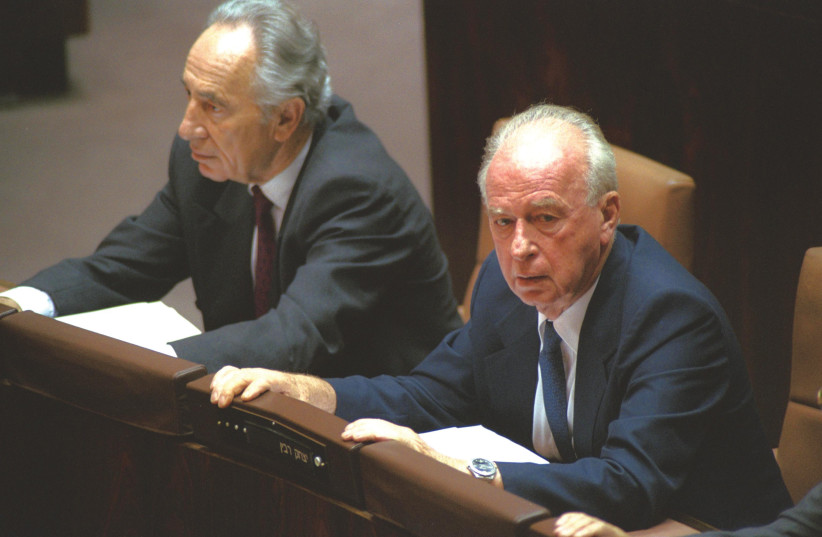
The 18-year fencing match between Shimon Peres and Yitzhak Rabin came to a sudden end, thanks to an invention Israel had never seen: primary elections.
Until February 1992, the Labor Party elected its leaders through forums of several hundred people. Now Labor handed the vote to 108,000 party members, who gave Rabin a decisive victory by 16 percentage points.
Moreover, Labor had its broad membership elect all its Knesset candidates. Swing voters were impressed. In a country where lawmakers were previously selected in smoke-filled rooms by huddles of party hacks, the primaries were a breath of fresh air. The result was Labor’s decisive defeat of Likud, by 44 to 32 seats.
Likud quickly realized the primaries’ popularity and set out to emulate Labor, as did the two parties’ respective satellites, the National Religious Party and Meretz.
That was all last century. Since then, the primaries that originally cleansed Israeli politics became a major engine of political debasement, corruption, and bankruptcy.
THE PRIMARIES’ rationale was twofold. First, bypass the party machinery, and second, help worthy people reach public office.
Back in 1992, the primaries helped Rabin bypass Labor’s Byzantine party apparatus, where his rival was particularly strong because over the previous 15 years, he had built and managed that system. By transferring the choice to a much broader electorate, Rabin’s popularity overpowered the party’s activists.
Initially, that is also what happened in Likud. Benjamin Netanyahu succeeded Yitzhak Shamir through that party’s first-ever primary election, in which he defeated veteran David Levy handily, who enjoyed more power in the party system. But that was 33 years ago. Since then, the primaries helped Likud flood the Knesset with people who should never have entered its halls.
One way Likud abused the primaries was by creating special slots that hacks can easily manipulate. That is how, in 2003, an anonymous woman named Inbal Gavrieli entered the Knesset, after having been elected in Likud’s primaries as “a representative of people under 30.”
People under 30 seldom run for public office, and in itself, their youth should be no reason to vote for them. Obviously, if they have a record despite their youth, it would be a very good reason to vote for them. But Gavrieli had no such record. What she did have was a family with reputed ties to the underworld’s gambling and money laundering industries.
A similar thing happened in 2015, when Likud landed in the Knesset, through its primaries’ “young candidates” slot, a 34-year-old guy named Oren Hazan.
Hazan had no public-service credentials, much less any original ideas concerning the country’s problems. What he did have was two years of work in Burgas, Bulgaria, during which, according to him, he ran a hotel. An investigation by Channel 12’s Amit Segal revealed that the hotel was actually a casino, and that Likud’s lawmaker had offered its patrons, as an extra, call girls.
Hazan, who was accused by the State Comptroller of lying in an affidavit regarding his campaign’s financial sources, was suspended for a while from the Knesset’s sessions after he mocked a wheelchair-bound lawmaker, Karin Elharar of Yesh Atid, for her immobility during a Knesset vote.
Another version of Hazan’s improbable penetration into the Knesset was the election in 2022 of Tally Gotliv into Likud’s list as “a new female,” another narrow category that allowed her to be elected despite her anonymity.
Having since become notorious for her screeching rants at lawmakers from the Knesset podium, and for her yelps at judges as they deliberate in the High Court of Justice, even a fellow Likud lawmaker, Eliyahu Revivo, admitted the other week that Gotliv is inflicting on the ruling party “incredible damage.”
The weirdos Likud thrust into the public arena were not limited to its electoral system’s special slots. Nissim Vaturi was elected through the Likud primary’s national slot. A construction contractor whose license was suspended after he let someone else use it, Vaturi is a conspiracy theorist who suggested in a TV interview that Labor leader Yair Golan, a retired general, helped Hamas on October 7. (In fact, Golan rushed that sorry morning to the Western Negev and joined the fighting.)
No other party, from the ultra-Orthodox factions to the Arabs, has brought into the Knesset the kind of dubious characters with which Likud has crowded it, from Finance Committee Chairman Hanoch Milwidsky, who publicly disgraced the committee’s legal adviser, to Environment Minister Idit Silman, who is being sued for inventing a story about Naftali Bennett’s mental health.
Such, in brief, is the face of the Likud, a political hegemony that has lost touch with its mission, purpose, and aim.
Israeli parties once assembled to discuss ideological dilemmas
THERE WAS a time when Israeli parties assembled to discuss ideological dilemmas. The National Religious Party’s delegates, for instance, met in 2004 to consider their response to the disengagement plan. On the Left, Mapam’s delegates gathered in 1968 to consider Golda Meir’s invitation to join the Labor Alignment (they said no).
Likud doesn’t do this kind of debating. Its institutions never discussed even its leaders’ most fateful choices, like the peace agreement with Egypt, the alliance with ultra-Orthodoxy, or the judicial revolution.
That’s not what Likud’s institutions do. They are not there to serve us. They are there to serve themselves. When they get together, it’s not for the sake of debating national ideas and social plans, but to wheel, deal, and steal, to buy power, to sell votes, and to pocket jobs. Hopefully, the voter will soon tell this Tammany Hall’s hacks what the biblical Daniel told Belshazzar as he feasted with his courtesans and concubines: that God has weighed the balance of their kingdom, that their license to rule has been revoked, that the party is over, and their time is up.
The writer, a Hartman Institute fellow, is the author of Ha’Sfar Ha’Yehudi Ha’Aharon (The Last Jewish Frontier, Yediot Sefarim, 2025), a sequel to Theodor Herzl’s The Old New Land.