
In 1897, on a balcony in Basel, Theodor Herzl stood still while history reorganized itself beneath him. Inside the First Zionist Congress, delegates argued over language, land, feasibility, and funding. Outside those walls, Europe debated a colder question: whether Jews were a permanent anomaly in the modern nation-state. Herzl understood that what Europe openly called Die Judenfrage — the Jewish Question — was not about etiquette or theology. It was about power. A people without sovereignty would always depend on others’ mercy, and mercy is not infrastructure.
A year earlier, in The Jewish State, Herzl had made his wager. The Jewish condition, he argued, was political, and therefore its solution had to be political. Emancipation had not erased suspicion; assimilation had not guaranteed safety. The answer was not tolerance; it was normalization. Jews had to become a nation like other nations — capable of defending themselves, cultivating their culture, and shaping their destiny.
And it worked.
A Jewish state exists. A Jewish army exists. Hebrew is spoken not only in prayer but in playgrounds, courtrooms, laboratories, and cafés. Jews are no longer stateless wanderers negotiating survival from empire to empire. Herzl solved the problem of survival. But in solving it, he transformed the Jewish condition. The old Jewish Question asked whether Jews could survive without power. The new Jewish Question asks whether Jews can retain legitimacy with power.
Legitimacy is not applause. It is not favorable headlines, trending hashtags, or international resolutions. It is the moral right to exist without being placed on permanent probation. It is the right to defend without apology, to be particular without being labeled supremacist, and to exercise sovereignty without being treated as a historical accident. Criticism of Israeli policy is legitimate in any democracy. Debate over borders, leaders, and strategy is healthy. But something different happens when Jewish sovereignty itself — not policy — is framed as uniquely immoral among nations. That is the move from political criticism to civilizational doubt.
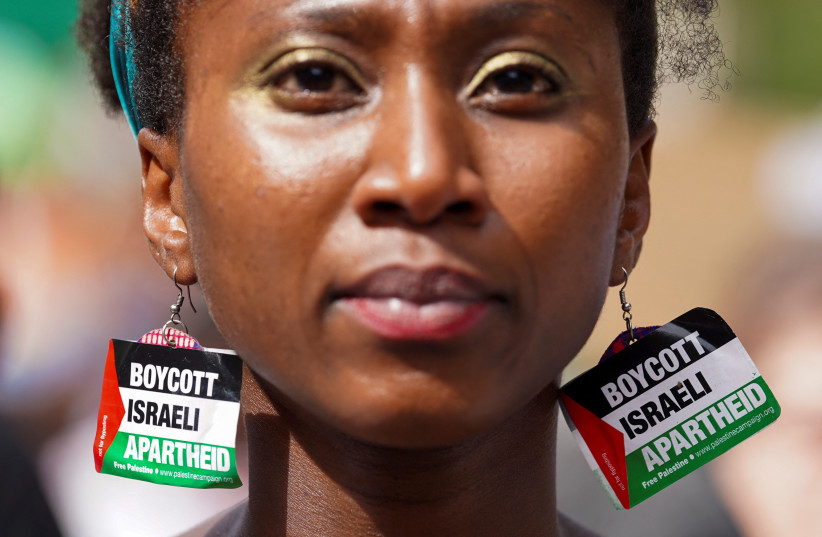
Antisemitism has always adapted to Jewish reality. In medieval Europe, Jews were condemned as a theological threat. In the nineteenth century, they were cast as racial contaminants. In the twentieth century, they were accused of orchestrating global conspiracies. In the 21st century, Jewish nationhood itself is frequently described as illegitimate — colonial, inherently unjust, fundamentally disqualified. Before 1948, Jews were accused of being rootless. After 1948, Jews are accused of being rooted in the wrong place. The accusation evolves; the refusal of Jewish normalcy remains.
The Iran war has made the point unavoidable. Jewish power remains indispensable; without sovereignty, Jews would once again be left to the mercy of others. But the war has also exposed the limits of power. A state can intercept missiles, strike enemies, and defend its citizens. It cannot, by military force, make the world understand why Jewish sovereignty is morally legitimate. Worse, the backlash revived old poisons in new language: ISD found that antisemitic content surged after the US and Israeli strikes on Iran, with narratives emphasizing Jewish political control, backlash against Israel or Zionism, and classic antisemitic tropes. Israel can win battles and still lose the vocabulary war if Jews themselves cannot explain the moral coherence of Jewish power. The battlefield is not only military. It is civilizational.
The New Jewish Question therefore arises not only from external hostility. It also emerges from internal uncertainty — from weakened familiarity with Israel and a thinning understanding of Zionism itself. A Jewish Federations of North America survey found that only about one-third of American Jews identify as Zionist, even though nearly nine in ten support Israel’s right to exist as a Jewish and democratic state. That gap cannot be dismissed as semantics. Many Jews affirm the achievement of Zionism while distancing themselves from its meaning. If Zionism denotes the Jewish right to self-determination in the ancestral homeland, then confusion about the word reflects confusion about the idea. And confusion about the idea reflects educational failure, not merely linguistic discomfort.
When a generation inherits sovereignty but hesitates to name the movement that made it possible, the problem is not branding. It is formation. Identity becomes negotiable when literacy is shallow. Legitimacy cannot be sustained by people unsure how to define themselves. That examination begins with questions — not rhetorical ones, but diagnostic ones.
1. Do Jews still believe we are a people?
Herzl’s revolution was peoplehood. If peoplehood dissolves into private spirituality or cultural nostalgia, sovereignty becomes abstract. Abstract sovereignty cannot withstand ideological assault.
2. Are we educating Jews to defend Jewish nationhood?
Can Jewish students articulate Jewish indigeneity, Jewish continuity in the Land of Israel, and the moral case for self-determination? If not, that is not a messaging problem. It is an educational gap.
3. Have we invested more in reacting to antisemitism than in forming Jewish identity?
Monitoring hatred is necessary. But formation is foundational. A civilization defined primarily by its enemies risks forgetting how to define itself positively.
4. Are we comfortable with Jewish power?
Exile conditioned Jews to survive through accommodation. Sovereignty requires psychological adjustment. If Jewish strength is softened instinctively to avoid controversy, legitimacy erodes from hesitation before it erodes from hostility.
5. Have we mistaken acceptance for security?
Decades of integration created comfort. But comfort is not sovereignty. Acceptance is not infrastructure.
6. Is Diaspora Jewish life structurally deep enough?
Israel guarantees refuge. It does not automatically guarantee global resilience. Without Hebrew literacy, historical grounding, and lived Zionist experience, identity becomes thin — and thin identities fracture.
7. Do we understand the shift from survival to legitimacy?
Herzl feared physical extinction. Today, the risk is psychological erosion — inheriting sovereignty without the vocabulary to justify it.
8. Have our institutions built architects of confidence — or managers of vulnerability?
Reports, statements, and advocacy campaigns are necessary. But do they cultivate civilizational depth, or perpetuate a cycle of reaction without formation?
9. Can sovereignty survive without a story?
The Hebrew revival was civilizational resurrection. If that story is not internalized, sovereignty becomes defensively held rather than confidently owned.
10. Do we believe Jewish normalcy is a moral good?
Herzl sought a nation like other nations — imperfect, contested, human. Yet Jewish normalcy is often treated as an anomaly. If Jews internalize that suspicion, delegitimization succeeds without coercion.
We made assumptions. That integration would protect us. That sovereignty would legitimize us. That advocacy could replace formation. It didn’t. Jewish literacy thinned while confidence hollowed. We treated legitimacy as automatic instead of something that must be built, taught, and defended.
Herzl feared Jews would disappear without power. We risk erosion because too many Jews cannot explain the power they have. The Iran war proved sovereignty is indispensable. The backlash proved it is not enough. Survival was secured by power. Legitimacy will be secured only by conviction — and conviction must be taught.
That is the New Jewish Question.
The writer is the founder and CEO of The Israel Innovation Fund (TIIF) and author of the forthcoming book: What is Zionism: Why Never Again Is Not Enough!