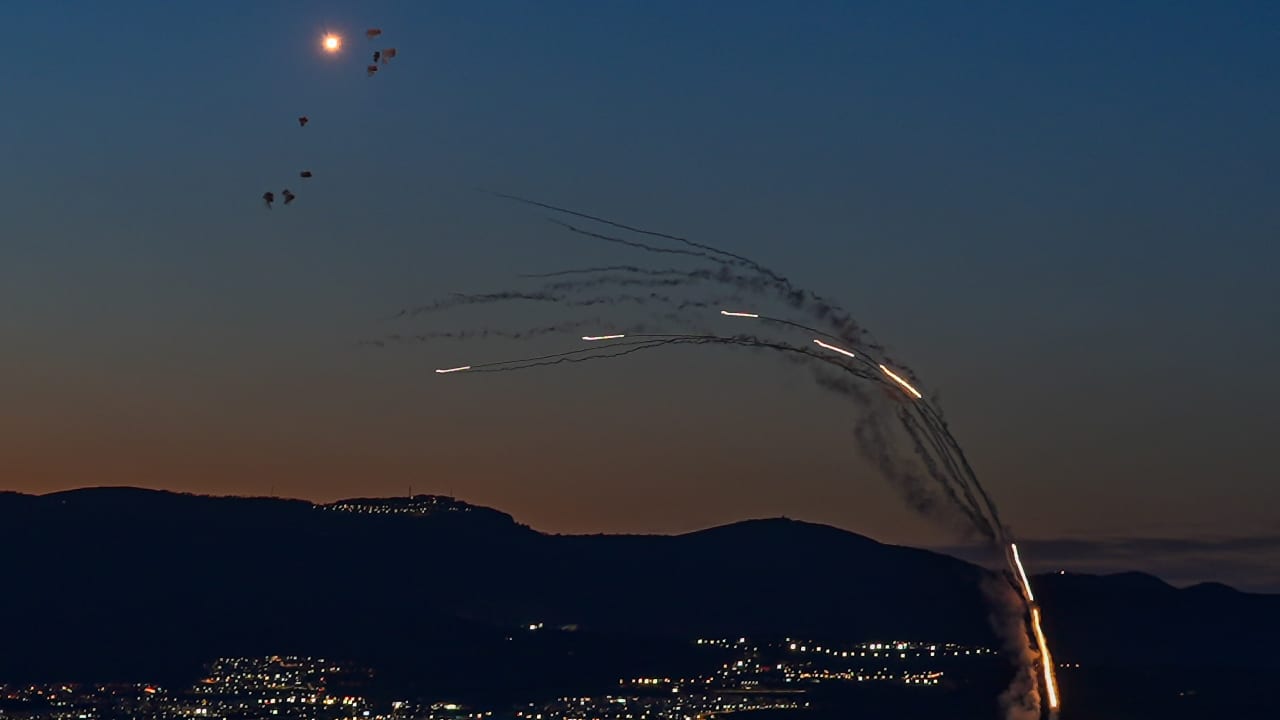
For years, support for Israel’s Iron Dome missile defense system was one of the few constants in Washington that seemed immune to the churn of politics.
Republicans backed it. Democrats backed it. Funding passed because it was obvious. Intercepting rockets aimed at civilians is not a complicated moral equation.
That clarity is now fading.
As recently as September, a bill to approve supplemental funding for Iron Dome passed the House with only 9 dissenting votes.
Today, a growing number of leading progressives have come out against continued American funding for the system.

J Street president Jeremy Ben-Ami, Reps. Alexandria Ocasio-Cortez (AOC), Ro Khanna, and Jewish Democratic congressional challenger Brad Lander all now oppose future budget earmarks for Israeli defense systems.
The Democratic Socialists of America have argued that the Iron Dome has “emboldened Israel to invade or bomb at least five different nations.” Jewish Voice for Peace has echoed the call.
'Defensive money' for 'offensive weapons'
In the race for Nancy Pelosi’s congressional seat, AOC’s former chief of staff Saikat Chakrabarti has gone further, arguing that the US should not fund Israel’s military at all because “defensive money can be used for offensive weapons.”
The shift is not only rhetorical. The 2026 National Defense Authorization Act cut US funding for Iron Dome co-development from $110 million to $60 million, redirecting the difference toward Arrow 3, the upper-tier ballistic missile interceptor.
The reallocation may reflect shifting threat assessments, but it also signals that the Iron Dome’s once-untouchable budget line is now subject to the same political gravity as everything else.
On its face, these positions are framed as policy. Critics cite budget constraints, argue that Israel can afford its own defenses, or fold the Iron Dome into a wholesale critique of US military aid.
But these arguments, taken seriously, collapse under scrutiny.
The Iron Dome is not a tool of warfighting. It does not enable offensives or expand territorial control. It does not escalate conflict. It exists for one purpose: to stop rockets midair before they strike homes, schools, and hospitals.
It is a system built around a single moral premise: that civilians should not die because they are within range of indiscriminate fire.
Rep. Ritchie Torres of New York, one of the few Democrats to push back forcefully, put it plainly: even the most committed pacifist should have no objection to the Iron Dome, because its only purpose is to prevent civilians from being killed.
To turn that premise into a subject of partisan debate is to move the conversation beyond policy and into something else entirely.
The Iron Dome has not changed. The politics around Israel have. In parts of American discourse, Israel is assessed less on what a given policy does and more on what it represents.
An ideological lens has taken hold that sorts Israel into a single category: partner or problem. Once that sorting is complete, even the most defensive measures are read with suspicion.
Protection becomes power. Interception becomes escalation. Saving lives becomes, somehow, morally ambiguous. That pattern is visible well beyond Washington.
On Tuesday, Italian Prime Minister Giorgia Meloni announced that her government has suspended the automatic renewal of its defense cooperation memorandum with Israel, citing “the current situation.”
Defense Minister Guido Crosetto sent a formal letter to his Israeli counterpart notifying him of the suspension. The memorandum, in place since 2005, had renewed automatically every five years without objection from any Italian government, Left or Right.
The danger of this shift extends beyond Israel. It sets a precedent that defense itself can be politicized to the point of inversion.
If a country’s ability to shield its civilians from attack requires justification, the boundary between offense and defense begins to collapse, driven by narratives imposed from afar rather than facts on the ground.
The Iron Dome was never controversial because it did not require agreement on every aspect of Israeli policy. It required agreement on something far more basic: that civilians should not be left defenseless against indiscriminate attack.
When that principle becomes negotiable, the argument is no longer about rockets or memorandums or funding lines. It is about whether the protection of civilian life can survive the pull of politics. If it cannot, the implications extend well beyond Israel.