
Passover has ended, and as every year, we spoke of freedom – of liberation from bondage, of a society taking responsibility for itself. Yet in Israel’s public sphere, we operate by the opposite logic: not freedom, but habitual coercion; not choice, but quiet submission to increasingly stringent theocratic norms that few seriously examine.
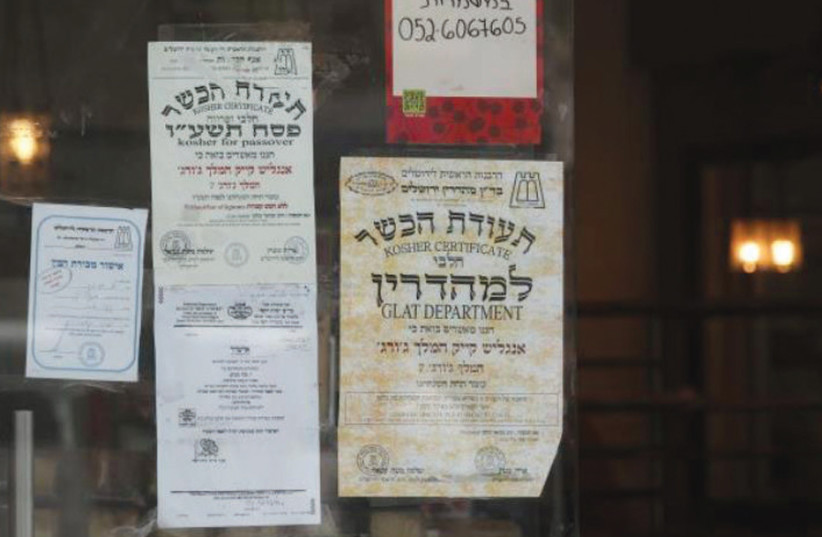
The signs are especially clear during the holiday, of course: hideous sheets covering every shelf bearing the forbidden scourge of hametz. The lenient will say, what’s the harm? It’s a Jewish state, it’s once a year, and so on. But that is not the reality. The coercion principle operates around the clock, all year long.
Religious coercion is often framed as a clash between religion and secularism, or as a legal issue. In reality, at least when it comes to kosher enforcement, there is little direct legal coercion – certainly not outside public institutions. Restaurant owners, hoteliers, and event operators are not acting because the law compels them – nor, in many cases, out of deep religious conviction. They act out of a simple market calculation: one group will punish them if they don’t comply, while the other will show up regardless.
Even the hint of a religious consumer boycott can shut entire markets. Deals collapse the moment the “non-kosher” is mentioned. Companies that claim liberal values refuse to purchase products lacking stamps from what has become, in effect, a corrupt certification cartel. Entire sectors are inaccessible to those who choose not to play along.
At the center of this system is not even the ultra-Orthodox public. With them, there is not much to discuss – they inhabit a different universe for now, and integrating them into a modern framework will be a long and complex process. The real discourse is with the moderate religious and traditional public – people who live modern, global, open lives, and who, everywhere else in the world, manage perfectly well in a non-kosher public space.
This same public that checks into a Hilton in London without expecting kosher certification or recoiling at the idea of hot coffee on Shabbat, may in Israel demand that the very same hotel chain adhere to the imagined rules of a modern Sanhedrin. Paralyzed by the fear of this inconsistent – and largely hypothetical – public, hotels shut down ovens and kettles and turn the day of rest into a time of rules and inconvenience. It is treated as a divine decree, though nothing in the Bible mentions electricity at all. Look it up.
The absurdity becomes most visible in select details of Israel’s economy. For example, non-kosher local wine – which has been a prizewinning national pride – is in danger of extinction. Wineries that refuse to comply with certification requirements are marginalized, producing small quantities and struggling to enter retail chains, restaurants, and hotels. Meanwhile, shelves runneth over with imported non-kosher wines – from France, Spain, New Zealand – sold cheaply and consumed without hesitation.
The absurd implication is that huge numbers of Israeli consumers are willing to drink non-kosher wine – so long as it isn’t produced by Jews in Israel. It is hard to imagine a clearer distortion. Instead of encouraging local production, the system pushes it out. Instead of reflecting religious choice, kosher certification has become a tool for creating artificial hierarchies: foreign products are acceptable; local ones are not.
As system built on distortion
There is no chance that most Israelis truly insist on this madness. On its preposterous margins, the cult of kashrut is a paper tiger. It is, I believe, something of a sacrilege.
Across the food sector, everything is more expensive and cumbersome than necessary, rendering it uncompetitive with imports, largely due to the labyrinth of kosher requirements. Some of these are at least grounded in religious law, but many are little more than tribute paid to the functionaries of the certification industry – a system of control and money.
How does it endure? The market assumes that one group is willing to boycott, apply pressure, and punish any deviation – and that “the religious” are monolithic in this regard –while the other group, secular and liberal, can be trampled.
And indeed, even those who do not observe kosher laws in their personal lives, who eat freely in non-kosher restaurants abroad, generally fall into line in Israel – not out of belief, but to avoid trouble. Perhaps even out of fear of being labeled unpatriotic.
Some warn that disrupting this balance will create “two peoples.” But the truth is more complex. The situation is part of a toxic mix of unwanted religious coercion that alienates large segments of the public – from the state and from religion itself.
There is no “unity” to be had in this – only a steady, one-directional drift toward religiosity. This is how coercion takes hold: through quiet surrender. And in the process, we will drive secular Israelis away and deter potential immigrants. This is how a halachic state might emerge.
If the mechanism of coercion is economic, it can be changed through economic means – not through direct confrontation with groups that cannot be persuaded, but through a simple shift in incentives. As long as restaurateurs and hoteliers fear only one kind of boycott, they will align in only one direction.
The question is what happens if it becomes clear that there is also a price to ignoring the public that does not want kosher hassles – a public that almost certainly still constitutes a majority, even if not indefinitely. This does not require revolution or extraordinary courage. The first step can be simple: transparency.
When a restaurant or hotel chooses, for example, to serve imported non-kosher wine but not Israeli non-kosher wine – that should be noted. Publicized. Questioned. When a business cancels a deal solely because of a missing certification – that should be exposed. In other words: call it out. Shaming? Perhaps. But coercion – and its costs – are shameful as well.
This is a minimal step, almost technical – but one that could begin to shift the equation.
Because the moment pressure no longer operates in only one direction, it will quickly become clear what lies behind these “norms,” and how committed each side really is. It is entirely possible that there is a significant market for hotels that simply ignore kosher rules. It is quite possible that there is a public more committed to non-kosher – and to resisting the corruption behind certification – than assumed.
Perhaps a boycott is not even necessary. Perhaps many consumers will simply prioritize hotels that operate normally on Shabbat – that are willing to pay more, sacrifice location, or certain amenities to make the point.
If enough hotels realize they can become especially popular this way, we may see movement. Like a passing cloud, a dissipating fog, a fever breaking – the public may realize that what no one demands in Rhodes need not be demanded in Israel.
When both sides bear a cost, real choice becomes possible. Those who wish to observe kosher restrictions may do so at home – and pay for the privilege and bureaucracy in places that cater to them. There is no justification for imposing it on the entire public. There is nothing patriotic, Jewish, or Israeli in that.
The writer is the former Cairo-based Middle East editor and London-based Europe/Africa editor of the Associated Press, the former chairman of the Foreign Press Association in Jerusalem, and the author of two books.