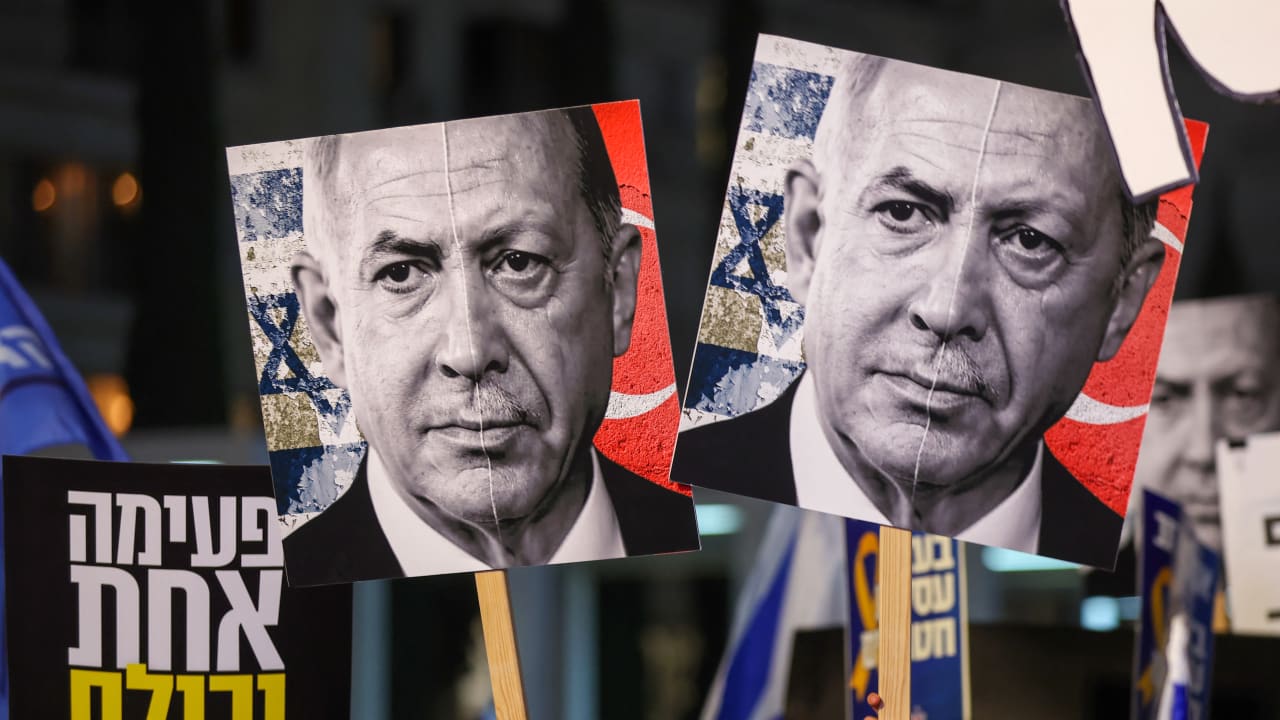
Rhetoric against Turkey and Syria continues to be a consistent theme in Israeli politics. In fact, Turkey is beginning to notice, and is increasingly reporting on Israeli comments.
Turkish media reported this week that Turkey’s Foreign Minister, Hakan Fidan, met with Khalil al-Hayya, the newly elected leader of Hamas. Israel will paint this in a negative light, given that some see Turkey as a rising threat.
First, a little history. Turkey and Israel have historic ties that date back to the era before the State of Israel was created. In 1913, Zionist leaders David Ben-Gurion and Yitzhak Ben-Zvi studied law in Istanbul. Decades later, Turkey became the first Muslim-majority country to recognize Israel after its founding.
Israel and Turkey had good relations until the rise of the AKP party in the early 2000s. Turkish leader Recep Tayyip Erdogan became increasingly critical of Israel, especially after the 2009 war in Gaza. His rhetoric was met with some attempts at reconciliation, most recently in 2021. However, the October 7 massacre and subsequent war in Gaza have soured relations, bringing them to a new low.
From Israel’s point of view, Turkey is increasingly pushing hostile narratives. Worse still, Turkey could potentially become a strategic or regional threat. This dovetails with Israeli politicians’ increasing critique of Qatar. Several years ago, Qatar was seen as helpful when dealing with Hamas in Gaza. After October 7, however, Israel shifted its perceptions of Turkey and Qatar, which has led to its constant criticisms of the two.

Syria has also been widely panned in Israel. Syria’s leadership is often called “jihadist,” and there are, on occasion, threats of war against Syria. Israel is already involved in conflicts in Lebanon and Gaza, and is fighting terrorism in the West Bank. Despite this fact, some voices in Jerusalem are still pushing for a war in Syria.
In its early days, Israel’s leadership preferred war as a last resort. Today, after more than 1,000 days of war, Israeli rhetoric generally argues for wars on more fronts. This is usually accompanied by the belief that Israel is now the strongest military in the region and, with US support, can take on more threats.
The White House, however, has appeared to push back against Israel’s role in Syria. The Trump administration doesn’t want to see more wars at the moment. In addition, the Trump administration is cordial with Turkey and Qatar, which could pose a challenge for Israeli policy-makers who predict hostilities with them.
Israel to establish Syrian bases if Turkey does
Many countries in the region have noticed the Israeli rhetoric. ANHA news, a Kurdish outlet, reported on Tuesday that “Energy and Infrastructure Minister Eli Cohen said [that] Israel would be compelled to establish military bases inside Syria if Turkey proceeds with plans to set up its own military bases on Syrian territory.”
It added, “Cohen stressed that Tel Aviv [Jerusalem] would not stand idly by in the face of any Turkish military deployment in neighboring Syria, asserting that Israel would respond in kind to safeguard its national security and protect its strategic interests in the region.”
Last week, Daily Sabah, a pro-government Turkish outlet, noted: “Diaspora Affairs Minister Amichai Chikli said on Wednesday that Israel should prepare for the possibility of a future confrontation with Turkey, arguing that direct military contact between the two countries was ‘not an impossible scenario.’”
It went on to report that, “speaking at a conference in west Jerusalem, Chikli said a direct encounter between the Israeli and Turkish militaries could occur at sea, adding that such a scenario could happen ‘even tomorrow morning.’”
In June, Middle East Eye reported: “Israel ‘will be at war with Syria sooner or later,’ says Likud minister.”
The pro-government Turkish outlet Yeni Safak noted in March that “former premier Naftali Bennett sparked controversy Wednesday with provocative statements targeting Turkey during a live Bloomberg interview. Bennett described Turkey as a ‘new strategic threat’ to Israel and hinted at possible action against Ankara, saying the choice is up to Turkey, and warning that, ‘after Iran, we won’t stay idle.’”
On Wednesday, Daily Sabah reported, “Defense Minister Israel Katz on Tuesday renewed his hostile rhetoric against Turkey, issuing a series of pointed remarks on regional security, Syria, and Iran.” It went on to note that, “during an interview with Israel’s Channel 14, Katz said Israel does not seek a military confrontation with Turkey, but argued that his country would defend itself against any threat. Referring to the Ottoman conquest of Constantinople, he said: ‘We are not the collapsing Christian empire.Jerusalem is not Constantinople, and we know how to defend ourselves.’”
Then, the report says that “the Israeli minister also argued that Turkey is seeking greater influence in Syria, and said Israel would not allow Syria to become a platform that could threaten its security.”
A separate comment from Bennett at the Conference of Presidents of Major American Jewish Organizations in February also was reported at The Media Line. The report said that he spoke about how “Turkey is the new Iran.”
Iran considered a threat to Israel, entire region
Currently, Iran is still considered an active threat. Iran retains its ballistic missiles, and despite five months of war, continues its attacks. For now, it is unclear how Israel expects to take on Turkey, a member of NATO, if Iran has not been vanquished. Even if Turkey is viewed as the “new Iran,” the fact remains that Turkey has a powerful army, air force, and navy.
Many examples of Israel’s recent statements about Turkey can be found on the social media news site Clash Report, which describes itself as a “global platform that focuses on conflict zones around the world, delivering detailed analyses and up-to-date news.” Clash Report has been critiqued for being pro-Turkey, however. This week, it highlighted Bennett’s comments on the US selling F-35 jets to Turkey.
The report claimed that Bennett said, “We cannot allow our enemies to be armed, because we won’t be able to defend ourselves against this very advanced weaponry.”
Ragip Soylu, the Turkey Bureau Chief of Middle East Eye, examined Bennett’s comments in an X/Twitter post, noting that Bennett called Turkey an “enemy.”
Clash Report recently highlighted Eli Cohen’s comments in a post: “Energy and Infrastructure Minister Eli Cohen: We will not accept Turkey’s entrenchment in Syria.” It added that Cohen noted, “if Turkey establishes bases in Syria, we will also act to establish bases within Syria itself.”
Israel’s discussions with US President Donald Trump about Turkey are also becoming more pronounced. Trump has often highlighted his positive relationship with Erdogan, and noted that Erdogan doesn’t get along with Prime Minister Benjamin Netanyahu. Trump appears to imply that he can balance the two.
Trump has also been supportive of Syria’s leader.
Recent tensions with Syria have involved Israeli civilians trying to sneak into Syria. There have also been clashes with local villagers who oppose the IDF’s presence. Israel stated that Syria cannot deploy its forces near the border, which has turned the Golan border area beyond the 1974 ceasefire lines into a no-man’s land; the area is currently contending with low-level chaos and a power vacuum.
It is hard for Syria to keep the area stable if it lacks military presence. This, in essence, becomes a self-fulfilling prophecy. Israeli officials see Syria as a threat, which leads to a power vacuum near the border. As civilians don’t want to live under IDF rule or contend with IDF raids, this creates the possibility for a new threat to emerge.
This is a major shift from the Assad regime, when Israel provided support for Syrian civilians near the border. Nowadays, the civilians only see hostility from the IDF.
Turkey’s leadership has taken note of Israeli comments. In mid-July, Fidan sought to tone down some of the rhetoric against Israel. Ankara is seemingly worried about a clash in Syria, it seems. However, Turkey’s meeting with Hayya – who now heads Hamas – will only serve to worsen its relationship with Israel.