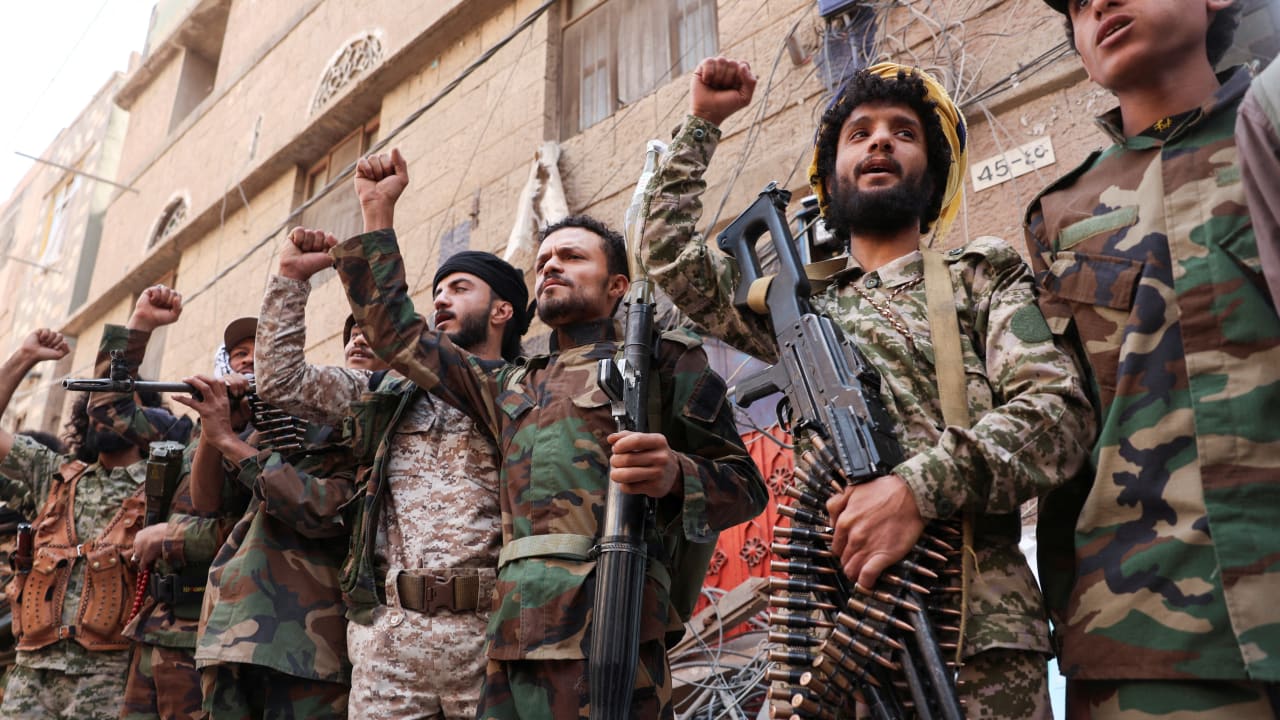
The Houthis are one of the Iranian-backed proxies in the region that remain strong. While Hezbollah and Hamas have suffered blows, the Assad regime fell, and militias in Iraq are under pressure, the Houthis remain steadfast in Yemen.
They have achieved this because they are secure in the mountains of northern Yemen. UAE-based news site Al-Ain News this week provided an exclusive look at how the Houthis turned the governorate of Ibb into an armed camp.
This area was known as Yemen’s “green paradise” in the past. It is an agricultural area in mountainous highlands with about four million people. It is located north of Taiz and south of the capital, Sanaa, making it an important area.
Al-Ain News has excellent sources in Yemen, and this article reflects the importance of its reporting on the country.
The Houthis matter because they can threaten Saudi Arabia, the Gulf states, and Israel, as well as the Red Sea.
“Since seizing control of it 11 years ago, the Houthis have transformed Yemen’s Ibb province from a tourist capital of the country known as the ‘Green Paradise’ into a fortified military barracks,” Al-Ain News reported.

The province serves as a kind of fulcrum of balance point in Yemen, 190 km. from Sanaa and 230 km. from Aden, the report said. “It is considered the largest Houthi military reconnaissance center towards the Red and Arabian Seas and towards southern Yemen and Tihama,” it added.
“The Houthi militias built an advanced defensive wall (in the form of an arc) on the borders of Ibb, starting from Al-Radhma district on the borders of Al-Bayda, Al-Dhali’ and Dhamar governorates, passing through Sabrah, Sayani and Mudhaykhirah, and up to the Al-Udayn areas on the borders of Taiz, Hodeidah and Dhamar governorates,” Al-Ain News reported, and they exploited these areas to build defenses and fortifications to support the neighboring fronts in the governorates of Al-Dhali’ and Al-Bayda’.
Houthis build over 14 military sites in area
“According to security and military sources in Al-Radhma, speaking to Al-Ain News, the Houthi militias have built more than 14 fixed and mobile sites in the district, most notably Al-Hadi Fort, Jabal Habwa, and Al-Daam and Azal Forts,” the report said.
The Houthis have a reserve force in the region that includes the “18th Samad Reserve Brigade” and “Rapid Intervention Units,” a force equipped with vehicles, medium-range missile launchers, and drone launch platforms, it said.
“In the districts of Al-Nadirah, Ba’dan and Al-Sabrah (east of Ibb), the Houthi militias have built defensive positions, taking advantage of the main roads that connect the governorate with neighboring governorates to facilitate the movement of military forces and to secure supply lines and reinforcements when necessary,” Al-Ain News reported.
There are dozens of fixed fortifications that include machine guns, rockets, and other weapons and vehicles, the report said.
“In the northwestern part of the governorate, where the three districts of Al-Udayn are located, especially the Al-Udayn branch, the Houthi militias are concentrated in about 10 main locations and overlap with the Shar’ab and Maqbanah districts of Taiz Governorate,” it said.
There are some 40 “strategic military sites for the Houthis throughout the Ibb Governorate, which has become a military base for providing logistical support and a center for launching operations on neighboring fronts,” Al-Ain News reported.
Report reveals Houthi leadership names
The report also revealed that local leadership includes a man named Abdul Wahid Salah; the head of the supervisory office, Yahya Nasser Al-Yousifi; and Amin Ali Hassan Wajih Al-Din.
This would be important if the Yemen government and its backers ever launched an offensive here.
“On the security front, other leaders in the province are present, most notably the commander of the rescue units, Ibrahim Muhammad Al-Hayas, and the commander of the military police units, Abdul Salam Habib, who are stationed at checkpoints on the main roads of the province and the districts,” the report said.
The gist of the report is to illustrate how the Houthis have turned an agricultural region into a major military strongpoint. They have prepared for the future and expect to lead part of Yemen for the long term.
Yemen was divided for many years between North and South Yemen, during the post-colonial period and the Cold War.
It is now divided between the Houthi-controlled areas and the areas controlled by Yemen’s government, which is backed by Saudi Arabia. Saudi Arabia and the UAE almost clashed in December over the UAE’s support for an Aden-based Southern Transitional Council in Yemen.
It still is not clear whether the Saudis, the UAE, and others will be able to confront the Houthis in the future. Most countries are now wary of war.
Furthermore, Riyadh appears concerned about Israel’s recognition of Somaliland, which could change the balance of power in the Red Sea area and the Horn of Africa region.