
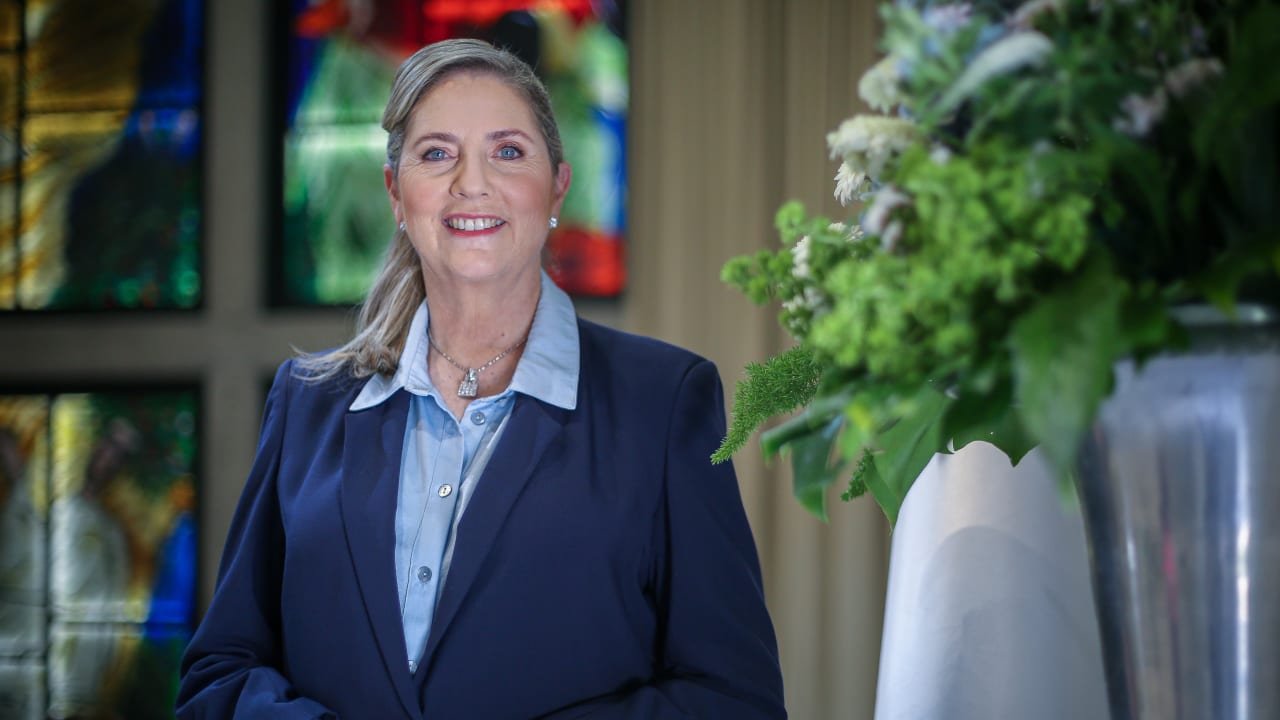

Israel’s First Lady, Michal Herzog, has a direct yet eloquent way of speaking that makes you want to sit up and listen.
That is fortunate because since October 7, as she has accompanied her husband, President Isaac Herzog, on state visits and to diplomatic events around the world, she has used her platform as Israel’s first lady to highlight Hamas’s systematic use of sexual violence and rape as weapons of war.
She has also spoken out fiercely in every forum she has attended against those who still deny that such brutal acts took place on October 7 and were endured for up to two years by those who were taken hostage on that dark day.
“For over two years, I refrained from saying it’s antisemitism,” Herzog, a trained lawyer, told The Jerusalem Report, referring to the denial and the deafening silence of many world leaders, women’s rights groups, and so-called activists on this particular topic.
“I didn’t want to say it was antisemitism because I thought that women in positions such as head of the UN Women organization or others would rise above that because their main purpose in life is protecting women’s rights,” Herzog explained during a recent interview in her Jerusalem office.
“Now, when I look back, I can no longer deny the fact that it’s partly antisemitism and partly, of course, it’s a mixture [of] anti-Zionism and anti-Israel,” she said.
Screams before silence
In the months after the October 7 attack, as bodies were being identified and prepared for burial, evidence began to amass that Hamas terrorists and other militants from Gaza who had infiltrated southern Israel had carried out violent sexual attacks, including rape, in civilian communities, on army bases, and particularly at the site of the Supernova music festival, where more than 300 people were murdered.

However, unlike in other conflicts around the world in which women have been barbarically attacked and become the focus of campaigns by women’s rights groups, in Israel’s case much of the world stayed silent, and some people even dismissed what had so clearly happened.
This was particularly stark coming from organizations and high-profile individuals who had championed causes such as the MeToo movement, calling out rape and sexual assault by powerful men, and the #BringBackOurGirls campaign, which drew attention to the kidnapping of some 276 Nigerian schoolgirls by the Islamist militia Boko Haram.
“I remembered the immediate reaction after the Boko Haram kidnappings… The reaction of the world and of all sorts of celebrities was immediate, they were all holding up those signs calling to bring the girls home,” recalled Herzog, describing how in the lead-up to the International Day for the Elimination of Violence against Women in November 2023 – just over a month after October 7 – she decided to start taking action.
“The timing of that International Day in November made me really go into this because it was so shameful that all these righteous organizations just ignored the fate of Israeli women,” she said.
From there, Herzog refused to stop. She spoke out – at the World Economic Forum in Davos, at the Munich Security Conference, in closed-door meetings with world leaders, in op-eds she penned for Newsweek, and in interviews with top news outlets such as Fox News and CNN.
Painful realization
While Herzog said that she and the president were proactive in their outreach to the Israeli people immediately after the horrific attack – visiting hospitals and assisting communities that had been evacuated – it was a tour of an army base that drew her attention to the sexual violence that had been perpetrated by Hamas.
In the operations room, she met female soldiers who showed her tangible evidence of the assaults and that sexual violence had been used as a clear and strategic weapon in the mass attack.
“I think that was the first time I really understood,” said Herzog. “They told me about victims of sexual assault who had not spoken out publicly… It was such a painful realization.
“I think people didn’t yet understand how vast and systematic the sexual violence was,” she continued, adding, “In hindsight, it’s difficult to understand, but we need to remember that in the first days there was total chaos.”
Herzog pointed out that due to the overwhelming size and scale of Hamas’s attack, most of the country was focused on making sense of the massive number of casualties from that day. Less attention was paid to the sexual war crimes that had been perpetrated.
Those tasked with the horrific job of collecting hundreds of dead bodies or examining battlefield failures did not think to gather forensic evidence of sexual violence. Many of the victims had either been murdered or kidnapped. Those who miraculously survived were too traumatized to speak up.
Today, more than two years later, that is changing. Over the past few months, hostages who have returned home from Gaza – including many of the men – have begun detailing their experiences of sexual violence.
Released female hostages Romi Gonen and Arbel Yehoud, both freed a year ago, recently spoke up in Israeli media interviews about what they endured in captivity, as have male hostages Keith Seigel and Guy Gilboa-Dalal.

Gonen described being raped by four different men during her first few weeks in captivity in Gaza. Yehoud said she endured sexual assault every day of the 482 days she was held. Seigel and his wife, Aviva, who was released during the first ceasefire in December 2023, both witnessed assaults against young women. Gilboa-Dalal has spoken about sexual advances made by his captors.
Their voices, said Herzog, are just the beginning. She believes they will pave the way for others to come forward and speak out about what they went through.
“I think we’re about to see more evidence,” she said. “Though truthfully, I don’t know if it will change the minds of those who are set in their way of thinking and deny it in the first place.”
Herzog noted recent comments made by the United Nations Special Rapporteur on violence against women and girls, Reem Alsalem, who posted on social media that “No Palestinian cheered for rape in Gaza. No independent investigation has found that rape occurred on October 7.”
Both Alsalem and Sima Sami Bahous, the head of UN Women, which focuses on gender equality and the empowerment of women, are from Jordan, which Herzog believes might have had an affect on their approach to this topic.
Alsalem responded to the Report, rejecting such assertions and highlighting a statement she made following her controversial post on X, where she laid out why she feels there is still not enough evidence to definitively say that rape occurred on October 7. UN Women told the Report in a statement that it has “not been silent. From the onset of the conflict, UN Women has unequivocally condemned all forms of violence against women and girls, which is a grave violation of human rights.” Neither addressed Hamas’s actions directly.
Herzog said that those in the international sphere who have been brave enough to investigate the issue and say outright that Hamas perpetrated such acts, such as Pramila Patten, the Special Representative of the United Nations Secretary-General on Sexual Violence in Conflict, have faced criticism and threats.
In March 2024, five months after October 7, Patten’s office released a report recognizing that Hamas terrorists carried out extreme acts of violence, including gang rape, in at least three locations in southern Israel. The report also highlighted that in some of the incidents, victims were subjected to rape and then killed; in others, Hamas terrorists raped women after they were killed.
In her notes, Patten wrote that she “found clear and convincing information that sexual violence, including rape, sexualized torture, cruel, inhuman and degrading treatment, has been committed against hostages.”
“I am glad that there are people like Patten, who do have the courage to speak out – but they suffer and are threatened because they dare come out with the truth,” Herzog said.
Beyond antisemitism, the first lady said she believes that the denials stem from several other factors, ranging from disbelief that sexual violence can take place in a conflict that had previously been perceived as free from such horrors, to perceptions about Islam as a religion.
Herzog said she had always believed that sexual violence was not used as a weapon in the Israeli-Palestinian conflict, but a recent study published by the University of Haifa found that it had always been there – just less strategic and less visible.

“It turns out it was always part of the conflict, [but] of course, not in the way it was on October 7,” she said. “In the past, it was sporadic, but [what happened on October 7] was premeditated and systematic, and the sheer number of cases, and the same images, the same injuries in different places around the Gaza envelope, it was a systematic tool of war.”
The denial also stems from the belief that such acts are not part of Islam but were used by a group that claims to be driven by religious ideology.
“People say, ‘This is not Islam,’ yet Islam was used as an excuse to attack the Jews, the Zionists, and the Israelis,” Herzog noted. “Other Muslim countries do not like talking about it, but that is why we have to keep this issue on the world stage; we have to continue talking about it – not to mention the fact, as I always say, that this should be a universal message.”
Herzog warned that while sexual violence was not previously a central point in the Israeli-Palestinian conflict, October 7 marked an escalation and that it will have an impact on other conflicts worldwide.
“We cry out for the Israeli women who do not have a voice anymore, but we cry out for women, period,” she said.
“I am not an expert on this, but I have consulted experts in the field, and all of them told me that it escalates from one conflict to the next,” Herzog explained. “They saw a huge escalation on October 7, and they said that the next conflict will be even worse.”
Antisemitism Down Under
The first lady and the president returned recently from a whirlwind trip to Australia aimed at showing solidarity with the Jewish community after the deadly attack at Bondi Beach that left 15 people dead.
She said the couple received a warm welcome not only from the Jewish community but also from the broader Australian public, who Herzog said were still reeling from what she described as the “largest-ever terrorist attack in Australia’s history.”
Alongside the embrace, however, there were also mass protests against the president and against Israel.
“The demonstrations did not surprise us as much as they saddened us,” she said. “It’s not that we were not expecting demonstrations, but it was the vile language, the extremism, the ignorance, the sheer ignorance on the part of the demonstrators that was very saddening.”

Despite the hate, Herzog told the Report that it was important for her – and the president – to visit the Jewish community on the other side of the world.
“We found a very hurt community, and we felt that our mere presence and the visit and the energy around it made people stand up and be proud,” she said. “They are a very proud community, and they showed us their pride in their Jewish life, in their values, and in their love of Israel.”
Herzog’s message about unity among Jews worldwide extends to women as well. In a closing message ahead of International Women’s Day, Herzog, who will be the keynote speaker at The Jerusalem Post’s Women Leaders Summit on March 24, told the Report:
“It is very clear that October 7 demonstrated the strength, the courage, the capabilities of women, who proved that they could do anything,” she said, adding that she would love to see Jewish women working together and supporting one another.
“I think this is one of our strengths, and we have to do it more,” she concluded.■