
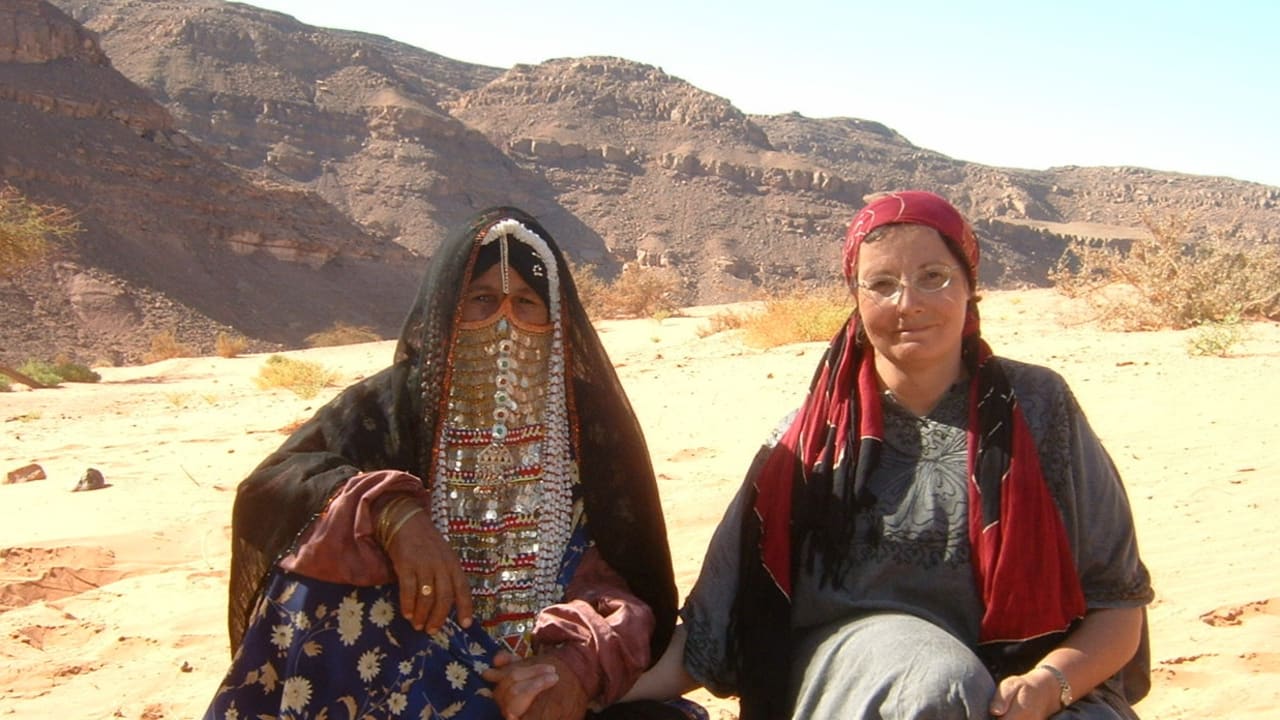

Silence heightens before light departs from the desert at night. Heat drains quickly from the ground, leaving behind a cold that settles into the bones. The sky presses close, dense with stars, unbroken by buildings, borders, or edges. There is no shelter to speak of – only rock, sand, and silence.
It is precisely this landscape that frames the Exodus story: the biblical account of the Israelites’ escape from slavery in Egypt and their long journey through the Sinai desert toward the Promised Land, defined not by conquest or triumph but by movement through scarcity.
The wilderness
In the Book of Numbers, the route is reduced to a stark itinerary: forty-two encampments listed without explanation, each one marking where the Israelites stopped, rested, or waited in the wilderness. A litany of names remembered at the Passover table, rarely imagined as places that still exist on the map.
And yet most of them do.
At 58, Margaret Malka Rawicz, exhausted by her role as assistant manager on a high-stakes project to develop a new national pollution control policy for the South African government, decided to find out what those names meant on the ground.
An observant South African Jewess with decades of experience navigating remote landscapes across Africa as an environmental consultant, she set out armed with maps, Hebrew text, and a Bedouin contact. She was not there to preach nor prove, but to test Numbers 33 against heat, distance, water, and rock.
Each night, as she lay awake on the desert floor, she held the name of the next place in her mind – a location fixed on a list she knew by heart. It was in moments like these, Rawicz told The Jerusalem Report, that the Exodus stopped feeling like a story and began to feel like a human undertaking.

“I wasn’t trying to prove anything,” she said. “I wondered where, in geographical and environmental terms, the biblical Exodus actually unfolded… and when I went looking for a journey that followed the path of Moses, I realized there wasn’t one.”
So, she created her own.
“The desert looked alluring,” she explained. “I needed perspective.”
What she took with her was not equipment so much as method. The biblical text itself; historical and modern maps in Hebrew, Arabic, and English; and a small, almost unremarkable sketch in The Living Torah – the English translation and commentary on the five books of Moses by Rabbi Aryeh Kaplan, who studies the Exodus not only as sacred text but as a journey embedded in real terrain. This included a faint outline of a proposed Exodus route, barely visible contour markings that Rawicz painstakingly correlated with satellite imagery and terrain.
Rawicz approached the biblical itinerary as a hypothesis. “I treated terrain, water availability, vegetation, and climate as interpretive partners in reading the text,” she explained. “This wasn’t about proving miracles. It was about asking whether the story corresponds to the land.”
Body and land
On foot, abstraction evaporates quickly. Distances that appear modest on a map become punishing under heat and rock. Progress slows to the rhythm of the body. Water is not a footnote; it governs movement, rest, and survival. Encampments make sense – or don’t – depending on whether there is shade, a spring, an aquifer, or a wadi that might hold runoff after rain.
“What changed most was the sense of scale, effort, and reality,” Rawicz said. “This was not a people moving through mythic space. They were moving through a landscape others used before them and would use after.”
Again and again, she found that the route named in the text aligned with real constraints. Most encampments sat near water sources and lay along ancient trade routes across the Sinai, Negev, and Jordan. Some places associated with complaint, fear, or craving in the biblical narrative revealed themselves as ecologically harsh or exposed. Others, like Elim – described as having wells and palm trees – still carried that profile thousands of years later.

Not everything could be confirmed. And that, she insisted, was never the point.
“There were moments when I could only say, ‘This may be the place,’ not ‘This is the place,’” she said. “That ambiguity never felt destabilizing. It felt honest.”
What unsettled her instead was the modern insistence that ancient stories must resolve into certainty; they are either accepted as irrefutable proof or dismissed as a myth. Walking the route clarified something else: The Exodus was never meant to function as a set of coordinates. It is a story of movement, dependence, and transformation – and those resist exact measurement.
The desert itself teaches that lesson quickly.
Unseen labor
“There is nowhere to hide – from the elements, from exhaustion, from vulnerability,” Rawicz said.
Strength does not look heroic on the ground. It looks repetitive. It looks like endurance. It looks like people managing thirst, children, fatigue, and uncertainty day after day.
And this is where walking the route as a woman sharpened her understanding.
“If survival is the question, then women are not marginal to the Exodus,” Rawicz pointed out. “They are its biological and ecological engine.”
The biblical text rarely names them. Yet no group could have crossed Sinai-type environments without women rationing water, preparing food, and keeping children alive under relentless conditions. Liberation is not sustained by spectacle, she argued, but by continuity – by the uncelebrated labor that keeps people alive when systems collapse.
Rawicz moved through remote desert terrain without a formal expedition, traveling by jeep, on foot, and sometimes by camel or donkey, accompanied by a local Bedouin. Traveling this way placed her inside a living culture shaped by the same environmental constraints – where hospitality required no ceremony, and knowledge of plants, water, and routes was transmitted as lived inheritance.
A Bedouin woman at one place took her out to tend sheep, showing her how to collect berries and brew tea from desert plants. “I felt transported back thousands of years,” she recalled. “As if I were using the same resources the Israelites might have used.”
Being framed as a woman on a pilgrimage – “a hajj for Moses,” as one Bedouin man described it – allowed Rawicz to move forward with acceptance. The journey, she said, became less about re-enactment and more about empathy.
Sometimes the emotional weight caught her off guard. At Hazeroth, one of the encampments named in the wilderness itinerary, the biblical text records that Miriam and Aaron spoke against Moses’ leadership, and Miriam was struck with leprosy before being healed and rejoining the camp. Standing there, Rawicz felt an unexpected sense of recognition, “as though the place itself carried memory of her ancient ancestors.” On Mount Nebo, where Moses is said to have looked towards a land he would not enter, the landscape demanded stillness.
Faith, for Rawicz, arrived as a necessity.
“In the desert, dependence is constant,” she said. “Faith stops being an idea. It becomes daily.”
Her work did not end when the journey did. It became the foundation for her book Walking the Exodus: My Journey in the Footsteps of Moses and, eventually, led to doctoral research into a new method for interpreting biblical text. Her conclusions are careful, provisional, and disciplined. The evidence supports plausibility, not proof. Geography aligns. Logistics make sense. Scale, however, remains unresolved.
Rawicz is comfortable living with that tension, saying: “What can be responsibly claimed is that the story is too grounded in environmental reality to be dismissed as pure invention.”■