


She is no ordinary spokesperson, simply delivering official statements or reading conventional messages from a script. Lt-Col. Ella Waweya, who is better known by her nickname “Captain Ella,” truly understands the power of the new world of social media, using it skillfully to reach as many people as possible across the Middle East.
Now, after years of being second in command to long-serving Arabic-language spokesman Col. Avichai Adraee, Waweya was appointed the IDF’s spokesperson for the Arab world in his place. Promoted to the rank of lieutenant colonel, she is now the highest-ranking Muslim officer in the army.
Anyone who follows Waweya online can’t help but notice her ability to connect with ease through the camera. At 36, the Arab Muslim officer steps into the role as the face of the Israeli military to Arab communities in Israel and the
region, after Adraee, who held the role for nearly two decades, announced his retirement late last year.
In the field
Like Adraee, who amassed millions of followers, fans, and haters across the Arab world, Waweya doesn’t confine herself to the comfort of the office or convey her messages from behind a desk. She goes out into the field, escorted by a group of soldiers. In the past month alone, she visited Tulkarm and Jenin in the West Bank two times, speaking directly with Palestinian residents.
“Before the operation, this place wasn’t just a residential area for people to live in,” stated Waweya in a video from Jenin, following recent clashes between the IDF and Palestinians. “Terrorist organizations have taken advantage of the civilian infrastructure, turning houses into terror sites and putting residents at risk.”
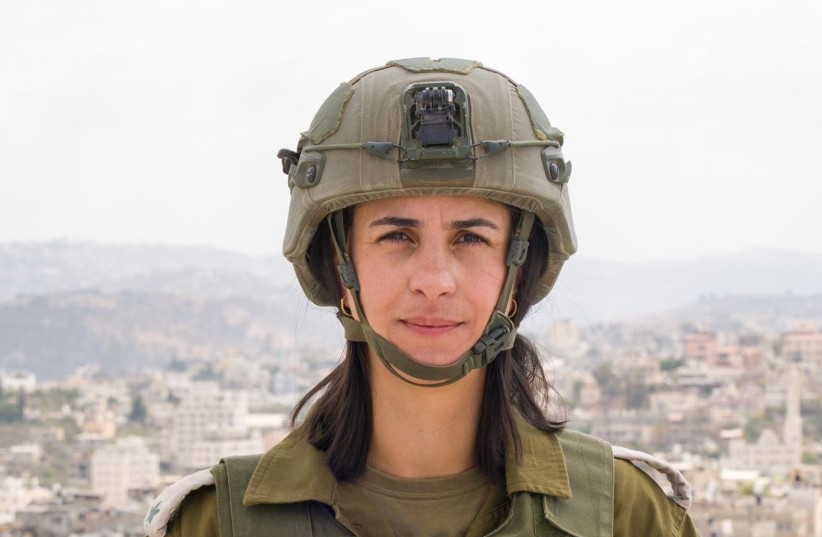
“The military keeps operating in Jenin to prevent terror from re-emerging,” she explained on camera.
In another video from the heart of Tulkarm, she addressed the city’s residents, urging them not to allow terrorists to find refuge among the civilian population.
“Lately, I’ve been communicating with you through social media platforms and also speaking with you in the markets and streets of Tulkarm,” she said, clad in a protective vest and helmet. “You told me: ‘We just want to make a living. We want to live without problems.’”
“Tulkarm residents are not asking for the impossible,” she later added.
“They are seeking basic rights: security, earning a living, and dignity. But there are those who are trying to take away that wish from you, dragging your youth onto the path of violence, and turning the streets of the city into bases of terror,” she explained.
“In the end, you and your children are the ones paying the price,” she warned. “Don’t allow terror to steal your lives or let anyone hide among you.”
Appearing in another clip, Waweya appealed to Palestinian mothers, calling on them to hold their children close so they will not be drawn into terrorist groups or influenced by them.
“Keep your kids away from terror and also from bad friends who can lead them to disaster,” she stated.
An exceptional step
Hailing from the Arab city of Qalanswa in central Israel, Waweya will be the first Muslim to serve as the Arabic-language spokesperson in the Israeli army. She grew up in a conservative Muslim community, where military service is highly unusual and goes far beyond accepted norms.
Her decision to enlist in the IDF 13 years ago, when she was 24, was in itself an exceptional step within her community, where people are not required to serve in the army like Israel’s Jewish and Druze populations. Building a military career in the IDF – and becoming the first Muslim woman officer to attain the rank of major in 2021 – was even more exceptional.
That year, she was appointed to become Adraee’s deputy on the Arabic-language desk of the IDF Spokesperson’s Unit. Taking on a high-profile role by publicly representing the IDF added another layer of uniqueness.
Also unusual among Israel’s Arab population is the fact that Waweya openly declares herself a proud Israeli. In one widely circulated video, the senior IDF officer pointed to the Israeli flag on her uniform and said: “I’m Captain Ella. I am Israeli in my heart and soul, and the army is my support and path to success. I am proud of the homeland – Israel.”

This clarity, and the choices she has made, truly set her apart. Many Israelis value her courage and praise her determination, though for some, her story is still a puzzle and somewhat difficult to grasp.
Her appointment as the IDF Arabic-language spokesperson sparked mixed reactions among members of Israel’s Arab community and beyond. Many were perplexed, asking whether she was really a Muslim. Others condemned her, calling her “a traitor.”
“Islam renounces you, shame,” read one online post. “They use you to whitewash the ugly face of their actions,” said another, with others accusing her of “serving the Zionists.”
Powerful woman
Despite the criticism and offensive comments, there were also some posts congratulating her and wishing her well in the new role.
“God bless you, we are proud of your achievement,” read one comment on Facebook. Another said: “I don’t know why, but you found a place in my heart. May God bless you.”
A woman identified as Safa Shama from Morocco cited women’s challenges and their ability to reach the top of the ladder. “Bravo! This represents the capabilities of a brave Arab woman, a powerful person with strong will and wisdom, representing success,” she wrote warmly.
However, a public figure told The Jerusalem Report that many in the Arab community reacted with sarcasm at best, and denunciation at worst.
“As long as the Israeli-Palestinian conflict is not resolved, it will be hard to accept recruiting from Arab society to the Israeli army,” he said, asking to remain anonymous in order to speak more freely.
“Neither the state nor the residents want Arab Muslims to join the IDF. Israel, for its part, doesn’t see Arab citizens as equals, and Arabs cannot serve in the Israeli army that fights their Palestinian brothers,” he noted.
Sensitive issue
Military service in the IDF is not mandatory for Arab Israelis. The vast majority of Muslim citizens in Israel, with the exception of those from the Bedouin community, do not enlist. Historically, both the State of Israel and the Arab
Muslim sector have shown little interest in this. Despite a slight recent increase, enlisting remains uncommon.
The issue has long been highly sensitive, as many Muslim Arabs identify as ethnically Palestinian and have relatives in the West Bank or even Gaza, along with national and emotional ties to the Palestinian cause. For them, the idea of a woman from the community joining the Israeli army is difficult, if not impossible, to comprehend.
The Arab sector in Israel, the public figure explained, is stuck between the state on one side and the Palestinian people on the other.
In addition to her daily responsibilities – exposing, for example, Hamas’s manipulations and how it uses emergency vehicles to transport weapons from a hospital to a school in northern Gaza – Waweya also puts effort into encouraging Arab-Israeli youth to join the army.
“It is a gateway to becoming part of Israeli society,” she has stressed in online videos.
Waweya is already a familiar name and face in the Arab world, but now, as she succeeds Adraee and is promoted to the rank of lieutenant colonel, she will command the spotlight, delivering Israel’s narrative to millions of people at a time of intense unrest across the region.
Observers say that as a native Arabic speaker with an understanding of Arab culture, she may have an added advantage in connecting with skeptical audiences.
While the political environment in light of the war in Gaza is highly tense and hostile – and almost nothing seems to soften negative perceptions of Israel – her engaging attitude and authenticity do appear to make communication a bit smoother.■