

For more than two years, my colleagues and I have lived inside the darkest evidence imaginable.
We watched. We listened. We documented. We cross-checked, again and again, with painstaking care.
The report we are releasing for International Women’s Day on March 8, documenting the sexual and gender-based atrocities committed by Hamas on October 7 and during the captivity that followed, is not merely a legal document. It is a moral intervention. It exists because we feel obligated to witness what very few are willing to witness. Silence is never neutral, and the denial, which is a form of violence, persists.
Bearing witness is not a metaphor. It demands endurance, persistence, restraint, and an unwavering commitment to truth, even when the truth resists comprehension.
Verified record
For the first time, we’ve been able to consolidate the evidence of sexual and gender-based crimes from October 7 into a single, systematically verified record. It draws on original testimonies, photographs, videos, official documents, and perpetrator-generated footage, all preserved within the Civil Commission’s October 7 War Crimes Archive, established immediately after the attack, while events were still unfolding and before crucial evidence could vanish.
That urgency was not abstract. We understood from the outset that time would work against the victims; memories would fragment, digital traces would disappear, and greater denial would emerge with unsettling speed. Indeed, even as documentation began, attempts were already underway to distort, minimize, or dismiss the sexual violence of October 7 altogether.
The archive, and the report it enabled, stands as a historical and legal record, an act of preservation and an assertion of memory in the face of anticipated erasure.
Darkness to documentation
The Civil Commission conducted more than 430 formal and informal interviews; testimonies; and meetings with survivors, witnesses, returned hostages, experts, family members, and first responders. Hundreds of hours were spent collecting, reviewing, and verifying material that no human being should ever have to witness.
Our task was not only to document these cases, each bearing its own unbearable gravity, but to discern what the cumulative evidence reveals. Through systematic analysis, we have been able to identify at least 13 recurring patterns of sexual and gender-based abuse.
Practices that are repeated again and again. These patterns demonstrate that the violence was not incidental or chaotic but widespread, coordinated, and deployed to terrorize, humiliate, and destroy.
Women, men, children, family members, and hostages were all targeted.
Many of the voices brought in this report can no longer speak. Others live with the weight of memory and trauma each day. To bear witness is to hold those voices with care and without compromise.
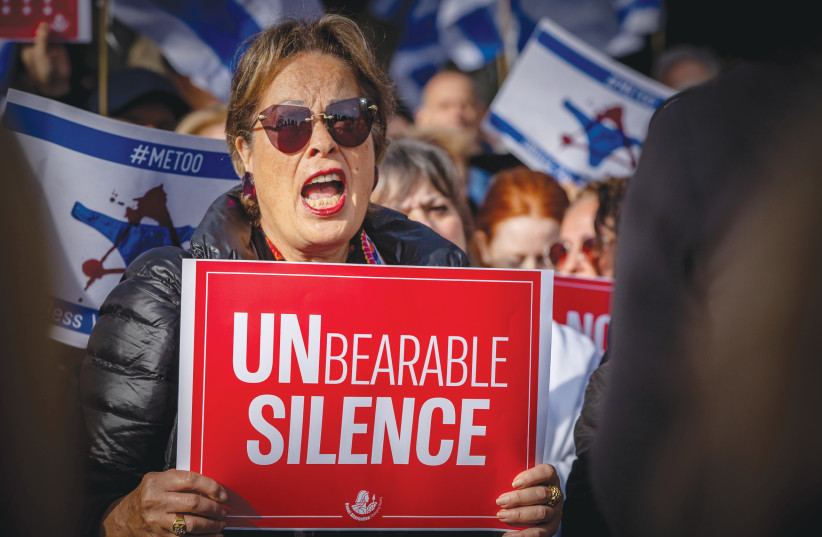
There is also an undeniable personal cost to this work. When we completed the report, the moment carried both relief and grief; the release of over two years of relentless exposure alongside the quiet recognition that the work had changed us.
We labored as jurists, researchers, and human rights experts, but also as members of the very community whose trauma we were documenting. We undertook this work not despite that proximity but because of it. I assume it will take years to reflect on what we did, but I have no doubt it has a significant contribution – for us as a nation and for many of our sisters and brothers who similarly experienced these atrocities.
For Jewish communities, the act of bearing witness has long been inseparable from our existence. Memory is not solely retrospective; it is, in many ways, protective. Healing begins with recognition.
For this reason, the report was constructed to meet the highest evidentiary thresholds required for domestic and international proceedings. Evidence has been meticulously curated, indexed, and preserved to support future prosecutions.
Extreme cruelty
Our conclusion is unequivocal: The sexual and gender-based violence was integral to the attack, and it was marked by extreme cruelty and profound human suffering.
And so the authorities must act without delay to establish adequately resourced investigative and prosecutorial mechanisms, equipped with specialized expertise in sexual and gender-based crimes and grounded in survivor-centered, trauma-informed practice.
Nevertheless, the significance of this work extends beyond the law. It concerns the restoration of trust, dignity, and collective resilience after mass trauma. No community can heal while its suffering remains contested. Resilience is not the product of forgetting but of insisting that what occurred is named, recorded, and acknowledged.
Bearing witness is how we tell survivors: “You were not invisible. You were not alone. What was done to you matters.”
Struggle for truth
October 7 generated not only extreme violence but also an epistemic struggle over truth and memory. It revealed how readily sexual violence can be minimized when it unsettles prevailing narratives, and how denial can evolve from crude dismissal into something far more sophisticated.
In this sense, the challenge was never solely evidentiary. Documentation became an assertion that truth cannot be contingent on political convenience, and that the suffering of victims cannot be acknowledged only when it aligns with prevailing narratives.
Ultimately, the truth does not belong to anyone. It must be upheld through the disciplined labor of documentation, verification, and careful judgment. When violence is followed by denial, the work of record-keeping becomes part of the defense of human dignity.
The obligation now is to ensure that the record endures, that accountability follows, and that the voices preserved within it are neither forgotten nor denied. For the survivors, for those who did not survive, and for the integrity of any society committed to human dignity, the record must stand.
Bearing witness is an act of resistance. It is also an act of rebuilding – of restoring legal and moral standards where they were violently broken. The record now stands. It must be upheld wherever the protection of human dignity is taken seriously.■
Cochav Elkayam Levy is an expert in international law and human rights and recipient of the 2024 Israel Prize (Israel’s highest civilian honor). She is the founder and chair of the Civil Commission on October 7 Crimes by Hamas against Women and Children and teaches at Reichman University.