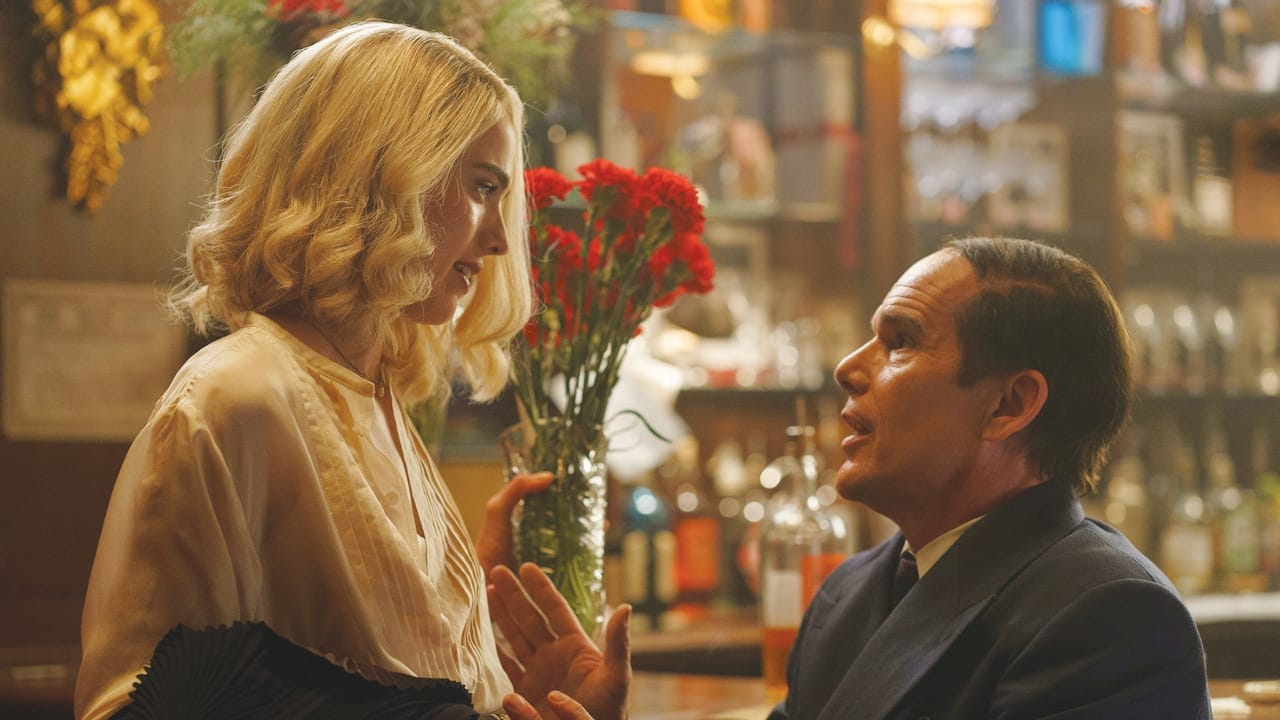
Two movies about major Jewish cultural figures are now available in Israel: Blue Moon, about lyricist Lorenz Hart on Apple TV+, and Mel Brooks: The 99-Year-Old Man on HBO Max.
These movies present a great contrast, both in their subjects and their styles. Blue Moon, directed by Richard Linklater, is a drama about one night in the life of the neurotic, alcoholic Hart (Ethan Hawke), an incredibly gifted songwriter who was nevertheless filled with self-loathing.
The movie played at film festivals in Israel but never had a theatrical release here, for some odd reason. “Blue Moon” was Hart’s greatest hit, and among the other classics he wrote, mostly with composer Richard Rodgers, were “Manhattan” (with the unforgettable line, “We’ll have Manhattan, the Bronx and Staten Island, too”), “My Funny Valentine” (a gem which includes the touching words, “Your looks are laughable/Unphotographable/Yet you’re my favorite work of art/…But don’t change a hair for me/Not if you care for me”), and “The Lady is a Tramp” (“She gets too hungry for dinner at eight/She likes the theater and never comes late/She never bothers with people she’d hate/That’s why the lady is a tramp”), among many others. His lyrics were clever, funny, and often self-deprecating. So, it’s to be applauded that Linklater managed to make a movie about Hart, who died at age 48 in 1943, and there is much to enjoy in the film, although it’s far from flawless.
It’s set on the night of the opening of the musical, Oklahoma!, which Rodgers wrote not with Hart but with Oscar Hammerstein, who wrote lyrics that were not as smart as Hart’s but more crowd-pleasing. Most of it takes place in the bar at Sardi’s, a legendary restaurant where the cast and creators of Broadway shows traditionally went to await and read the reviews of their play just after it opened. Hart banters with the bartender (Bobby Cannavale) and with another patron, writer E.B. White (Patrick Kennedy). He is sometimes witty and insightful, while at other moments, he’s bitchy and needy, and much of what he talks about is his obsession with Elizabeth (Margaret Qualley), a co-ed with whom he has fallen head over heels in love, despite his apparently being gay up till then. That she doesn’t reciprocate his passion is a given, although she does like him, and when she shows up and titillates him by confessing to fiascoes in her love life, the writing is some of the strongest in the movie. It’s also painful to see him suffer because of her rejection.
Hawke has received an Oscar nomination for his performance, and he does his best, but he’s essentially miscast in a way that’s distracting. Hawke, a tall, WASPy actor, was transformed by makeup and camera angles (to make him look shorter) into the diminutive, balding Hart, but I could never forget who the actor really is. I don’t care at all about the religion of an actor, but they should be suited to their roles, and Hawke is an inappropriate choice for Hart. When he tosses off lines that refer to this Jewish identity like, “Mazel Tov, as they say in Maine,” it points to the disconnect between who he is and who he’s playing. Andrew Scott, who portrays another Jewish musician, Richard Rodgers, is similarly wrong for the part. Scott is a brilliant actor, but his chiseled good looks just don’t make sense here.
My other reservation about the movie is that there is so little music in it. A pianist at the bar plays a few of Hart’s songs, but we only get to hear parts of them. Still, there are good lines throughout the movie, such as the moment when Hart meets aspiring director George Roy Hill, who went on to make the movies Butch Cassidy and the Sundance Kid and The Sting, and gives him some advice: “Be careful of love stories. Think about friendship stories. That’s where the really enduring stuff lives.” Ultimately, Hart is able to accept the compliment when his rival, Oscar Hammerstein, tells him, “You made American songs finally sound like American speech.”

Mel Brooks: The 99-Year-Old Man
Mel Brooks is from a similar background to Hart and is similarly talented, but he is the polar opposite of Hart in so many ways: He’s brimming with self-esteem, good cheer, and endurance. At nearly 100, he is sharp as a tack and as entertaining as ever. Mel Brooks: The 99-Year-Old Man was directed by Judd Apatow (who made such comedies as The 40-Year-Old Virgin) and its two episodes run almost four hours altogether, but I wish it were longer.
Brooks tells Apatow he doesn’t care so much about sharing his story and his legacy, but he does care about “little, short, funny-looking Jews who are trepidatious about entering show business… If I can do it, you can do it.”
The first episode is the most interesting in some ways because while you may know about Brooks’s comedy classics, such as Blazing Saddles and Young Frankenstein, you probably know much less about his early life. His father died young, and his loving mother managed to raise four boys on her own. “I always felt adored. And I think that, given a lot of love as a child, it was the need to continue it. I never really did feel inferior, though I had every right to, looking at myself in the mirror. But I never did,” he says.
Brooks recalls his big break at 14, making an audience in the Catskills laugh after he dropped a prop by mistake, and felt, “That’s it. You were meant, not for the garment center [where many people from his neighborhood worked], but to make people laugh. Go forth from this place, Melvin, and make people happy, make them laugh, and you’ll get a lot more money than the garment center.”
One of the highlights of the series is seeing Rob Reiner, the great director who was recently murdered, reminisce about the longtime partnership and friendship between his father, Carl Reiner, and Brooks. The two men were famous for a routine they did, “The 2,000-Year-Old Man,” in which Brooks played that man and Carl Reiner interviewed him. Rob Reiner recalls how his father “would push Mel into a corner and that would make Mel explode with creativity and humor,” in their “2,000-Year-Old Man” performances, which were largely improvised. But it’s sad to see Rob Reiner, who seemed to be well on his way to become a long-lived Jewish funnyman and to think how tragically his life was cut short. If you’re interested in seeing more of Rob Reiner’s work, the HBO Max library includes the 2023 documentary, Albert Brooks: Defending My Life, which was one of the late director’s final films, and is a loving portrait of an iconoclastic comic, who was no relation to Mel Brooks.
For all the Hot and Yes subscribers who are trying HBO Max free for six months as well as for those who are subscribing to the service on its own, the library that it offers will be a real joy. Sure, there are the new shows like Heated Rivalry and A Knight of the Seven Kingdoms, but I have been drawn to rewatch some of the older series. Obviously, it’s worth rewatching The Sopranos and The Wire. If you’ve never seen them, it’s a great chance to enjoy some of the all-time best shows in television history.
But there are other series, too, that weren’t quite as celebrated but are well worth seeing. One of these is Big Love, a series from 20 years ago that tells a quirky, sexy story of a modern-day polygamous family in a Utah suburb who tries to fit in while hiding their true lifestyle. It stars the late Bill Paxton, a wonderful actor, as the patriarch of the family, which includes his modern Mormon wife, Barb (Jeanne Tripplehorn); his second wife; Nikki (Chloe Sevigny), who, like him, is originally from a cruel, rural polygamous cult; and his third wife, Margene (Ginnifer Goodwin), a vulnerable young woman who has found a better home than she ever had before. The show both makes fun of them and shows how they really aren’t so different from anyone else. It was also a great showcase for veteran actors such as Bruce Dern, Sissy Spacek, Harry Dean Stanton, Ellen Burstyn, and Mary Kay Place, plus pro-Israel activist Noa Tishby, who appears in several episodes as a Native American casino executive.