
The IDF legal division’s rollout of its probes into alleged war crimes in the military’s conduct of the Israel-Hamas War has been delayed again, The Jerusalem Post has learned.
IDF Military Advocate-General Maj.-Gen. Itay Offir would be issuing multiple major decisions regarding the war-crimes allegations within the coming weeks, the Post exclusively reported on June 18.
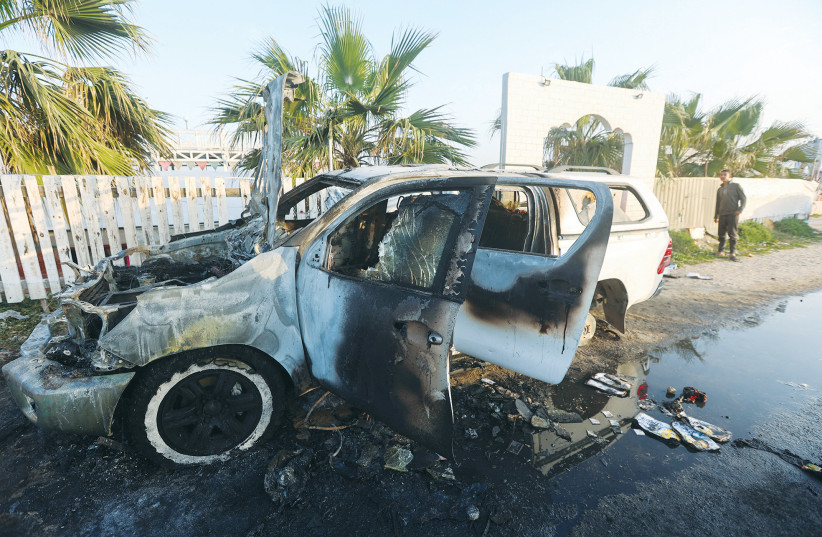
The World Central Kitchen (WCK) incident in April 2024, the International Red Crescent incident in March 2025, and a few other high-profile incidents in which numerous foreign-aid workers or civilians were killed are expected to be among the cases addressed in those decisions.
These are to be the first Gaza-related decisions that Offir will be publicly announcing since taking office last November.
The source for the delay is unclear, but it appears to be the result of pressure from outside the IDF legal division and possibly outside the IDF itself.
The Justice Ministry would have supported publication of the reports as originally scheduled, according to information made available to the Post.
Furthermore, the Foreign Ministry did not deny that it had sought to delay publicizing the report, although it also did not confirm this.
Prime Minister's Office denies being source of delay
The Prime Minister’s Office said it had not been the source of the delay.
Prime Minister Benjamin Netanyahu and Foreign Minister Gideon Sa’ar, however, have generally taken a combative approach, as opposed to pursuing dialogue, toward any allegations of IDF war crimes by the International Criminal Court (ICC) specifically and international judicial bodies in general.
The dialogue approach of sharing the maximum amount of information available and as rapidly as possible from IDF probes was Israeli policy before the October 7 massacre in 2023. Since the start of the Israel-Hamas War, however, prying loose details about probes has been more like pulling teeth.
Senior Israeli legal officials have expressed concern that any data they provide could be abused by the ICC, the International Court of Justice (ICJ), and other international legal bodies in war-crimes cases.
In 2024, the IDF issued two very general and generic updates about its probes, but the last update was filed in August 2024.
As early as mid-2024, then again in January 2025, and in multiple instances since then, senior IDF sources indicated to the Post that decisions on high-profile probes would be published very soon.
It appears that when IDF Chief of Staff Lt.-Gen. Eyal Zamir replaced Herzi Halevi, however, the rollout was delayed, and then there were other delays likely due to pressure from outside the military.
The next watershed moment came last October, when Offir’s predecessor, Yifat Tomer-Yerushalmi, suddenly resigned – along with some of her top staff – after admitting to illegally publicly leaking a video of evidence in the Sde Teiman saga.
When Offir took office, it was clear that there would be some kind of pause in rolling out public announcements, because he would need time to study the cases before making decisions and approving material for publication.
Some sources said they hoped the report would still be published before the upcoming election on October 27, and that election considerations would not delay publication.
WCK, Islamic Red Crescent high-profile alleged war crimes incidents
Regarding the WCK incident, a fascinating twist is that Offir is not making the decision.
In his prior role as the Defense Ministry legal adviser, Offir reportedly worked very closely with Col. Nochi Mendel, one of the key commanders and suspects, on several projects.
Although this does not necessarily violate the “conflict of interest” definition to technically disqualify Offir from rendering a decision the way it would if the two were family members, Offir did not feel he could objectively judge Mendel or at least wanted to remove any perception of favoritism.
For that reason, IDF Chief Military Prosecutor Col. Eli Levertov will be issuing the decision regarding the WCK case.
Levertov became the military chief prosecutor last August, about two months before Tomer-Yerushalmi’s resignation.
Regarding the International Red Crescent case and several other case decisions that will be issued, however, Offir’s broader approach is clear. He is not expected to examine them in a vacuum or from the perspective of a law-school professor in an ivory tower.
Looking at the cases in perspective
Rather, he is expected to look at the cases from the perspective of the IDF having been engaged in a war to topple Hamas in Gaza as a response to the October 7 massacre.
Offir is also expected to take into account all of Hamas’s techniques, such as systematically using human shields and civilian locations throughout Gaza to fight the IDF, including using women and children with white flags to try to entrap and kill IDF soldiers.
In other words, there will be a heavy burden of proof to meet before concluding that an IDF soldier who killed innocent Palestinians did so with deliberate intent, as opposed to unintentionally as a result of difficult circumstances and the gray fog of war.
There may be indictments and punishments for harming or killing Palestinians, such as an incident this past February in which soldiers were recorded beating an innocent Palestinian without any obvious cause, or an incident earlier this month in which soldiers killed a Palestinian baby in a car.
The Post understands there are at least five additional incidents in which soldiers beat Palestinians in the West Bank and are being probed or prosecuted since Offir took office.
One difference between Offir and previous military advocates-general could be that he may also make less of a public display regarding such cases.
In any event, Israel might decide on a diplomatic level to privately report cases to international bodies such as the ICJ so that they cannot claim Israel does not prosecute its own soldiers.