
The road to Arab al-Aramshe on Israel’s northern border consists of a series of vertigo-inducing switchbacks. This is route 8993, and it winds around the hills that lead up to the border. The ravines here are steep, marked by rocky outcroppings and large caves, one of which, Keshet, is located near Kibbutz Adamit and features a natural arch.
On May 9, the northern border was on alert for possible escalation amid clashes with Hezbollah. Even though there is a ceasefire between Israel and Lebanon, there are daily clashes with Hezbollah. The IDF now controls a buffer zone inside Lebanon, where villages have been evacuated. Hezbollah has innovated by using First Person View (FPV) drones to attack troops.
On May 6, Israel eliminated a commander of Hezbollah’s Radwan force in a strike in Beirut. On May 8, Hezbollah retaliated with rocket fire toward the Krayot, an urban area north of Haifa. On Saturday, May 9, the attacks continued. The IDF said “an explosive drone launched by the Hezbollah terrorist organization was located in northern Israel, in proximity to the Israel-Lebanon border. No injuries or damage were reported. Security forces are currently operating at the scene to neutralize the drone. Further handling of the incident has been transferred to the Israel Police.”
The IDF also carried out numerous strikes in Lebanon. “In order to remove threats, in the past 24 hours, the IDF struck more than 85 Hezbollah terrorist organization infrastructure sites from the air and on the ground. Among the targets struck were weapon storage facilities, launchers, and structures used by the Hezbollah terrorist organization to advance terrorist activities against Israeli civilians and IDF soldiers,” the IDF said.
Despite all this fighting, the northern border in Israel appears outwardly quiet. North of Nahariya, on the road that leads to Rosh Hanikra, there are a dozen cars, and some people have come to look out over Israel’s tranquil Mediterranean coastline. The water is a turquoise blue in some areas. The rocky coastline is made up of brownish rocks that knife their way into the water.
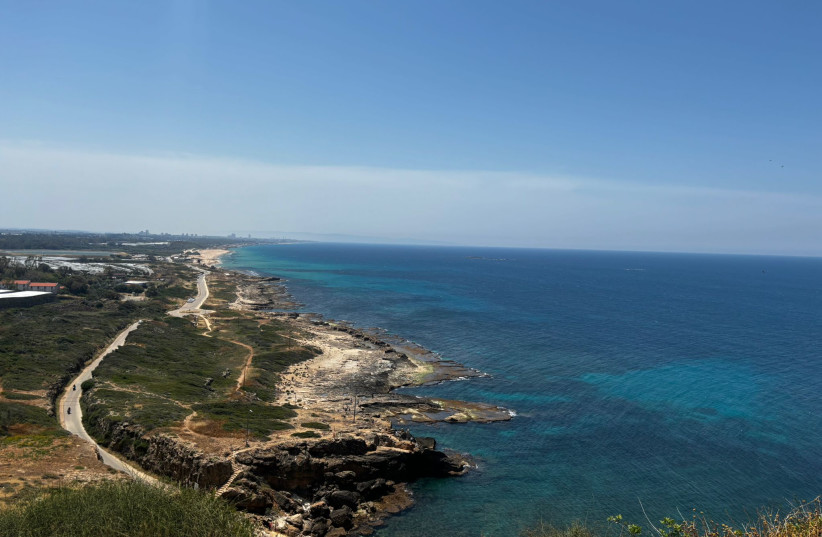
Near Achziv, which was once a busy tourist beach, people are fishing. The fishermen do not mind the threat of rockets and killer drones. At Rosh Hanikra, a middle-aged couple has put out lawn chairs near their small caravan. They are having a beer, enjoying a warm afternoon. There is no sense of war. Neither is their sense of war for the young men on motorcycles revving their engines and trying to pop their front wheels up, annoying everyone else around.
After Rosh Hanikra, the road passes through Shlomi. It was here, during Passover in 2023, that rockets were fired at Israel by terrorist groups in Lebanon. Hezbollah was being appeased, and its provocations did not result in a strong response, with the group setting up a tent in Mount Dov to challenge Israel’s control and dispatching a terrorist to the Megiddo junction. We all preferred quiet over confrontation, even with Hezbollah looming over the border, like a coming storm.
The situation has changed
Now the situation has changed. The IDF has pushed into Lebanon from its perch on the hills above Shlomi. This line of hills borders the area near the border communities of Adamit, Arab al-Aramshe, Zarit, and Shtula. During the war that began with the Hamas attack on October 7, 2023, most of these border communities were evacuated, and the people who remained were largely cut off from the outside world.
In those days, much of the border road and nearby routes, such as 8993, were in a military zone. Arab al-Aramshe, an Arab village named after a Bedouin tribe, was one exception where people remained. But they were an island amidst the maelstrom of war.
Now the roads are open. Many armored shelters dot the landscape near bus stops and communities. There is a sense of peace and safety. The border fence has become a wall now. Memories of the war and previous wars mark the landscape. Near the Keshet cave, there is a stone in memory of Ehud Goldwasser and Eldad Regev, the two Israeli soldiers who were killed and their bodies kidnapped by Hezbollah in 2006.
I have been on the northern border throughout the war. After October 7, I came to Shtula soon after it was evacuated. It was under fire by anti-tank guided missiles at the time. Today, the Shi’ite communities on the other side, such as Ayta ash Shab, are empty. The ATGM threat appears to have ended for now. The FPV drone threat has replaced it, but because they work on optic fiber tether, they don’t have a long range. Nevertheless, there is still a threat here.
Leaving the border road, the route passes Shomera and then descends to the 899, the major east-west route in the upper Galilee. It’s near the border, but not a border road, and passes the large Christian village of Fassuta and ends near Sasa, where it intersects with the 89.

Here one can see Mount Meron, the highest peak in the Galilee, as well as the peak of Mount Adir. Adir has a view of much of southern Lebanon. The roads here have signs that warn of falling rocks. There are no warnings for falling missiles. For northern residents who want to live a normal life, and for the few tourists coming up here, that’s a good sign.
On June 8, 2024, I was driving in this same area when news came that Noa Argamani had been freed in an operation in Gaza. She was freed along with Shlomi Ziv, Almog Meir Jan, and Andrey Kozlov from captivity in Nuseirat in Gaza. This was rare good news in the spring of 2024. Today, all the hostages are home. This is a weight off many shoulders. This is part of the peace that's slowly growing.
Leaving the border road and Sasa, the wider road 89 traverses the green hills down toward the Druze town of Hurfeish. Here, I decided to stop for lunch at Meet and Eat. It serves hamburgers. Outside on the road, the Druze flag is flying next to the Israeli flag. There is a sense that things are returning to normal here. Nevertheless, the lack of tourists and visitors is apparent.