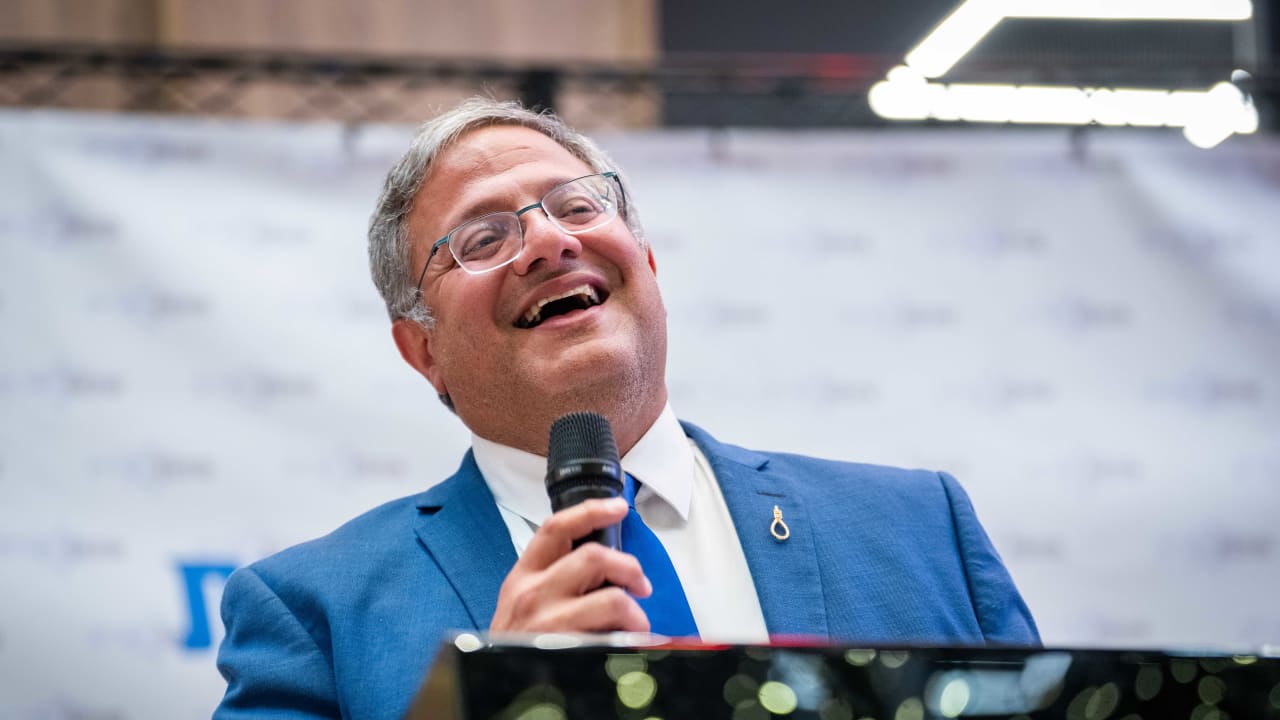
Central Elections Committee chairman and Supreme Court Deputy Chief Justice Noam Sohlberg on Monday morning rejected a petition seeking to bar National Security Minister Itamar Ben-Gvir from attending and speaking at a police event, citing concerns that his participation would amount to prohibited election campaigning.
The event, an appreciation event for Israel Police volunteers and members of police emergency squads, was scheduled for Monday evening in Tel Aviv. It was officially planned to mark 50 years of the police volunteer system.
Attorney-General Gali Baharav-Miara supported the request to bar Ben-Gvir from the event, arguing that his participation, even without speaking, raised a serious concern that the police-funded event would effectively become election campaigning. The argument was that the minister’s attendance itself would amount to the use of public resources for prohibited election campaigning, and could give the event as a whole a political character.
The petition, filed by NGO Voting for Israel, sought primarily to prevent the minister from speaking or participating in the event. Alternatively, it asked Sohlberg to prevent the event from taking place altogether.
According to the state's filing, the police began planning the event in 2024, with unsuccessful attempts the following year to contract a production company. The event was ultimately approved as part of the police’s 2026 work plan, with NIS 1.3 million in police funding and participants paying NIS 30 per ticket.

Ben-Gvir invited by police to speak, thousands of tickets sold
Thousands of tickets had already been sold by the time the petition was heard. The event, which is internal and not open to the general public, was also set to include performances by singers Moshe Peretz and Ivri Lider. Ben-Gvir was invited by the police to attend and speak, as is customary at police events and ceremonies of this kind.
Those circumstances were central to Baharav-Miara’s position. Election law prohibits the use of public funds and assets for election campaigning. Courts assess whether an official event crosses that line based on its dominant purpose, including its timing, scale, who organized it, whether it is recurring or unusual, who is speaking, and whether it becomes associated with a particular candidate.
The state argued that several of those factors weighed against Ben-Gvir’s participation. The event is being held during the election period, is not recurring, is largely funded by the police, and is unusually large, with the venue able to hold 10,800 people and host performances by prominent artists.
It also pointed to Ben-Gvir’s close association with the emergency squad project, one of the National Security Ministry’s flagship initiatives during his tenure.
The ministry itself told the state that the emergency squad system now numbers around 14,000 volunteers, and stressed that the ministry initiated, funded and equipped the project. It argued that Ben-Gvir’s participation was therefore a natural consequence of his responsibility for the program and had no political or campaign purpose.
Baharav-Miara reached the opposite conclusion on his attendance. In the state’s view, the association between Ben-Gvir and the emergency squads meant that his appearance before the large, publicly funded gathering would give him a central platform connected directly to an issue with which he has identified himself politically.
His participation, the state argued, therefore raised a serious concern of prohibited election campaigning even if he did not speak at all.
The attorney-general did not, however, support the petition’s alternative request to cancel the event entirely.
While the state said the timing, scale and performances raised “not insignificant difficulties” – particularly because the final production tender closed only on August 14, after the Knesset had entered its election recess - it noted that planning had begun long before the election period and that thousands of tickets had already been sold. It argued that barring Ben-Gvir was therefore sufficient, while stressing that election campaigning would remain prohibited at the event regardless of whether the minister attended.
Campaigning remains prohibited during event
Sohlberg rejected that position. Because of the tight timetable, he issued the decision without full reasoning, which he said he would publish separately as soon as possible.
Ben-Gvir committed in a sworn affidavit not to engage in election campaigning during the event, Sohlberg noted.
“It goes without saying that no one is permitted to engage in election campaigning - verbally, visually, or in any other manner – at this event,” Sohlberg wrote.
Sohlberg also recommended that the speeches be provided to legal advisers for review ahead of the event, although he did not make that a condition of Ben-Gvir’s participation.
Ben-Gvir welcomed the ruling, portraying it as a defeat for Baharav-Miara.
“Gali Baharav-Miara tried to stop us when we established the emergency squads – and failed. Now she tried to prevent me from coming to thank them – and failed again,” he said, adding that he would attend the event to thank the volunteers.
Monday’s case was not the first time Sohlberg has considered Ben-Gvir’s use of police or other state resources during an election campaign. Earlier this year, Sohlberg ordered Ben-Gvir in March to remove videos filmed with police and Israel Prison Service personnel after finding that the minister had used public assets to promote his political messages in violation of election campaigning rules.
In the present case, however, Sohlberg accepted Ben-Gvir’s undertaking not to campaign and allowed him to attend and speak. His full reasoning, along with a decision on legal costs, is expected to follow.