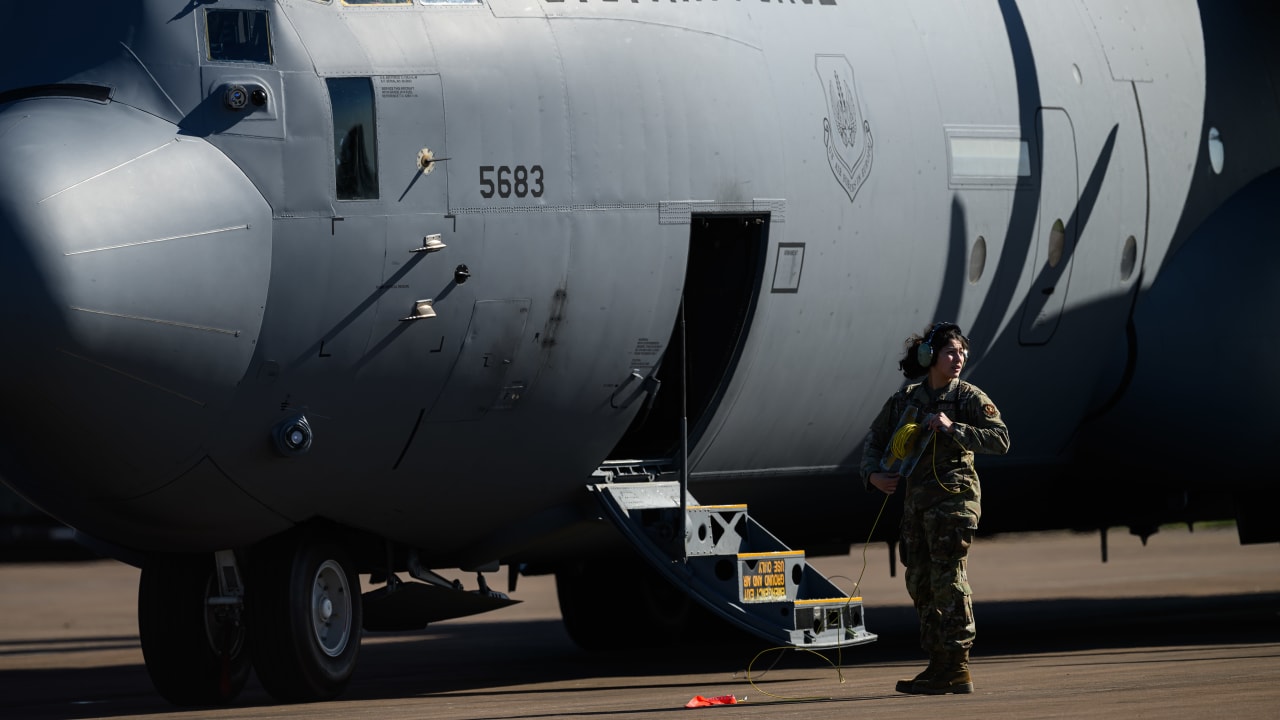
In parallel with confirmation from American sources that a US military fighter jet was shot down in Iran on Friday, recent footage from the southern part of the country shows US Army Black Hawk helicopters refueling from an AC-130 Hercules aircraft, repeatedly flying around the area.
Earlier, Iran claimed to have shot down a US Air Force F-35 stealth jet, but photos of the wreckage indicated that it was actually an F-15E from Squadron 494, based in the UK. With one of the pilots already rescued, the US is currently searching for the second crewmember in an attempt to reach them before the Islamic Revolutionary Guard Corps (IRGC).
The Islamic regime's news agency, Tasnim, claims that one of the pilots has already been captured, although the same agency had previously reported that a stealth jet was shot down and exploded with no survivors.
While the Israel Air Force operates Unit 669, established after the Yom Kippur War, for rescuing ejected pilots, the US Air Force's model is the Pararescue (PJ) unit - elite forces tasked with locating and rescuing any aircrew member forced to eject behind enemy lines and bringing them home in the "Whiskey" - an upgraded Black Hawk designed for extraction under fire.
While Unit 669 uses available IAF helicopters, the Americans have helicopters and aircraft specifically designed for the task, having invested billions of dollars into their development.

Once a pilot is forced to eject, the US Air Force's combat rescue system comes into play, having been deployed ahead of the war in the Gulf region. Aircrews have a special locator and communication device made by Boeing, similar to devices provided by Israel's Elbit Systems to IAF pilots and foreign militaries.
The device includes built-in GPS, encrypted text message transmission, and the ability to communicate with satellites. This system enables rescuers to pinpoint a pilot’s exact location to within meters without the enemy being able to track the signal, thanks to frequency-hopping and advanced encryption technology.
Under the ejection seat is a survival kit designed to keep the pilot alive for at least 72 hours under extreme conditions. It includes a first aid kit, water-resistant pouches, water purification tablets, and high-calorie energy bars.
It also contains a signal mirror, small flares, and an infrared flashlight visible only to rescuers equipped with night vision devices. The kit also includes a lightweight thermal blanket to preserve body heat and camouflage the pilot from enemy thermal sensors.
US Air Force's specialized rescue fleet
In the US, there are actually three separate air forces, with most helicopters under the control of the US Army, Navy, and Marines. The US Air Force operates a fleet of assault helicopters primarily for rescue operations; these were previously "Jolly Green" helicopters based on the CH-53, similar to Israel's Sikorsky CH-53 Yas'ur, and are now "Jolly Green 2" helicopters based on Black Hawks.
The US had planned to invest nearly $8 billion in purchasing 113 of these helicopters, a number later cut to 85. The HH-60W, also called "Whiskey," is made by Sikorsky and includes enlarged fuel tanks for extended range, an aerial refueling probe, missile defense systems, FLIR night vision, and twin machine guns capable of creating a "wall of fire" to keep enemy forces away as the rescue team descends via rope.
Alongside these, the HC-130J Combat King II, a special variant of the Lockheed Martin Hercules, is used for rescue and recovery missions. These can refuel the Jolly Green helicopters in midair, extending search time; maintain communication with command centers; drop supplies to pilots until they are rescued; and scan large areas for approaching enemy forces and pilots.
The rescue doctrine evolved during the Vietnam War due to dense jungles and heavy anti-aircraft fire, with rescue helicopters operating under constant fighter cover. As a result, while in the Korean War, the US was able to rescue about 1,000 aircrews (10% of those shot down), the number increased to 71% in Vietnam, rescuing 3,880 individuals. During the Gulf War in Iraq, dozens of aircrews were rescued, marking nearly all the ejected pilots.
The rescues come with a heavy price. In Vietnam alone, the US Air Force lost 71 rescuers and 45 helicopters in rescue missions, underscoring the reputation: they will come for you, even if it means fighting their way in and out.
The US's reputation for rescuing pilots was cemented by two famous cases that received worldwide attention (and were turned into movies): Captain Scott O'Grady (Bosnia, 1995) – shot down in an F-16 and survived six days eating ants and drinking rainwater before being rescued in a daring Marine operation.
The other case was pilot David Goldfein (Serbia, 1999), whose F-16 was shot down. He was rescued within five hours of his crash and later became the Chief of Staff of the US Air Force.