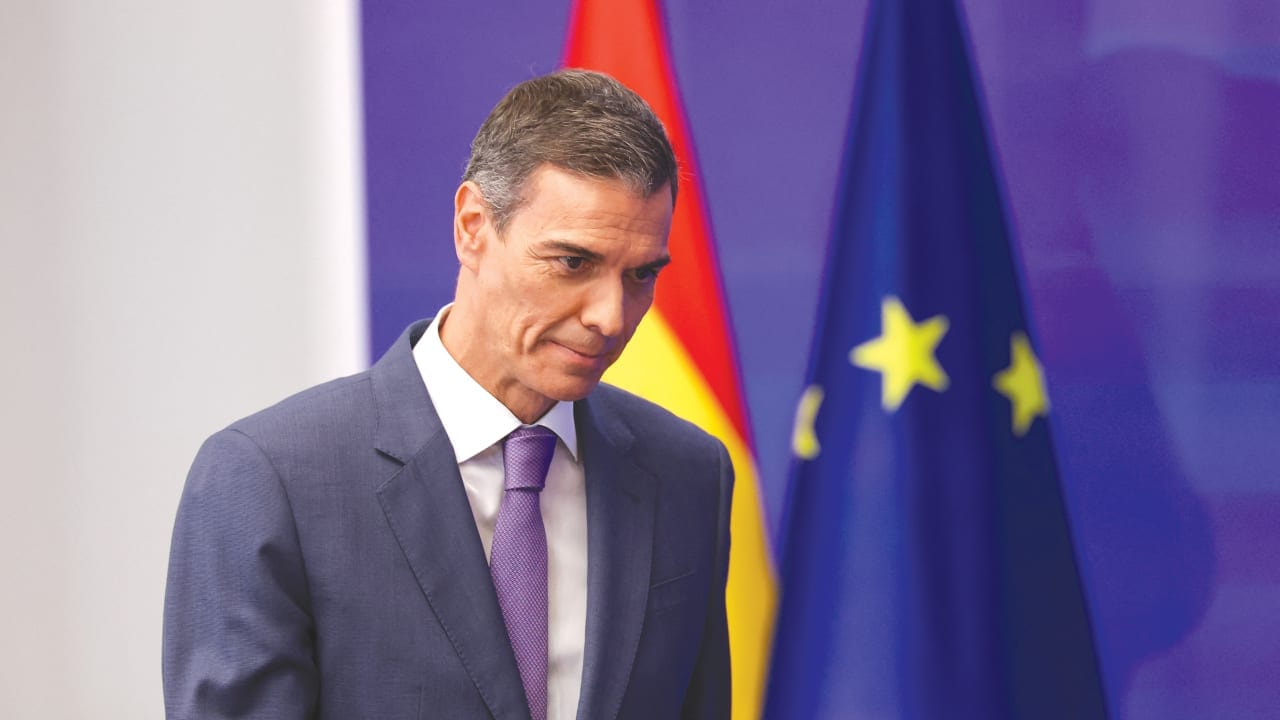
For years, Spanish Prime Minister Pedro Sánchez has governed through escalation.
Cornered? Double down. Isolated? Polarize. Under pressure? Move the battlefield.
That approach worked at home. It built a myth of resilience. It helped him survive fragile coalitions and constant turbulence.
Geopolitics runs on different rules, and Sánchez is running into them.
The illusion of low consequences
Spain’s increasingly aggressive posture toward Israel was not driven only by moral language. It was calibrated around a belief that consequences would stay limited.
The calculation was straightforward: Spain was not central to US strategic focus. Washington had bigger priorities. Rhetorical hostility toward Israel would not materially damage bilateral ties.
So the gestures escalated. The language hardened. The symbolism intensified. Little happened right away.
That apparent immunity bred confidence. Immunity built on irrelevance, though, has an expiration date.
From peripheral to problem
For decades, Spain benefited from being a lower-tier priority in Washington. Now, through accumulated friction over Israel, strategic alignment, and posture, Spain risks becoming a higher-tier issue.
Once that shift happens, the dynamic changes. When the US recalibrates, it rarely announces it with dramatic ultimatums. It adjusts quietly, then structurally: Defense cooperation becomes conditional. Strategic assets get reconsidered. Trade scrutiny rises. Diplomatic trust thins. Influence inside NATO councils erodes.
This is power asymmetry. Spain lacks the leverage to win a prolonged test of will with Washington.
Europe will not absorb strategic recklessness
Some assume the European Union will cushion any fallout. Spain benefits from eurozone architecture, European Central Bank credibility, and structural funds. Europe stabilizes Spain’s macroeconomy.
Europe is not built to underwrite unilateral geopolitical adventurism.
The parliamentary détente between the European People’s Party and the Progressive Alliance of Socialists and Democrats has softened pressure on Madrid and helped produce a restrained domestic opposition. That balance is conditional.
Eastern Europe will not trade Atlantic cohesion for Spanish posturing. Germany will not jeopardize transatlantic stability lightly. France will calculate its own advantage first.
If Spain becomes a source of friction rather than cohesion, Brussels will distance itself, quietly at first, then firmly.
Europe is Spain’s economic lifeline. It is not Sánchez’s geopolitical bodyguard.
Domestic tactics do not intimidate superpowers
Sánchez’s instinct is escalation. Domestic escalation, though, does not add up to a foreign policy.
Parliamentary adversaries may hesitate. Markets do not. Alliances do not. Superpowers do not.
The belief that Spain could confront Israel loudly, strain Washington rhetorically, and avoid structural consequences depended on one condition: Spain staying strategically peripheral. If that condition is gone, the margin for maneuver is gone with it.
The end of the runway
A huida hacia adelante (a headlong rush forward) works only while there is runway ahead. Sánchez has survived by constantly pushing forward, shifting crises, reframing battles, and raising stakes.
Geopolitics has gravity. As the Government of Spain under Prime Minister Pedro Sánchez drifts into open tension with its principal security ally, while branding itself as the most visibly hostile European country toward Israel, it will not read as moral clarity. It will read as overreach.
Political resilience can outlast scandals. It rarely outlasts structural miscalculation.
Momentum can turn into free fall. Spain is nearing that moment, and gravity does not negotiate. We may be watching Sánchez’s last failed bluff.
The writer is the chairman of ACOM.