
In a bestseller published in Sweden in 1900 and the United States nine years later, Ellen Key predicted the imminent arrival of “the century of the child.” It would recast play as essential to healthy development, a safe space for personal growth and creativity, as well as leisure.
And dolls, toys, and comics, author Michael Kimmel (a professor emeritus of sociology and gender studies at Stonybrook University and author of, among many other books, Angry White Men and Guyland) reminds us, “became a material expression of the new idea of childhood.”
In his book Playmakers, Kimmel demonstrates that a group of Jewish immigrants from Eastern Europe and Russia “staked a claim for their share of the American Dream” by designing, manufacturing, and selling products to educate and entertain young boys and girls.
He makes a compelling case that these “Yiddish Jews” invented 20th-century American childhood.
Prior to the 20th century, Kimmel points out, stores stocked few, if any, toys. Girls had homemade dolls; boys played with marbles and balls, jumped rope, and flew kites. Excluded from many professions, Jewish Americans saw and seized an opportunity.

In 1902, Morris Michtom (Kimmel’s great-granduncle) and his wife, Rose, used mohair and wood shavings to fashion a stuffed animal they called a “Teddy bear,” an homage to president Theodore Roosevelt, a big game hunter who had recently refused to shoot an injured bear. Displayed in the window of their candy store in Brooklyn, New York, the toy was an instant hit. The couple subsequently established the Ideal Toy Company.
By 1948, thanks to huge sales of Shirley Temple dolls and diapered Betsy Wetsys, Ideal controlled 10% of the $300 million toy market in the United States.
For much of the 20th century, Kimmel reveals, virtually all major toy companies were owned and operated by first- or second-generation Jewish immigrants.
After making pencils and pencil boxes, and bags for doctors and nurses, Hillel, Herman, and Henry Hassenfeld established Hasbro. The company climbed to the top of the heap with Mr. Potato Head, the first toy advertised on television, and stayed there with G.I. Joe, an “action figure” that enabled boys to play with a “doll” without any loss of masculinity.
Manufacturers of plastic picture frames, Ruth Moskowicz and Izzy Handler produced toy guns and a doll named Barbie for their company called Mattel.
The business bearing Louis Marx’s name became the nation’s largest toy company by making products already on the market and underselling the competition.
Owned and operated by Joshua Lionel Cohen, Lionel Trains is still the world’s largest toy train manufacturer.
Wham-O, a company started in Richard Knerr’s garage, made Frisbees and then cashed in on hula hoops, one of the biggest fads of the 1950s and ’60s.
American Jews and the comic strip
Jewish Americans also made foundational contributions to comic strips, comic books, and animated cartoons. The low status of these “junk fields,” Kimmel indicates, made them havens for talented people who found “more acceptable” occupations closed to them.
A sassy caricature of Jazz Age flappers, Betty Boop was created by Max Fleischer, who immigrated to the United States from Krakow at age four. Elzie Segar based Popeye the Sailor Man on Frank “Rocky” Feigel, a Polish Jewish immigrant with massive forearms and a deformed eye, who rarely took his pipe out of his mouth. In his comic strip L’il Abner, Al Capp (born Alfred Caplin) imagined a world that Jews never entered, the rural South. Created by Hammond Fisher, the son of a Jewish scrapyard dealer, Joe Palooka, about “a goyish Everyman” with a heart of gold, reached 100 million newspaper readers every week.
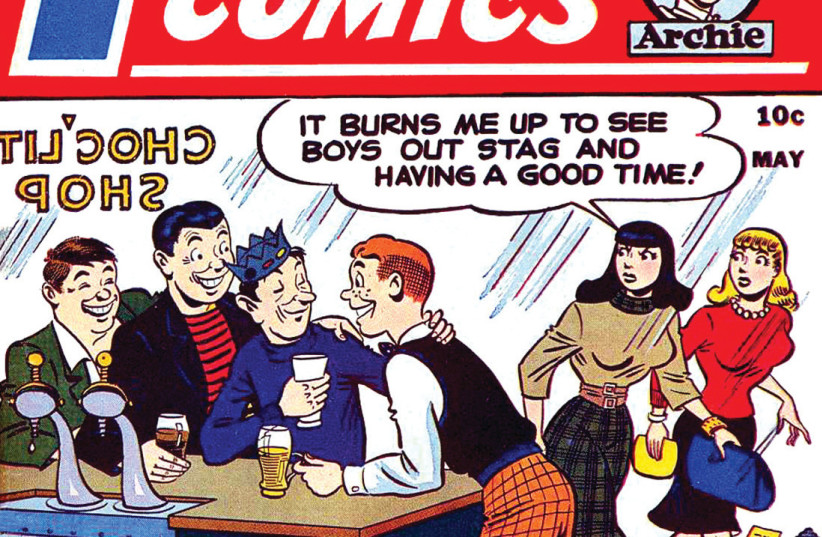
Archie, starring perhaps the most American cartoon character, was launched in 1941 by first-generation Jewish Americans John Goldwater and Victor Bloom.
To reinforce his claim that Superman, created by Jerry Siegel and Joe Shuster, is Jewish, Kimmel cites no less an authority than Sammy Clayman, the protagonist of Michael Chabon’s terrific novel The Amazing Adventures of Kavalier and Clay: “Coming over from the old country, changing his name like that. Clark Kent, only a Jew would pick a name like that.” Superman didn’t really come from Krypton, the celebrated writer Jules Feiffer maintained; “it was the planet Minsk.”
Superheroes and villains created by Stan Lee (Stanley Martin Lieber) and Jacob Kurtzberg, we learn, often had post-World War II Jewish backstories. Spider-Man/Peter Parker, “the most Jewish superhero of all,” Kimmel emphasizes, embodies the quest for acceptance by nerdy Jews with glasses, who continue to be misunderstood and criticized no matter how hard they try.
EVER THE sociologist, Kimmel is not content with a descriptive account, however “tempting or gratifying that might be,” of the indispensable contributions of Jewish Americans to “the century of the child,” even if it contains, as Playmakers does, Jewish authors and illustrators of children’s books and child psychologists. And so, his book concludes with an analysis of why and how Yiddish Jews had such an outsized impact on the popular culture of the United States.
True believers in America’s promise of equal opportunity, these Jews, Kimmel writes, created it for themselves when they were shut out of banking, advertising, and other professions. They “stumbled” into an area – toys and games – that had not been colonized by WASPs or other ethnic groups.
Marginality and antisemitism gave them the edge they needed to innovate and invent. Interconnections among toys, comics, children’s books, and retail stores allowed each enterprise to feed off the others. And there was an added plus in the stories they told and the toys they invented: Orphans end up as heroes; clumsy outsiders acquire “enviable superpowers.” ■
The writer is the Thomas and Dorothy Litwin emeritus professor of American studies at Cornell University.