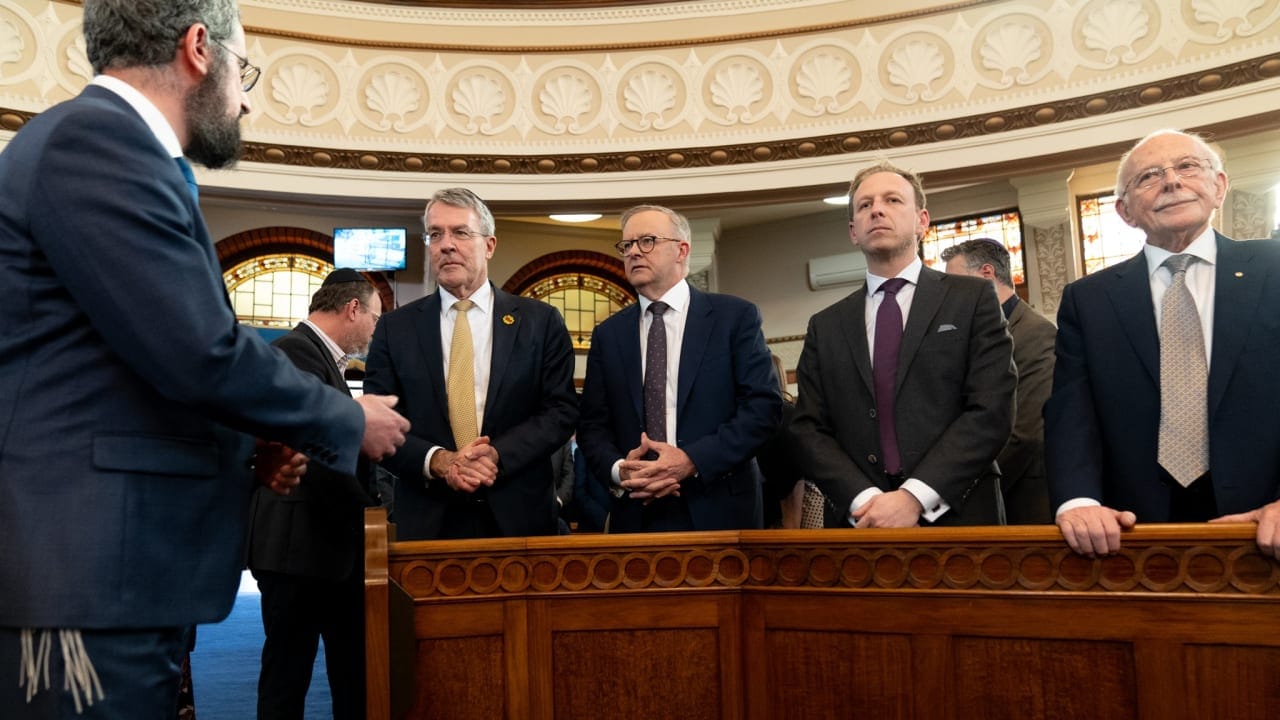
Growing up as a Religious Zionist Jew in Melbourne, Jeremy Leibler remembers sneaking around the house while his parents hosted dinner parties attended by Australian prime ministers and Israeli ambassadors. Being involved in his country and maintaining a strong Jewish identity seemed to go hand in hand.
“I grew up genuinely feeling, wow, you can be in the real world, contributing, and yet have this connection to Israel in a very modern and meaningful way,” Leibler, who will complete eight years as president of the Zionist Federation of Australia (ZFA) next month, told The Jerusalem Post.

That early connection to Israel took on new layers of complexity when Israeli Prime Minister Yitzhak Rabin was assassinated by a Jewish man wearing a kippah.
“It caused me to ask a lot of questions,” Leibler recalled. “That was the beginning of me developing my own more nuanced engagement with Israel. … I learned early on that you can love something, be passionate about it, and still grapple with it. It doesn’t have to be perfect, and that’s maybe part of the process.”
The ZFA is Australia's main Zionist umbrella organization, representing more than 200 organizations. Its work spans advocacy, education, youth leadership, Israel programming, aliyah and community life.
When Leibler assumed the presidency, he focused on “broadening the tent.”
Inspired partly by former Israeli President Reuven Rivlin's speech at the Herzliya Conference describing Israel's four population "tribes," Leibler sought to bring Australia's diverse Jewish community together.

He worked to empower young people and involve more sectors of the community. Looking back, Leibler believes he succeeded, saying “the makeup of the ZFA today is far broader and more diverse than it was.”
But everything changed on October 7, 2023.
First came the Hamas massacre, in which more than 6,000 terrorists infiltrated southern Israel, murdered some 1,200 people and kidnapped more than 250 others.
Two days later, around 1,000 pro-Palestinian protesters gathered outside the Sydney Opera House, marking the beginning of a wave of demonstrations across Australia, accompanied by rising antisemitism, violence and fear within the Jewish community.
“Even a week or two after the seventh, it was very clear that this was not going to be over,” Leibler recalled. “Something had shifted on the ground. It almost felt as if our enemies had put all these things in place and were just waiting for this moment to happen.”
Almost overnight, Leibler's role changed. Community members who had once called primarily with complaints now turned to him for leadership, reassurance and representation.
“It is amazing how hatred and antisemitism can be normalized,” Leibler said, shaking his red head in disbelief.
“In the weeks after the seventh of October, I quite wrongly said to people, these protests are going to backfire. Australians don't want to see these lunatics taking over their streets every week, to see small businesses suffering. … I don't think the ordinary Australian likes these protests. Still, I underestimated the power of intimidation and these protests and the obsessive attacks on anyone connected to Israel and Zionism, particularly our leaders. The pro-Palestinian agenda was very successful, very successful in intimidating our leaders.”
The community, he said, “subconsciously put me under enormous pressure because it really felt at that time that the community was feeling that they were relying on other Jewish leaders and me as well to be their voice.”
There was little escape, even at home. Every meal became a conversation about Israel, antisemitism and the safety of Australian Jews.
Leibler, a father of four, recalled walking with two of his children past a public school where students were playing ball. One child asked why there was no security fence. Then they realized that, unlike a Jewish school, it did not need the same protection.
Around the December 2024 arson attack on Melbourne's Adass Israel Synagogue, another of Leibler's children observed that the political right and left seemed to agree on one thing: their hatred of Zionists.
“Isn’t the writing on the wall? Haven’t we seen this before?” the child asked.
Leibler found the conversation deeply confronting.
Then, on December 14, 2025, two armed terrorists opened fire at a Hanukkah celebration at Sydney's Bondi Beach, murdering 15 people.
For Australia's Jewish community, the attack followed more than two years of pleading with the government to confront antisemitism and protect Jews. It was also a defining moment for Leibler, who had to support a grieving community while challenging the government over its failures and working with that same government to repair the damage.
After the attack, Israeli President Isaac Herzog called Leibler to offer support.
The two had developed a relationship six weeks after October 7, when Leibler led an Australian solidarity mission to Israel with Keren Hayesod-United Israel Appeal. Following Bondi, Leibler helped initiate the ZFA invitation that led to Herzog's February 2026 state visit to Australia.
Leibler said the visit was pivotal.
“The prime minister, the opposition leader, senior ministers, and the Israeli president and the first lady standing there with full honors … it was incredibly moving,” he recalled. “It felt like the years of this demonization were sort of just momentarily washed away, because we had, on a bipartisan basis, the highest levels of government and leadership in the country recognizing whether or not they agree with the Netanyahu government or not … that Israel is legitimate, that they are a friend of Australia, that there are shared values, and that most importantly, frankly, the Jewish community's connection to Israel and Zionism is legitimate.”
Leibler, who is among the keynote speakers at the upcoming Jerusalem Post Australia Summit, helped secure the visit by maintaining relationships with Australian government leaders despite their shortcomings. He still believes none of the government's senior members are antisemitic.
"There has been a lot of justified criticism of the Australian government, and I believe the government failed to demonstrate moral clarity after October 7th, but they were not motivated by antisemitism," he said.
Rabbi Doron Peretz, chairman of the World Mizrachi Movement, said Leibler demonstrated the confidence and backbone to challenge the Australian government while maintaining the tact needed to work with its leaders. Leibler’s father, Mark Leibler, said his son understood early that Jewish leadership required relationships across the political spectrum.
“From the outset he understood that when you're a leader of the Jewish community in the way that he's been, you need to establish relationships with political leaders, not only on one side but on both sides, and that he managed to accomplish incredibly well.”
Former Israeli ambassador to Australia Amir Maimon, who served during the Bondi attack, recalled working closely with Leibler.
“Canberra was very, very cold, and I'm not just talking about the weather. Jeremy was always there to support me personally… Jeremy demonstrated exceptional leadership skills.”
Speaking at a recent event in Israel where Herzog honored Leibler, the president praised his leadership.
"Jeremy, you are an outstanding leader with immense leadership qualities. Since October 7 and the Bondi terror attack, you have steered the community through the darkest hours in a very impressive way. You have a dialogue with both sides of the aisle in your government, and you are a huge asset to the Jewish people worldwide. You are leaving on the formal level, but your voice and your impact are still needed, and I am sure that you will bring this to any other role you take on."
The Royal Commission established after Bondi to investigate antisemitism in Australia is expected to release its findings on December 18, 2026.
Leibler described watching testimony as “very difficult.” He never wanted Australian Jewry to define itself through antisemitism, but he believes the commission has provided an important opportunity for the community to be heard. He hopes its recommendations will help “push antisemitism back to the fringes where it belongs and away from mainstream.”
The grandson of Holocaust survivors, Leibler grew up in a post-Holocaust generation. But he believes “guilt and trauma don't sustain more than one generation,” and that trauma itself is exhausting. He hopes the community will now invest in thriving rather than merely surviving, inspiring the next generation to embrace Jewish life.
Leibler does not yet know what he will do after stepping down next month, although Jewish leadership is so deeply ingrained in his identity that he expects to remain involved.
For other Jewish leaders, he offered this advice:
“Do not fall into the trap of assuming that anyone who expresses support for Israel is a friend, and likewise that anyone who has some criticism of Israel is an enemy. What we need to do is focus on fundamental values and principles and hold that center, because that's what's ultimately going to be in the interest of the community.”
As the conversation drew to a close, Leibler sat with his legs crossed and smiled. Despite everything, he remains optimistic.
“The truth is that Israel is very strong,” Leibler said. “We're more isolated than we've ever been, but we're probably the strongest that we've ever been. Ultimately, I have always believed that the only way you can have a Diaspora that can thrive is having a strong Israel.”
This article is part of a special series leading up to The Jerusalem Post Australia Summit, taking place in Sydney on November 19. To buy tickets: www.jpost.com/australia2026.
Written in collaboration with Arnold Bloch Leibler.