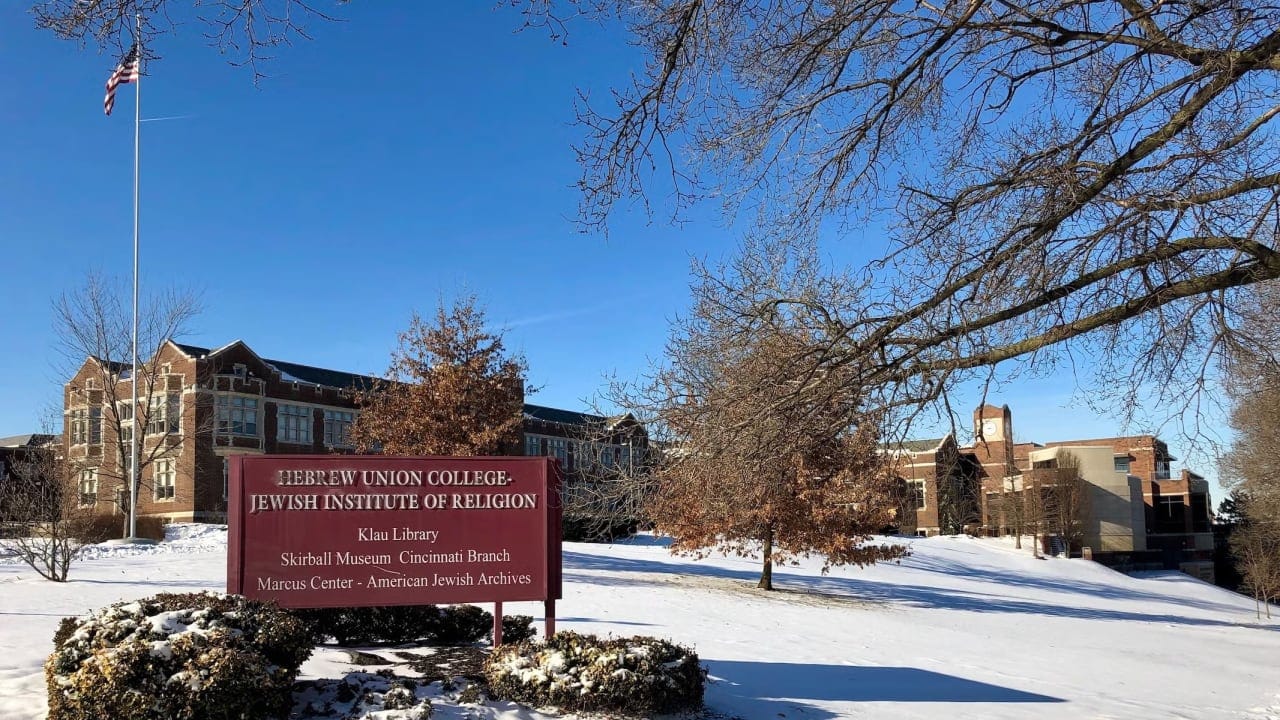
The attorney-general of Ohio has filed a second lawsuit against the nation’s largest Reform rabbinical school over the planned shuttering of its historic Cincinnati campus - a controversial move that has also prompted the creation of a new rabbinical school in the city.
Ohio A-G Dave Yost, a Republican, says he wants to prevent Hebrew Union College-Jewish Institute of Religion from closing its 151-year-old Cincinnati campus at the end of the current school year.
Yost’s lawsuit alleges that the planned closure would violate state laws intended to protect the original intent of nonprofit donors, who believed they were supporting HUC’s Cincinnati base.
“Hebrew Union accepted millions of dollars in donations based on a 76-year-old promise it now would like to break,” Yost’s office said in a statement accompanying the lawsuit, citing the school’s 1950 agreement to “permanently maintain” a rabbinical school in the city. “We’re suing to keep these assets in Cincinnati, where they belong.” The suit asks a judge to bar HUC from closing its doors before a court date.
A request for comment to spokespeople for HUC was not immediately returned.

In 2022, HUC leadership announced that they would be closing degree-granting programs at their flagship Cincinnati campus in order to focus on their other campuses in New York and Los Angeles, which the school claimed were more popular with students.
The college has pledged to preserve its archives and library housed on the campus, but has also pursued plans to sell off property across all its campuses, as well as, reportedly, to sell rare books from its collection.
The move sparked intense blowback from leaders in the Reform movement, some of whom have argued that the college was abandoning its founding principles by moving out of the Midwest in favor of the coasts.
Former HUC Ohio leaders, other Reform movement leaders, announce launch of new Cincinnati-based rabbinical school
Some of HUC’s former Ohio figureheads, along with other Reform leaders, have since announced plans to launch their own Cincinnati-based rabbinical school: The College for Contemporary Judaism.
“We believe it is imperative that there be a strong, vibrant rabbinical school in Cincinnati to serve the liberal American Jewish community, especially between the coasts where access to congregational rabbis and rabbinical education is severely limited,” the college’s founders said in a statement Tuesday.
“While we cannot comment directly on the lawsuit filed by Ohio Attorney-General Dave Yost against Hebrew Union College, it is vitally important that assets subject to the lawsuit are used as originally intended: to support a strong, thriving rabbinical school in Cincinnati.”
The college’s founders include Rabbi Sally Priesand, the first female rabbi to have been ordained by HUC in 1972, who will serve as the new college’s honorary president; and Rabbi Gary Zola, longtime director of HUC’s Cincinnati-based American Jewish Archives, who will now serve as CCJ’s founding president.
The college pledges not to be affiliated with any particular denomination, but will instead commit itself to “Liberal Judaism” with what its site describes as “an unwavering commitment to the existence and well-being of the Jewish and democratic State of Israel.” It will have a particular focus on Jewish communities in the Midwest, South and Mountain West, where its founders say “access to rabbinical education has been severely limited.”
In explaining the decision to base the college in Cincinnati, the school points to some of the Jewish institutions there currently being shepherded by HUC, including the library and archives. It also names the region’s historical importance to American Judaism, as the city where Rabbi Isaac Mayer Wise, spiritual forefather of Reform Judaism, chose to base his fledgling movement.
Yost’s latest lawsuit, filed April 10, was the second time the Ohio A-G had taken HUC to court over its planned downsizing. He also sued the school in 2024 following reports that leadership was exploring the sale of some of its rare books.
The two parties settled the following year with an agreement intended to keep HUC from selling its items without 45 days’ notice to the state.