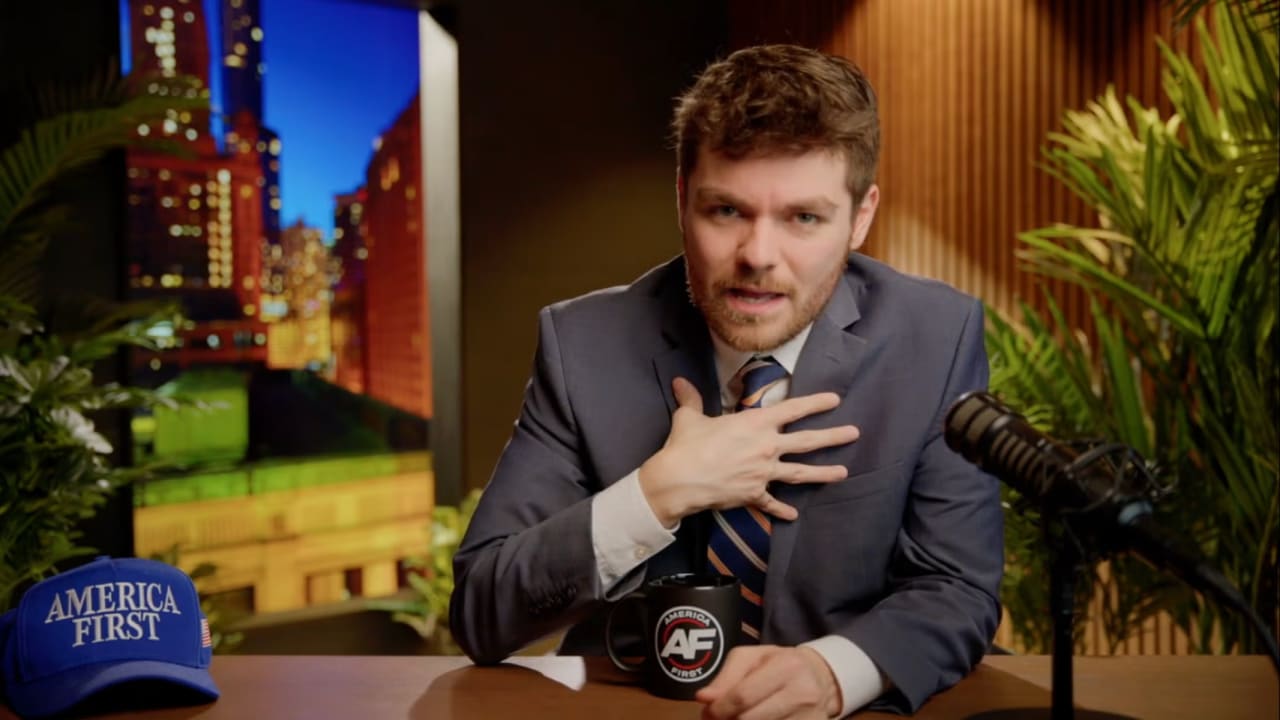
Recently, Nick Fuentes, the far-right influencer and unrepentant antisemite and misogynist, did something unusual for him: He apologized to a Jew.
Sort of.
The apology was court-ordered, and Fuentes himself was not present for it. His attorney handed a note to the recipient, 59-year-old Marla Rose, and quickly demanded it back before it could appear in public.
And it had nothing to do with Fuentes’s hate speech, but rather with a misdemeanor battery charge stemming from the 27-year-old streamer’s assault of Rose in late 2024 as she approached his front door.
Yet the incident and its aftermath have become one of the few ways in which Fuentes has been held accountable for some of his actions as his public influence has continued to grow. And for Rose, a freelance writer and self-described “jack-of-all-trades progressive activist” who does not typically foreground her Jewish identity, her up-close encounters with Fuentes have proved an education in other ways.

“My Jewish identity is also forged by social justice, of the history of speaking up for those who are oppressed,” she said in an interview. “I think that Jewish people have a long and beautiful history of social justice.”
Rose grew up in a family of “High Holiday Jews,” as she describes them, who originally came from Russia and Ukraine. While her mother held a leadership role in the sisterhood of their local synagogue, today she doesn’t engage much in religious life; she also identifies as agnostic.
Background of the incident
Despite Fuentes’ constant torrent of antisemitic invective online, Rose said her own Jewish identity had little bearing on her decision to walk up to his door - though it wasn’t entirely absent, either.
“My culturally Jewish background is very aligned with what I did,” she said. “My heroes are people like Emma Goldman,” the Jewish socialist leader of the early 20th century.
Instead, it was the realization that the two lived in the same town - revealed when a Fuentes tweet after President Donald Trump’s reelection (“Your body, my choice”) led to his address being doxxed online.
When Rose saw his address listed as located in the Chicago suburb of Berwyn, Illinois, she drove the 10 minutes to his house and filmed the front of it to send to her friends. As she was filming, she recalled, someone drove by and asked if it was indeed Fuentes’ house. They dared her to knock on the door, and she agreed - a longtime political canvasser, she was used to knocking on strangers’ doors.
“I don’t believe that people should hide behind screens,” she said, about why she did it. “And since he did make this very public statement that contributes to violence against women and reducing our bodily autonomy, I figured … OK, what the hell, I’ll ask. I didn’t expect he would answer the door.”
But Fuentes did open the door. He pepper-sprayed Rose, shoved her off his porch, and grabbed and stomped on her phone, breaking it. The experience was harrowing and, Rose says, unexpected: she didn’t think her approaching his property was grounds for assault. (Rose maintains she had not yet rung Fuentes’ doorbell, though the local police report stated she knocked on his door until he answered.)
After she decided to press charges, the state negotiated a deferred prosecution for Fuentes rather than a trial. In exchange, Fuentes promised to complete 75 hours of community service, attend an anger management class, compensate Rose for the phone, and offer an apology. But his attorneys kept pushing for extensions on completing the work, until Rose last month threatened to take him to trial in response to the delays.
That led to the court appearance last month, in which Fuentes’s attorneys produced two of the four required consequences: the phone repayment and the apology. Arguing that having a public apology circulating online would be unfair to their client, his attorneys instead handed Rose a paper note containing the apology before quickly withdrawing it.
“I was in shock,” Rose recalled, saying she had been blindsided by the new arrangement. “That’s not what we had agreed upon between us.”
Requests for comment to Fuentes’s attorney were not returned.
In her recollection, Rose described the apology as “a ChatGPT-type short letter.” Fuentes stated that he had “overreacted” to her presence, while noting several times that she was “uninvited.” His long history of hate speech was not mentioned, and he attended the hearing by Zoom instead of in person (his camera was also off, to her recollection). His attorneys had pushed for an additional delay in completing his community service and anger-management requirements.
“I’m still trying to find some sort of justice with that letter of apology,” she said.
In recent weeks, Fuentes - while keeping up his antisemitism - has staked out positions that some observers have found surprising. He’s loudly opposed war with Iran and even urged his followers to vote Democrat over Republican. His longstanding crusade against Israel is looking more and more in keeping with the growing consensus on the left, as well.
That has led some of Rose’s friends and fellow activists - “quote-unquote, ‘progressive people,’” as she describes them - to send her articles about Fuentes on Facebook, expressing seeming admiration that he has changed his tune. “I get a lot of messages from people who are like, ‘Wow, is Nick Fuentes changing his ways?’”
It dismays her; she knows better.
“It bothers me that people aren’t seeing the larger, broader context in which he’s making these new claims,” she said. “I think it’s 100% opportunistic. He’s trying to get more people to follow him.”
One way Fuentes does that, she acknowledges, is through Israel - a region where the left is vulnerable. “There are people who conflate Israel and Jewish people and Judaism, and whatever your views are on Zionism, conflate all those things together,” she reflected. “And it’s the perfect opportunity for a bad actor like Fuentes to jump in there and stir up more antisemitism and just lean into the tropes that are so ancient.”