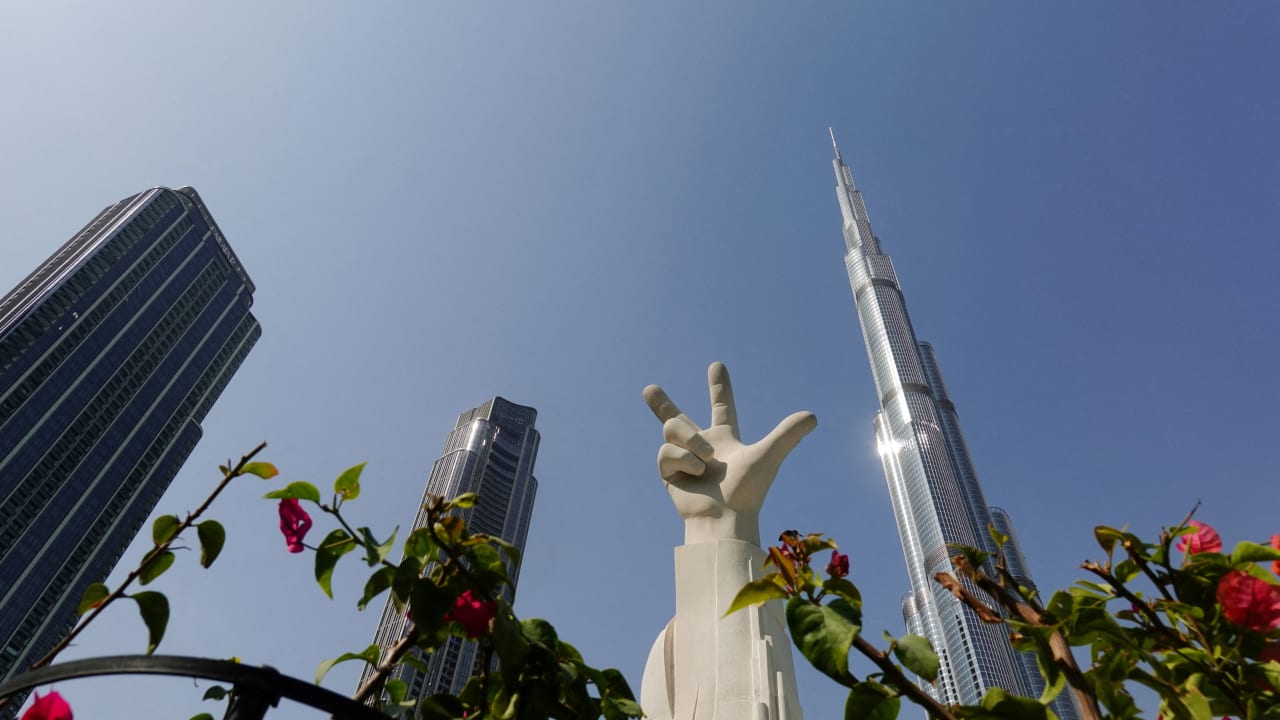
The war against the Iranian regime is reshaping the strategic landscape of the entire region and creating a military alignment between the US, Israel, and the Gulf states unlike anything seen before, according to Col. (ret.) Abbas Dahouk, former senior military adviser for Middle Eastern Affairs at the US Department of State.
“This is an unprecedented war,” he told Defense & Tech by The Jerusalem Post. “The objective is to deny Iran the ability to operate beyond its borders, addressing not just the nuclear program, but its missiles, drones, and naval assets as well.”
For the first time, Israel and the US are fully integrated in this effort, Dahouk said. So far, the force multiplier created by this cooperation has been successful in striking hundreds of targets in Iran and suppressing retaliatory fire against Israel and the Gulf states.
Since the start of the war, Iran had launched 174 ballistic missiles toward the United Arab Emirates, and 161 of them were destroyed, while 13 fell into the sea, the UAE reported Monday.
Some 689 Iranian drones had been detected, and 645 were intercepted, while 44 fell within the UAE, it said, adding that eight cruise missiles were detected and destroyed. In the UAE, three people had been killed, and 68 were slightly wounded, the UAE said. Even though most of the projectiles were intercepted, others hit Dubai International Airport and the Burj Al Arab and Palm Jumeirah hotels.

The Iranian strikes against the UAE were “mind-boggling,” Dahouk said. “Launching hundreds of missiles at the UAE raises a fundamental question,” he said. “What was Iran hoping to achieve?”
Brunt of the attack
More than half of all the missiles fired by Iran have targeted the UAE, according to some reports. The UAE and other Gulf states have condemned Iran and warned that they would not sit idly by.
Kuwait, Oman, Bahrain, and Saudi Arabia are said to have been involved in intercepting hostile targets. On Monday, Qatar shot down two SU-24 fighter jets after it was targeted by ballistic missiles and drones.
The level of participation by Gulf states that have historically remained neutral has been unprecedented. Until now, they had hosted US bases or troops, or bought US weapons, while urging a diplomatic process to deal with Iran’s nuclear program.
Prior to the war, several Gulf states warned against a military campaign, and Saudi Arabia, the UAE, and Jordan said they would not allow the US to launch airstrikes against Iran from their territory. But since being hit, everything has changed.
“The strikes on its cities are imposing real costs on the UAE, requiring it to prioritize homeland defense and operate defensively,” Dahouk said.
Saudi Arabia initially hesitated to join the effort or allow US use of its bases, he said, but “after being targeted, they recognized the IRGC’s intentions and chose to condemn the Iranian government and fight back.”
Turning point
The 2021 decision to move Israel into the US Central Command (CENTCOM) structure was a turning point. It forced Arab militaries and Israel to train, plan, and rehearse together – something that would have been unthinkable a decade ago, Dahouk said.
“Israel’s integration into CENTCOM was transformative,” he said. “It brought regional partners into operational alignment with Israel and enabled the US and Israel to quietly mature counter-Iran plans over years of joint exercises and coordination. What we are seeing now is the execution of long-prepared concepts.”
The result is a level of coordination that allows hundreds of aircraft to operate simultaneously, refueling one another, striking hidden targets, and countering Iran’s drone and missile networks, he added.
Iran is a vast country, but the massive opening round by Israel and the US has degraded its air‑defense network, Dahouk said.
“The Saudis have both the capacity and the operational experience to carry out an effective air campaign, and Iran no longer retains the air-defense capability it once relied on,” he said.
Saudi and Emirati air forces have used fighter jets to shoot down missiles and drones, which is “an expensive but effective tactic,” Dahouk said, and this approach was part of their defense strategy against the Houthis.
The Gulf states “hold sufficient inventories of Patriot and THAAD interceptors, alongside other air-defense systems and early-warning networks that can be seamlessly integrated into combat operations,” he said.
Technology alone does not win wars, Dahouk said.
“If a system isn’t integrated into the wider defense architecture, and operators aren’t thoroughly trained, it has little value,” he said. “The US and Israeli militaries distinguish themselves through constant rehearsal and preparation... This war is far more complex than it appears.”
Gulf States under pressure
The US and Israel have ample firepower and readiness to fight, but what the region needs now is stronger regional defensive alignment, not more technology, said Dahouk, a former US defense and army attaché to Saudi Arabia.
“The Gulf states have enough capability,” he said. “The real advantage comes from integrating early-warning systems and joint operations centers so nothing catches them by surprise.”
Gulf states possess sufficient stockpiles of Patriot and THAAD interceptors, advanced early-warning systems, drones, and some of the most modern aircraft fleets in the world, Dahouk said. Nevertheless, they are increasingly feeling both the economic burden of sustaining these capabilities and the political pressure associated with employing them, he said.
“With these capabilities, they are able to defend themselves without relying entirely on the United States,” he added.
Saudi Arabia is considered the most powerful and well-funded military in the area after Israel, and it has been effectively rehearsing for war since 2015 through its long conflict with the Houthis, Dahouk said.
Saudi Arabia is considered the most powerful and well-funded military in the area after Israel, and, according to Dahouk, has been effectively rehearsing for war since 2015 through its long conflict with the Houthis.
Of all the countries involved, Iran has targeted Saudi Arabia five times, which is the fewest number of attacks among all the countries involved.
“Iran may have calculated that Saudi Arabia was the most likely of the Gulf countries to respond militarily, and so refrained from major attacks,” according to a report by the Atlantic Council, a US think tank.
While it likely would not take offensive action, Riyadh also stands to benefit from a weakened Iran, as Tehran has been the greatest threat to the kingdom’s regional ambitions and oil infrastructure, the report said.
Gulf ultimately has no choice
From a logistical and strategic standpoint, the way Iran has retaliated has pushed the Gulf states toward deeper cooperation with the US and Israel, Dahouk said.
“The region must view the Iranian regime as a common threat alongside the United States and Israel,” he said. “At this moment, they have little alternative.”
The scale and frequency of Iranian attacks against neighboring states has also reshaped public perceptions, influencing how regional populations view Iran and the prospect of direct confrontation, Dahouk said.
“The regional states now have the option to act collectively and decisively, rather than responding incrementally,” he said.