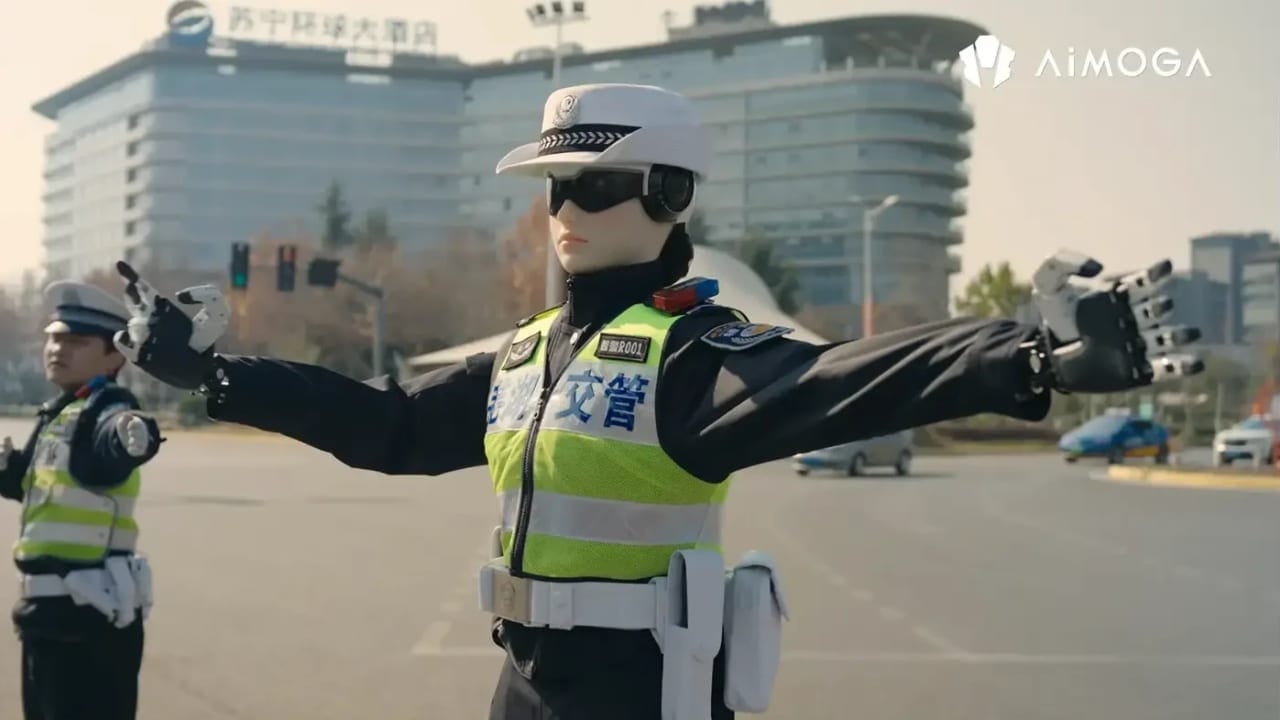
The idea of robots operating alongside humans in the public space has long ceased to belong solely to science fiction movies. Now, AiMOGA Robotics, the robotics company of the OMODA & JAECOO group, presents another step in this direction with the development of a smart police robot designed to assist in traffic management, improve road safety, and provide information services to the public.
The new robot was developed with the goal of operating in complex urban environments, where the ability to respond in real time to changing traffic situations and provide assistance to pedestrians and drivers is required. To this end, it integrates a variety of advanced technologies, including artificial intelligence systems, autonomous navigation capabilities, multi-sensory environmental recognition, and voice communication interfaces that enable direct interaction with the public.
According to the company, the robot is capable of identifying changes in the movement of vehicles and pedestrians, providing voice guidance in real time, offering information to the public, and even assisting in raising awareness of road safety. The goal is not to replace enforcement or safety officials, but rather to examine how humanoid robots can integrate in the future alongside local authorities and various safety bodies and support their activities.
At AiMOGA, they note that the system is based on a combination of advanced perception technologies, AI–based learning capabilities, and large language models. This combination allows the robot to understand its environment, hold a natural conversation with users, and provide answers and guidance as needed.
The presentation of the police robot is part of a broader strategy by the company to promote robotics applications in the real world. AiMOGA currently operates in a variety of fields, including public service, transportation, retail, culture, and customer service, and operates robots in dozens of countries around the world in a variety of use cases.
The development also integrates into the broader vision of the Chery group, which aspires to connect the fields of transportation, automation, and artificial intelligence within a broad technological ecosystem. As part of this, the group invests in developing solutions that go beyond the traditional automotive world and target the worlds of service, mobility, and smart interaction.
The company estimates that in the coming years, humanoid robots will become a more familiar presence in the urban space. According to them, they will be able to assist in improving safety, streamline various services, and provide a response to the public in a wide range of tasks – while working together with humans and not instead of them.