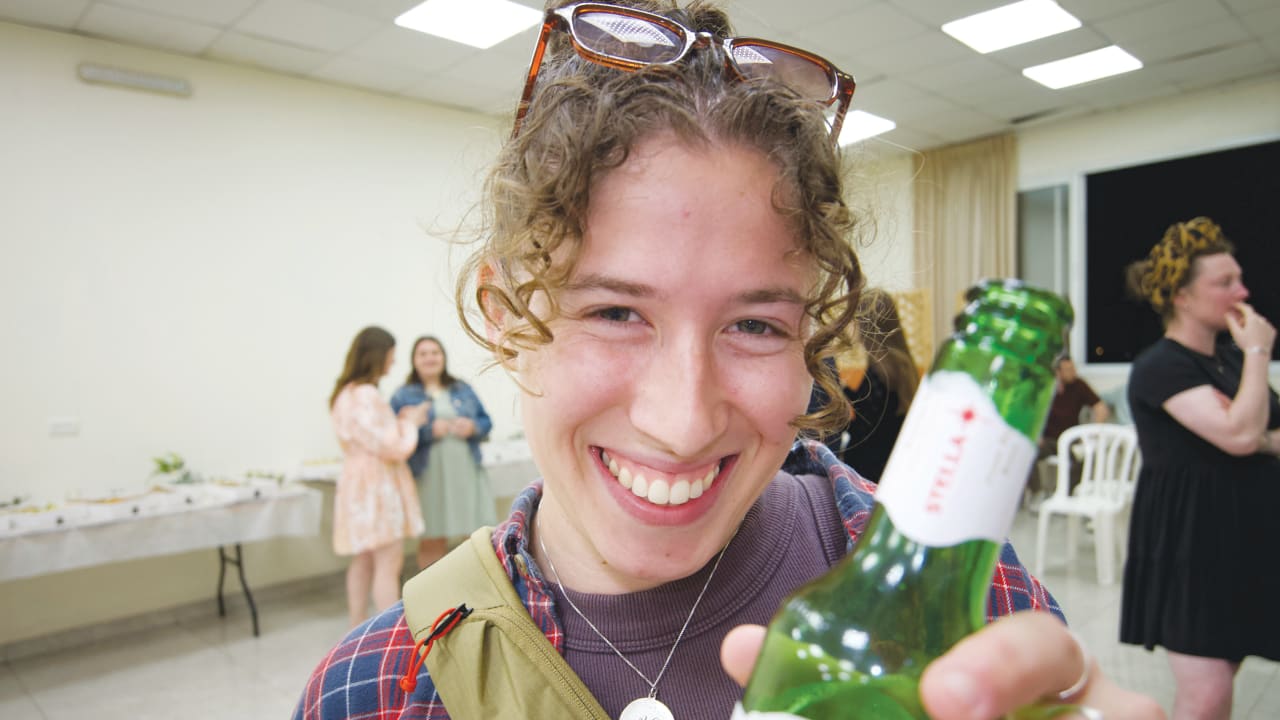
Chani Kaplan was born and bred in Sydney, Australia, where she attended Chabad schools with students “from a broad spectrum of backgrounds.”
Periodic visits by Chabadnik girls from the US and Canada who organized activities during lunch breaks livened up the scene.
However, there was a specter of unease in the background. She remembers occasional shooter or lockdown drills in high school to protect them from an armed intruder.
“We had to lock ourselves in the classroom, remain quiet, turn off the lights, and crouch beneath our desks,” she relates.
Though the recent Bondi Beach attack was profoundly shocking, it was not a total surprise to her. Nine or 10 years before this hate crime, Chani’s Hebrew teacher and her husband were attacked while walking on the street. The latter was badly hurt and hospitalized for some time.

While she and her family visited Israel a lot, for a while Chani had visions of moving to the US or London.
“I just never felt at home in Australia,” she admits. “My grandparents were Holocaust survivors who had survived undercover in France with false papers and talked freely about that period in our presence.”
Chani joins her siblings
She even remembers her great-grandmother from Poland who left her a book she wrote about her wartime experiences in Europe.
However, when her gap year came around at age 18, Chani, the youngest of four children, joined a brother and sister who had already moved to Israel.
This time, Israel made a stronger impression on her than in the past. Actually, she realized immediately that she was destined to stay and announced that first week, “I want to make aliyah.”
Her parents realized that time was running out for them, too, and arrived a year later.
"I spent my gap year on a Bnei Akiva seminary program for Australian and South African youth called MTA [Midreshet Torah V’Avodah],” Chani explains. “I studied in the Jewish Quarter of the Old City [of Jerusalem].”
Like TVA, its counterpart for American, Canadian and British youth, MTA was strongly Modern Orthodox and Zionistic and exposed its students to different environments within Israel. None of these really disturbed their comfort zones, however.
Not so the trip to Poland with MTA. The students visited death camps and mass Jewish graves in forested areas, most notably the Lopuchowo forest in northeastern Poland.
There the group experienced the traumatic execution site of almost all Jewish residents of the nearby town of Tykocin (whose Jewish community was founded in 1522). The Nazis and their collaborators massacred these 1,400 Jewish men, women, and children on August 25 and 26, 1941, burying many alive, a grim instance of the “Holocaust by bullets” they perpetrated in Eastern Europe.
“This tragedy solidified my desire to move to Israel: I cried a lot,” she confides.
Many seminary students stay on in Israel at year’s end. Nonetheless, Chani’s decision to join the army rather than opt for Sherut Leumi (National Service) was not mainstream.
When she drafted that same year, she needed to improve her Hebrew.
After the military ulpan she attended during basic training, “I got the basics but had no confidence to speak,” she recounts. “However, in my first army unit, I was the only English-speaker there. I had no choice!”
This involuntary immersion worked wonders. “I now speak Hebrew the way I speak English,” she says. “I live my life half in Hebrew. A lot of my friends are Israeli because of the army.”
The army changed her in other respects, too. “I learned a lot about my strengths and my weaknesses,” she explains. “At times I was pushed further than the limit both physically and mentally. Though Australians don’t like to make waves, I learned that you really have to speak up and fight for things.”
'Small but mighty'
Just 1.55 meters tall, Chani describes herself humorously as “small but mighty.”
After the army, when she went to Reichman University in Herzliya and studied communications from 2022 to 2025, she encountered a sympathetic atmosphere. It was a relief to study in English and have Friday night services and Shabbat meals on campus.
“It’s a great university for networking,” she enthuses.
In her final year at the university, she opted to do one course in journalism as a challenge, though originally she thought of taking filmmaking. This course subsequently led to a job opportunity at The Jerusalem Report.
Chani played on the Israel Women’s National Flag Football team for two years around that time, beginning just before the traumatic events of October 7, 2023.
“I completely fell into this adventure by accident,” she discloses. “At first I was a 23-year-old, training with teenagers.”
Actually, British soccer was Chani’s “one true love” as a child, a Sunday hobby that had captivated her from age nine.
Though she invested lots of time and effort in learning US flag football here, training three times a week in Wingate and Jerusalem, “I didn’t really love the sport,” she confesses. But the teamwork was a draw for her.
She also had to cope with frequent bouts of reserve duty and the demands of her studies. Other drawbacks included physical injuries sustained on the football field. “I was constantly bruised, on crutches or bandaged up, having been kneed, elbowed in the face, and incurring bad ankle sprains.”
Chani loves her job and Jerusalem, has friends all over the country, and is happy that most of her family is here.
“I currently work at The Jerusalem Report as staff writer, editorial assistant, and social media manager,” she says.
Running social media entails updating accounts across various platforms and publishing articles in a shortened format to appeal to young people.
“That’s the way they’re going to get their news,” she tells me, now that skimming screens has replaced print reading for this demographic.
She enjoys working with colleagues in the office and sometimes going out to interview people.
As for settling down in Israel, she advises equanimity and going with the flow.
“It takes time. I’ve been here seven years and been open to so many different experiences. Everything happens when it’s meant to happen. When I look at the trajectory of my last few years, everything makes sense. You have to be patient because it is a difficult country. That is the adventure though.”
Chani Kaplan
From Sydney, Australia to Jerusalem, 2019